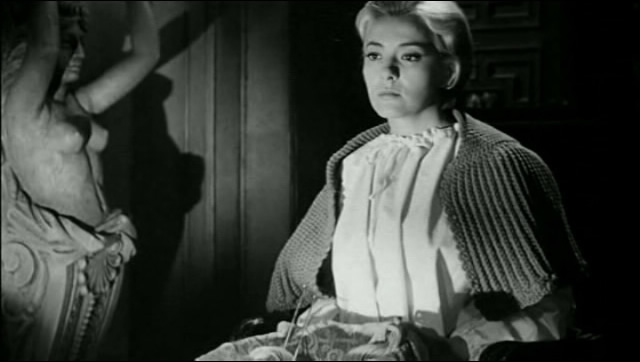
 Viridiana may seem like an odd film to fall in love with, but the Siren did, and hard, back in her college days when she was trying to see every European film denied her back home in Birmingham, Ala. Her first months in New York often found her in the college cafeteria with a copy of the New Yorker, staring at the listings, like a Soviet refugee transfixed by the overstuffed produce aisle at D'Agostino's. Viridiana was an early choice, and a formative experience. Along with Les Enfants du Paradis and a handful of others viewed around age 18, the Buñuel
film was an electrifying gateway drug to European cinema. However, there are many things the Siren loved when she was 18 that she loves no longer--Southern Comfort, four-inch heels, false eyelashes--so who knew how'd she react when Turner Classic Movies recently screened the movie.
Happily, the Siren can report that Viridiana still knocks her sideways. It has been dissected many times, by critical minds more refined than hers, but the Siren wants to tell you about why she loves this rather bleak, but utterly brilliant film.
Anybody here familiar with Alabama? To say it's religious down there is like remarking that Manhattan is urban. Now my late father and my beloved mother both grew up a few blocks from a local church--Baptist for Daddy, Methodist for Mom. They attended every Sunday until the day they left home, with the happy result that neither one wanted anything to do with weekly services as an adult. But they were Christian enough to want their offspring to choose a nice denomination to settle down with. So the Siren went often to several churches, spent a long time studying Catholicism, and in the end picked the box marked "none of the above." She was tired of Jesus. He kept turning up in the Siren's daily life, whether she invited Him or not, usually invoked by people who wanted to tell her she was wrong. The Siren started to regard the Lord the way other people saw Chuck Barris--someone who pops up to tell you the gong has rung and the fun's all over.
So the lights go down on Viridiana, and the Siren's eyelids pop. There, up on screen, was every seething, rebellious thought she ever had during a Sunday sermon, or while resisting recruitment for the Brothers And Sisters in Christ club, or listening to Coach Jeffries at the pep rally asking Jesus to help us whup the Spartans on Friday night.
For those who haven't seen it--and if you haven't, what else are you doing that's so important?--a little plot summary. Gorgeous Viridiana (Sylvia Pinal) is a novice at a local convent, and one day she is told she should visit her uncle, local farmer Don Jaime. When Viridiana arrives, her uncle, played by a gloriously lecherous Fernando Rey, is thunderstruck by her resemblance to his dead wife. From there out, he is obsessed with getting his virginal niece into bed. 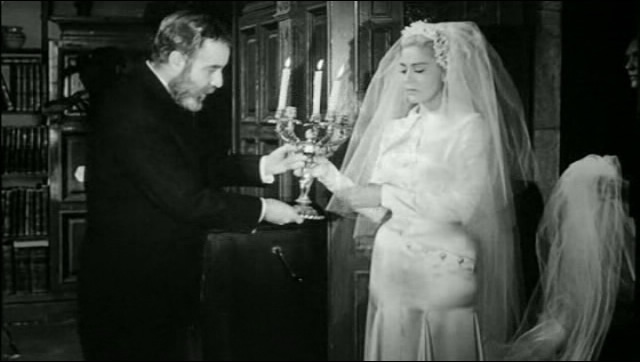 What follows includes a drugging and contemplated rape, a nice little episode of foot fetishism and the uncle's abrupt exit. Don Jaime's illegitimate son Jorge (Francisco Rabal) arrives and he too lusts for Viridiana, but is content to wait for her to see the error of her virginity. She takes over the farm and tries to set up a sort of rural food kitchen for the local beggars, but they prove to be about as salvageable as her uncle. To watch the film is to see Viridiana's Christian ideals taken apart, hanged, burnt, tied up, knifed, buried and seduced into a possible game of strip tute. Maybe others find it depressing. To me, it's pure adrenalin. That night in New York, if I could have found Luis Buñuel, I'd have touched the hem of his garment.
You can find a lot of writing on Viridiana around the Web, some of it claiming that the film is anti-Catholic but not anti-Christianity, and it really isn't all that shocking anymore. To which the Siren says, poppycock. If you could show the BASIC club or Coach Jeffries this movie, I guarantee they would ban it just as fast as Pope John XXIII did. If Viridiana's sensual pleasure in whipping herself while wearing a crown of thorns didn't do it, the beggars' celebrated burlesque of the Last Supper would. You can easily turn a screening into a game of Spot the Blasphemy.
Christian beliefs are hung out to dry (in one instance literally), but the film has no special contempt for Christians personally. Viridiana isn't a bad sort, just rather dopey and possessed of a virgin's tendency to think all the other characters are making sexual innuendos at her expense. (Sometimes they are, as with Rabal; sometimes they aren't, as when Pinal is invited to milk a cow.) Her vows of poverty aren't admirable, but neither are they especially despicable. They are just Viridiana's particular way of entertaining herself, no more or less worthy than jumping rope or drugging someone's tea.
There is a great deal of political satire too, although in Buñuel's memoirs he said that when General Franco saw the movie he didn't see what the fuss was about. To the Siren, this just demonstrates that dictators aren't always very bright. (John Nesbit at Toxic Universe points out the acid implication of the line, "The weeds have taken over the past 20 years... And beyond the second floor, the house is overrun with spiders.")
But there is little comfort for the do-gooder liberal, either. Buñuel refuses to romanticize poverty. There is nothing ennobling or beautiful about it, whether it is chosen like Viridiana's, or forced by circumstances like that of the beggars. 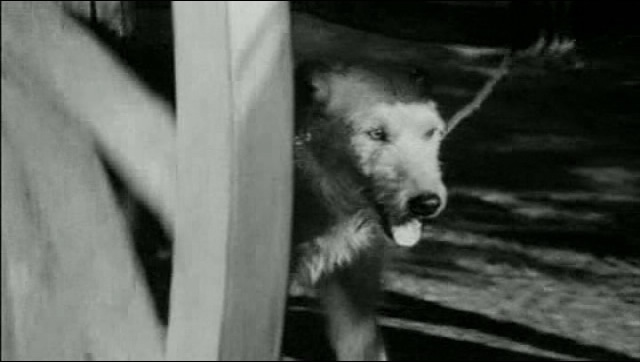 They aren't purehearted children of the sod, oppressed by the system. They're just poor, and creepy, and eager to grab any momentary gratification. Emerging from poverty is purely a matter of luck, as it is for an abused mutt in the movie's other celebrated sequence. Whether you seek it through Jesus or the kindness of the better-off, your illusion of salvation is just that.
Buñuel made this film after a 22-year exile from Spain. (Here the Siren sees a bit of similarity to Robert Altman, another gleefully godless filmmaker: Invited to return to his homeland and make a movie, Buñuel made a lengthy disquisition on what bums they all were.) If Franco wasn't incensed, plenty of others got the point. When Viridiana was released, it was promptly banned in Spain and denounced by the Vatican. Spain's chief censor was forced to resign. Even Sturges and Lubitsch didn't manage to get the censors fired. If that doesn't tell you Viridiana's worth, the Siren doesn't know what will.
 Orson Welles was playing the Narrator in Start the Revolution Without Me, and I wanted to meet him. He only had two filiming days, and I thought it would be more polite if I waited until the second day to say hello. On the second day, at about three in the afternoon, I got to the chateau where they were filiming; Orson Welles was gone. I asked [Revolution director] Bud Yorkin what happened.
"Well," Bud said, "we'd start a scene, and after a little while Orson would call 'Cut!' He'd look at me and say, 'Now, you don't honestly want any more of that shot, do you, Bud? Surely you'll be cutting to the twins at that point.' And I'd say, 'Yes ... well ... yes, I suppose so.' Then we'd be in the middle of the next scene, and he'd yell, 'Cut!' and he'd say, 'Now surely you've got to cut there, Bud--it wouldn't make any sense if you didn't cut to the mob at that point.' So we finished shooting all of his sequences an hour ago."
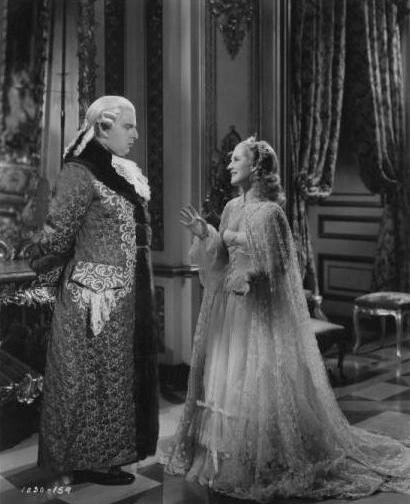 Certain cultural moments leave the Siren scratching her head, and the greeting accorded Sofia Coppola's Marie Antoinette is one. Not because the Siren dislikes the movie--she hasn't seen it and isn't enough of a Sofia fan to drop the newborn and rush out to remedy that--but because all the critics keep telling her it's based on a "revisionist" view of the doomed queen, an analysis that doesn't paint the woman as heartless, extravagant and silly.
To which the Siren replies, just what in the sam hill is so all-fired revisionist about that? Has any American film ever portrayed the French queen as anything other than sympathetic? Okay, the Siren can think of one: Start the Revolution Without Me, a breathlessly silly 1970 comedy the Siren loves. In it, Billie Whitelaw plays MA as a scheming nymphomaniac, a characterization the Revolutionary pamphleteers would have recognized and relished. Otherwise, l'Autrichienne gets sweetheart press over here, and always has. Prime example: the 1938 biopic starring MGM's Queen of the Lot, Norma Shearer.
No European film could ever be quite as royalist as this one. As hagiography, it makes Ivan the Terrible Part I look like Scarface. Marie is a victim of history, a good-hearted woman with a strong sense of duty, too noble to act on her passion for Count Axel von Fersen (Tyrone Power, barely there) after Louis XVI gets his (delicately unmentioned) phimosis cured. The revolution, it's suggested, wouldn't have been necessary if that nasty Joseph Schildkraut, playing the Duc d'Orleans, hadn't kept stirring things up. Starving peasants? Overtaxed middle class? ruinous wars? Geez, it wasn't Marie's fault that she didn't know how to stop a bread riot. She was just trying to be the best darn Queen of France she could be.
Still, I defy anyone with a love of classic film to view Marie Antoinette without, at minimum, getting some pleasure out of Cedric Gibbons' art direction. You could say MGM was unable to use Versailles, but the real answer is why bother, when they had the back lot? Gibbons worked not to recreate the world's most famous palace, but to suggest and, finally, outdo it as only MGM could. The spaces are bigger and bolder than in real life, full of laquered staircases, blazing klieg-light candelabra, and furniture and tapestries brought back by buyers rummaging through France. When the studio recreated the Hall of Mirrors for a ball sequence, they made it twice as big as the original. That's a pretty good metaphor for MGM's entire aesthetic, right there.
Adrian's costumes were equally over the top--check out this marvelously detailed site for a complete rundown of each costume. The site also has color snapshots of those costumes which have survived to the present day, and the gowns may be more lavish than anything the real Marie ever wore. Irving Thalberg was planning this vehicle for wife Shearer when he died in 1936, and at first it was planned as a Technicolor feature. It is a crying shame that money considerations meant it was filmed in black-and-white. One fur was even sent abroad to be dyed the color of Norma's eyes.
Shearer was a fascinating person, as Gavin Lambert demonstrated in his 1990 biography, but the Siren has a hard time warming to her performances. She had a marvelous voice, elegant posture and one of the most beautiful profiles in screen history, but she was very mannered, a back-of-the-hand-to-the-forehead kind of dramatic actress. Marie Antoinette, however, definitely ranks with The Women and Idiot's Delight as one of Shearer's best talkie performances. Shearer spent hours learning to move gracefully under the heavy costumes, and her carriage is always aristocratic. That physical focus frees up Shearer's face and gestures, and her emotions flow much more organically than usual. The movie was a personal favorite of the actress. (In later years Shearer owned prints of only two of her movies--Romeo and Juliet and Marie Antoinette.)
And Shearer's greater believability as Marie Antoinette also probably had something to do with a wee bit of identification. Thalberg had been dead two years, and Shearer's power as Queen of the Lot was ebbing away. She had wanted old pal Sidney Franklin to direct, but an underhanded maneuver (did he make any other kind?) by studio chief Louis B. Mayer resulted in Franklin being replaced with W.S. "One-Take Woody" Van Dyke. The replacement probably helped the picture (Van Dyke, of Thin Man fame, was a better director), but such a thing would never have happened when Norma ruled at the Boy King Thalberg's side. When filming stopped, she was only four years and five movies from retirement.
The 1938 Marie Antoinette puts suffering Shearer front and center throughout, but it is the kings who stand out. John Barrymore seems more dissipated than even his role as Louis XV requires. But the Siren's favorite, and the real reason she would watch the movie again, is Robert Morley as Louis XVI. The Siren is an ardent small-r republican, prone to point out irritably that tearjerking scenes of Marie separated from her children rather beg the question of the sufferings of France's less privileged children. But Morley, spending his last night alive lovingly repairing his son's toy soldier, manages to make her feel sorry for a Bourbon. Touché, MGM.
Griffin: It lacked certain elements that we need to market a film successfully.
June: What elements?
Griffin: Suspense, laughter, violence. Hope, heart, nudity, sex. Happy endings. Mainly happy endings.
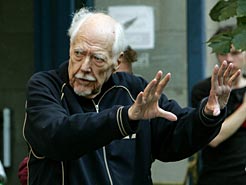
The Siren bids hail and farewell to the great Robert Altman.