PRINCE POPPYCOCK

The graphics are a significant upgrade from the Prince of Persia that was on the Apple computer, but they are not amazing. Players will experience the game on a two dimensional environment (ala Castlevania). You will encounter a myriad of trapped doors, hazardous spikes, and deadly blades. Jumping from platform to platform makes up a great deal of the gameplay (too much for my taste)

Best and Worst of the Best Actor Oscars

It's that time of year again, when Edward Copeland, hardest-working man in Film Blogdom, puts together another Oscar survey. This year, the extravaganza of second-guessing extends to the Best Actor category. Which five performances represent the best the film world had to offer? With which five did the Academy get it forehead-smackingly wrong? The Siren has compiled her list, and you should too. The deadline is tomorrow, Friday, Feb. 1, at the stroke of midnight. This is a huge service that Mr. Copeland performs for us each year, offering a constructive outlet for carping that we would otherwise have to direct at our office mates, our spouses or the television set (and maybe not even the TV if the strike continues). Details are here.

When looking over the long list of Oscar-winning Best Actors, the Siren was struck by two things. First, she's seen nearly all of the movies. Second, a big chunk of the list is awfully dull. Not bad, just boring. Well-meaning. Earnest. Didactic. Sidney Poitier isn't bad in Lilies of the Field, he's very good, but the movie is a snooze. Ditto Dustin Hoffman in Kramer vs. Kramer, Ben Kingsley in Gandhi...just nothing the Siren wants to sit down and watch again.

So for her Best Best Actor list, the Siren used this single yardstick: which five performances, if shown on TCM tonight, would likely glue the Siren to her couch, no matter what she had to do? So, with that alone in mind, here are the Siren's top five, in reverse order.

The Best


5. Charles Laughton, The Private Life of Henry VIII. The Siren doesn't expect to find this one very high on the final list, due mostly to its age. But god is Laughton good, so much so that our collective memory of Henry is neither Shakespeare nor Holbein, but rather the lusty, impulsive figure that Laughton creates here. He is, as Simon Callow says, "more Henry than Henry."


4. Alec Guinness, The Bridge on the River Kwai. Courageous, pigheaded, utterly bonkers, Guinness carries the weight of a script that has him standing in for all the mythical glories and bloody illogic of imperial Britain. His performance is so superb that the moment you glimpse Nicholson's madness is the moment of his greatest heroism, as he is carried out of the hotbox--the colonel is still fighting for that crisp self-discipline. And you realize, looking at Guinness's wobbly yet triumphant walk, that a sane man would have snapped.


3. James Cagney, Yankee Doodle Dandy. As George M. Cohan, the flag-waving showman and songwriter, Cagney steals everything but the floorboards in the most sheerly enjoyable biopic of all time. The Siren never gets tired of Cagney turning a tuneless voice and a weird, high-pockets dance style into the movie's greatest virtues. That final walk down the White House staircase, which gradually becomes a hoof-step expressing all the joy of Cohan's patriotism and his vanished theatrical world, was reportedly improvised on the spot by Cagney.


2. Fredric March, The Best Years of Our Lives. March is usually described as a flashy, scene-stealing actor, but his two finest moments in this movie are played in silence. There's March's expression as he walks into his home and sees Myrna Loy, flesh and blood instead of the image he yearned for through all his time at war. And then there's March's face, tired and hung over, trying to find himself in the picture on the mantelpiece, a photo of a man he will never be again.


1. Marlon Brando, On the Waterfront. Brando had to be number one, but which to pick--this one, or The Godfather, in which he is equally brilliant? Well, The Godfather is the better movie but like a judge at the Olympics, the Siren is awarding extra points here for degree of difficulty. Simple human decency will never have the glittering, seductive fascination of greed, power and violence. Brando gives us an ordinary man of somewhat less than average intelligence, and makes that man's struggles with his conscience not only interesting, but moving.

The Worst

With the exception of No. 4, the Siren probably wouldn't watch these again even if she were snowed in and without other entertainment at the Missoula International Airport.


5. Lee Marvin, Cat Ballou. Here we have the major, major problem with the Academy Awards: Rarely has the Academy known what to do with comedy. On the infrequent occasions that it honors a comic performance, it picks the wrong damn one. This example isn't as egregious as the Siren's number one, but it still hasn't aged well, assuming you ever thought it was all that great. Listen, the Siren finds Marvin appealing too--the man had cool to spare. But when Cat Ballou is viewed dispassionately, without all the awe at his incredible Lee Marvin-ness, the fact is that his timing is leaden and overall his drunk routine isn't a patch on W.C. Fields. Somewhat amusing in spots but the best actor of 1965? No wonder Richard Burton's drinking began to get worse at this point.


4. Spencer Tracy, Captains Courageous. To a younger generation the once-unquestionable reputation of Spencer Tracy as the best actor in Hollywood is sometimes understandable, and then again, sometimes not. "You never catch him acting!" said his enraptured colleagues. True enough in something like Bad Day at Black Rock. However, not only can Tracy be found acting in Captains Courageous, he can be found indicating, mugging and just plain hamming it up. The accent is inexcusably dreadful but it's only the most obvious manifestation of Tracy's phoniness as a Portuguese fisherman. Freddie Bartholomew is a good deal more truthful in his transition from sniveling brat to nice kid. The Siren maintains that Bartholomew is the one who gives Tracy more believability, not the other way around.


3. Bing Crosby, Going My Way. The story goes that Noel Coward, at the peak of his popularity, one day found himself surrounded by a large group of reporters shouting questions. "Mr. Coward! Mr. Coward!" bellowed one. "Have you anything to say to the Star?" "Certainly," replied Coward. "Twinkle." Bing Crosby here takes that admonishment, and turns it into an entire performance.


2. Al Pacino, The Scent of a Woman. The intelligent, carefully calibrated actor of Dog Day Afternoon and The Godfather movies hides behind a wall of shouting, tangoing, full-throttle mannerisms. The mere thought of watching the movie again gives the Siren a headache.


1. Roberto Benigni, Life is Beautiful. The Siren left the movie with her lace hanky soaked to the hem with her tears, ready to snatch Roberto Benigni bald-headed for this nauseating exercise in audience manipulation. The man has an enormous talent for slapstick but no taste whatsoever. He's so busy being touching and humane and the endearing character whose comic eccentricity makes him the island of sanity in an ocean of madness that he can't be bothered to REact to anyone, including his beautiful, ghost-eyed son.

NOTE: The Siren hasn't seen Ray, Capote, Gladiator, The Last King of Scotland, The Last Command, The Way of All Flesh and In Old Arizona.


*****


This week marks the one-year anniversary of Tom Watson's excellent brainchild, Newcritics. As a celebration, all this week we are contributing posts on the one bit of media that touched our lives in the past year. You will not be surprised to hear that the Siren's post is still under construction, but meanwhile do mosey over to Newcritics and have a look around.

The Oscar (1966)


Props to Dan Callahan. The Citizen Kane of bad movies is the best description evah. It's awe-inspiring, how no hint of talent or artistry crops up to mar the perfection of The Oscar's badness. No detail was too small to fuck up. My new life's ambition is to watch this with the Blogdorf Goodman crew and Beauty Addict, because the makeup is the world's most complete list of don'ts. Jill St. John's eyelids were turned into baby blue dinner plates and Eleanor Parker (ah, Eleanor, how you suffered for this one) had her coral lips drawn way outside the mouth edge (girls, don't ever do that). The costume designer signals which women are the tarts (St. John and Edie Adams) by dressing them both in doubleknit polyester that drapes straight down like a windowshade and has the added benefit of making their breasts look like lemons stuck to a wall. Even the hairstyles are awful, especially when they've been "mussed" to indicate a romp in the hay.


Parker, all of 44 in this movie and she would have looked 34 if not for the hair and lips, knocks Elke Sommer into a propeller beanie in the looks department. You get to compare the two Miss Es directly, as Eleanor plays her big topless scene on her tummy facing stage left and peeling the paint off the walls with her emotions; and Elke plays her topless scene on her tummy facing the same way and delivering her lines like she's announcing that the train will be held at the station momentarily. Joseph Cotten is the stalwart, integrity-stuffed studio head--lots of those in Hollywood-on-Hollywood movies, for that extra touch of versimilitude, one assumes.


As for Tony Bennett, in his big scene, his suit dusted with cornstarch to indicate a soul's struggle in the depths, the singer seems to be channeling John Garfield on a frequency that can only tune in to late-period Jack Webb.

Stephen Boyd anchors the cast, his dimpled chin working furiously to indicate the states of emotion he can't convey by squaring his shoulders. He also has the ugliest speaking voice the Siren has yet encountered, a bastard mix of Irish and American that drowns the consonants in his throat like kittens and forces the vowels back out through his nose. But it's Milton Berle, as the goodhearted agent done wrong by his two-timing client, who gives this peerless defense of the honor and decency of Hollywood:

Boyd: I'm no different from anybody else in this damn town.
Berle: That's not true, Frankie. Oh, if it comes to a matter of life or death, if we have no other choice, then we hurt others--but reluctantly.

The Pathécolor is hideous and the art direction was a trip down memory lanes marked Wood Paneling, Harvest Gold and Avocado. And the Siren still wants to know how many pairs of false eyelashes were on Merle Oberon for the finale, which was just as thrillingly god-awful as Yojimboen promised.

Need I tell you I stayed up way past my bedtime to finish it? My god, it was wonderful.

Oscars 2010: A Brief Commentary


The Siren doesn't have much to say about the Oscars this year. She went to a swell party full of lively, smart, funny people and enjoyed herself.

Bravo for Katherine Bigelow, smashing the glass ceiling. I do wish that in her speech, she had been a little less overwhelmed and a little more like the lady above, costume designer Sandy Powell. Ms Powell, who appears to be about eight feet tall, sashayed on stage wearing a drop-dead high-fashion dress and gave a perfectly poised speech that made it clear she thought she deserved to be up there. I loved that; the Siren doesn't dig false modesty. And Powell also captured the Siren's heart by mentioning all the costume designers who don't do period pieces, and who are ignored year after year by the Academy. Costumes, no matter what the film, are extremely important to an actor's performance, as Louise Brooks could have told you. For the climactic scene in Pandora's Box, G.W. Pabst took her favorite suit and soiled and tore it; she said she went on set feeling "as hopelessly defiled as my clothes." How short-sighted for the Oscars to go, year after year, only to clothes of the past or some imaginary future.

The evening was marred by the decision to move the honorary Oscars to some kind of dinner thing in November. You wanna have a banquet, awesome, go for it, but do not deprive me and others who care about the industry's history of the opportunity to see Roger Corman, Gordon Willis, John Calley and the fabulous Lauren Bacall on the stage during the actual ceremony.

Many people have suggested that the John Hughes tribute took up time that rightfully belonged to the old-timers. Well, the Siren grew up with Hughes' movies and some of them have a permanent place in her heart. They're a part of the Siren's adolescence and so she regards Sixteen Candles, The Breakfast Club and Pretty in Pink with the kind of nostalgic affection that precludes rational analysis. So it probably was with the people who decided on that whole presentation. It was nice to see Molly Ringwald after all this time.

But the Siren would have deep-sixed that horror montage in a New York minute.

And the Siren also agrees with Glenn Kenny about the death montage. This isn't quantum physics. All you have to do is come up with a reasonably complete list, a nice melancholy piece of music and some good clips. Given that simple formula it is kind of astonishing that this key piece of the evening is so consistently mucked up. Hire the TCM guys, okay? They do a great job year after year and don't try to gild the lily.

On the plus side, Alec Baldwin and Steve Martin were very funny and I kind of loved the Neal Patrick Harris dance-cum-Sally-Rand tribute. Oprah Winfrey's speech to Gabourey Sidibe was very touching, Sandra Bullock was funny, and bravo to Mo'Nique for her Hattie McDaniel tribute. (The Siren didn't see Precious and won't, as she absolutely does not do child-abuse movies; the Siren just appreciated the sentiments.) Overall it was a fine ceremony that made the minutes fly by like hours, as Addison would have said.

I just really hope the DVR recorded The Oscar.

The Luck of Luise; Or, We Should All Be So Cursed

On Jan. 12 of the fast-approaching New Year, the enduringly mysterious Luise Rainer turns 100 years old. Almost four years ago the Siren wrote one of her first true marathon posts on this actress, gaining in the process a great deal of respect and affection for her. She was talented, intellectual and free-spirited, and therefore a problematic fit for Hollywood in that age or this. But the Siren treasures those who refuse to let busted stardom crush them altogether. Rainer did what she could, and when that ebbed out she moved on and created another life, a fine one.

The Siren points out that in celebration of this birthday of one of the last of the great stars from the glory days, Turner Classic Movies will screen a marathon of Luise movies. The Siren recommends: The Great Ziegfeld (Rainer's scene is indeed quite special); The Good Earth (her finest performance and a moving film); and Big City (very good, gritty social drama with Spencer Tracy in fine form, directed by Frank Borzage and that last bit alone should make you set the DVR). The Great Waltz (directed by David Cairns' beloved Julien Duvivier) has definite, batty charms as well. The one going on the Siren's DVR will be The Emperor's Candlesticks. William Powell is always, wonderfully William Powell.

Here, then, for those who missed it the first time around, is The Luck of Luise, which the Siren now subtitles: We Should All Be So Cursed. It has been revised and updated to account for certain things like my not wanting to go off on the Golden Globes again, I've now seen Big City and Luise was just fine, and The Good Earth is out on DVD.

P.S. On an unrelated note, if you are near a newstand this month and happen to see a copy of the January GQ--that would be the one with a half-naked Rihanna--please consider buying it and turning to page 32. There is, I admit, no naked Rihanna on that page, but you will find me listed as critic Tom Caron's "Fave Film Blogger." The Siren is tickled to death at the honor and thanks Tom profusely, although she hopes finding out her real identity wasn't truly as big a letdown as finding out that Kissinger wasn't Deep Throat.

*****************************
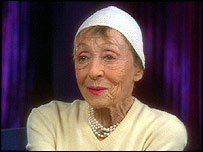

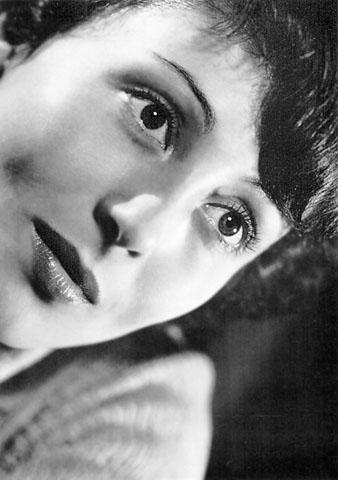
The start of the annual awards season has the Siren contemplating the mysteries of awards in general. So let's talk about Luise Rainer, the most famous double-Oscar-winning flameout in the history of Hollywood. Her career couldn't even be termed a brief candle--more like the brilliance and timespan of a bottle rocket.

On Jan. 12, Ms. Rainer turns 100 years old, bless her. The last time she showed at the Oscars, in 2002, she looked astonishingly good, as you can see from the photo here. When her Hollywood career was finished, she married a wealthy publisher and retired, and she now lives in London's Belgravia, surely one of the world's most beautiful neighborhoods. So obviously, Luise is doing much better than all right. That she made so few movies is our loss, but happily it doesn't seem to have been hers.
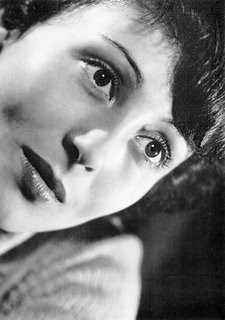

Born in Vienna in 1910 (some accounts say 1912, and others claim she was born in Dusseldorf, Germany), she was brought to Hollywood by an MGM talent scout. Apparently in the mid-1930s MGM was full of talent scouts who heard a European accent of any sort and immediately thought, "the successor to Garbo!" L.B. Mayer often used an up-and-comer as a none-too-subtle threat to an established star. (For years, Rosalind Russell was the threat behind Myrna Loy, unlikely as that sounds. Russell recalled an occasion when she was being fitted for a costume. Loy walked in and said "They signed my contract," and Russell had to disrobe on the spot. Fortunately, they were friends and could joke about it.)

So the dark, elfin Viennese came to California to line up behind the blonde, chiseled Swede like a taxi in front of a hotel. For a while she was given no roles but then, according to film historian David Shipman, Myrna Loy declined Escapade and Rainer was given the part. (Where was Russell?) The movie was forgettable, but Rainer photographed well, and the studio decided to cast her as Anna Held, The Great Ziegfeld's first wife.

The Siren enjoys The Great Ziegfeld (1936), though when she remembers it won the Academy Award for Best Picture over Modern Times she does tend to put hand to forehead. Rainer has an astonishingly short role, with but one evergreen scene. She calls Flo Ziegfeld (William Powell) on the telephone, to congratulate him on his marriage to Billie Burke (Myrna Loy). She still loves him, but she's determined to maintain her dignity. He tells her he's happy. She says she's happy, too. Tears pouring down her face, smiling all the while, she remarks on how funny it is, two former spouses "telling each other how 'appy we are."

Pause now to consider what the Oscars were like in 1937, the year Rainer won. The dinner was open to favored members of the press but was nothing like the lavish stage show we see now. Stars were usually filmed for newsreels after the ceremony, giving canned versions of their speeches. Extras were permitted to vote, which they did in huge numbers, resulting some say in ex-extra Walter Brennan's extraordinary run--as Shipman put it, three Oscars, one performance. MGM also commanded a hefty bloc vote of people on its payroll who, essentially, voted as their bosses wanted them to. The power of that bloc endured for years.

Rainer got her award in the first year the Supporting Actress category was added, but MGM nominated her for a leading role anyway. It was the most powerful studio in town and its brass did as they pleased. The telephone scene is very nicely played, but I doubt most people nowadays would grant it an Oscar. But win Rainer did, over Carole Lombard in My Man Godfrey among others. In later years, Rainer would claim the first award was no lucky break, but a harbinger of career doom.
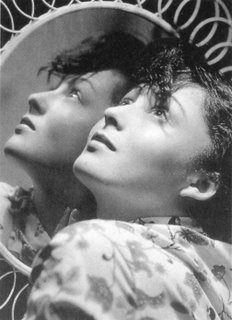


David Shipman's essay on Luise Rainer starts with an anecdote about Raymond Chandler preparing to go to an Oscar ceremony. The writer, no fan of Hollywood, still was nervous over his nomination for Double Indemnity. His wife told him to relax, that an Oscar was no big deal--"after all, Luise Rainer won it twice."

Since Rainer left Hollywood in 1940, judgments on her career have fallen into two categories. Mrs. Chandler summarizes one line of thinking, echoed here--Rainer was a zealously promoted, so-so actress whose Oscar wins over the likes of Lombard, Garbo, Dunne and Stanwyck are an enduring mystery. The other you can find here and here, with Luise described as an early Hollywood rebel, a great talent whose intellect couldn't suffer the film colony gladly.

After spending the week looking at all the Luise material she could find, the Siren thinks Luise was a little of both. Hers was not a broad talent, but on the strength of her best performance it is hard to argue that more could not have been made of her.

In 2003, before appearing in a line-up of former Academy Award winners, Rainer gave an interview to the BBC, describing the night in 1937 when she won her first Oscar. Her endearing catalogue of small disasters involves a breathless maid, an oversized mattress sent by her father-in-law and a spat on the way to the banquet that forced her to ask the driver to circle the block a few times so she could pull herself together and go inside. The squabble was with playwright (and Barton Fink model) Clifford Odets, whom Rainer had married earlier that year. It would not be the last time he caused her grief.

Whatever you think of Odets as a playwright, as a husband his desirable qualities were scarce indeed. There is a persistent story that at times Odets refused to sleep with his wife owing to his belief that ejaculation drained away his creativity. When Luise became pregnant after one period during which Odets evidently decided his creativity could take the strain, he talked her into having an abortion. During the marriage Odets also carried on an affair with the luckless Frances Farmer. (While few would name Odets as the source of Farmer's legendary instability, there appears to be consensus that he sure as hell didn't help.)

Whatever the home situation, Rainer's career was at its apex. Soon after her first Oscar she won the role of Olan in Irving Thalberg's swan song, The Good Earth. The decision broke the heart of Anna May Wong, the stunning Chinese-American actress who had tested several times for the role. But once Rainer's fellow Austrian Paul Muni was cast as Olan's husband, Wong could not play the part without triggering the wrath of the Hays Office. High on that useless body's list of things it didn't want Americans seeing was on-screen miscegenation, actual or depicted. Anna couldn't even get the secondary role of the concubine Lotus, and had to watch that go to yet another Austrian, and a dancer at that, Tilly Losch. As a result the movie gives the odd impression that Chinese women tend to sound German. (Some secondary roles are played by Asian actors, notably the wonderful Keye Luke as the Elder Son.)

This sad casting history, and the offense a later age feels at Caucausian actors in yellowface, have marred The Good Earth's reputation. The Siren hopes that won't submerge it entirely; it was released on DVD in 2006. The movie is a dazzling piece of old-style filmmaking, the definition of the sort of epic we shall not see again, and at times it is very moving, due in large part to Rainer's touching performance.
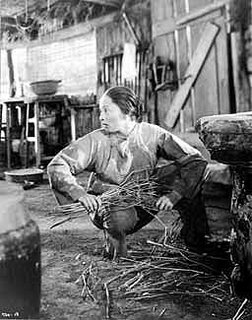
The Siren's knowledge of Chinese history is pitifully inadequate, but she suspects The Good Earth is not an exact depiction of Chinese peasant life before the rise of Mao. She respectfully suggests it shouldn't be judged that way. The art direction by Cedric Gibbons and the costumes are beautiful, and Karl Freund's cinematography is astounding. This is an archetypal story of peasants fighting against nature and their own baser impulses. It has more in common with Laura Ingalls Wilder's novels or even Renoir's The Southerner than it probably does with, say, some of the Chinese talkies my Cinemarati colleague Filmbrain has written about. (See his striking take on "The Orientalization of Myrna Loy" here.)

Rainer's method of conveying Chinese-ness relies less on broad strokes and indication than Muni's. Her makeup is minimal, leaving her eyes unhampered for the camera. Given little in the way of dialogue, Rainer's performance has effects similar to the best silent acting, with emotion conveyed by the flicker of an eyelid or the position of a hand. Her greatest moments come during the long, agonizing famine scenes. Her character is often derided as a doormat, but look at the scene where Olan gives birth as the family is starving. There is a brief cry, then silence. Rainer appears and tell Muni their child is dead. "But I heard a cry ..." Muni begins. "The child is dead," replies Rainer, with an intensity that silences her husband in mid-sentence.
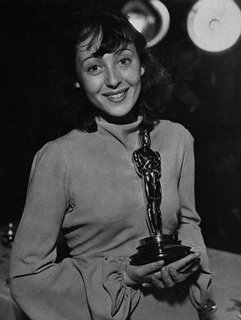
Convinced she couldn't possibly win two years in a row, Rainer opted to stay home on Oscar night in 1938. Then came another phone call, and another headlong rush to the banquet. In photos from that night she looks almost as though she's still panting. Her win came, notoriously, over contenders that included Garbo for Camille. Despite high regard for Rainer's performance the Siren, for her part, would have voted for Irene Dunne in The Awful Truth. To this day, however, Oscar tends to go home with someone who's perceived to have tackled a "difficult" role--meaning, heart-rendingly dramatic and preferably something that requires the actress to look plain, or at least de-glammed. The Academy evidently decided that for a Hollywood actress, a starving peasant is more of a stretch than a kept woman.

Rainer rounded out the year with The Emperor's Candlesticks (some titles seem designed to warn you off, don't they?) and Frank Borzage's The Big City with Spencer Tracy. She made little box-office impression in either, although the Siren can attest that she's swell in the Borzage. Shipman says Rainer, with two Oscars for support, asked MGM for more money. I haven't been able to track down whether she got it, but the fact that she disappeared for part of 1938 suggests "no." On hiatus at the very time she should have been expanding upon her success, Rainer finally made The Toy Wife.

The Siren caught this one a few years ago on Turner Classic Movies. Rather than the fiery Southern belle you get in Jezebel or that Selznick movie, in this one you get Southern Belle Version 2.0, the doomed variety. Rainer's character is named Frou Frou, in imitation of the sound her skirts make. She was educated in Paris and returns to her native New Orleans with a German accent. She marries Melvyn Douglas, but has an affair with Robert Taylor, and for whatever reason, Rainer was about 100 times more convincing as a Chinese peasant. The one moment where the Siren thought she saw an actress was a scene where Frou Frou's small son comes to wake her up. She bounces around on the bed and plays with him, and in this small moment displays an unaffected sparkle that she never summons again, not in this movie.

She finally got another hit with The Great Waltz, Julien Duvivier's venture into the MGM musical. Or is operetta? or biopic? or historical romance? The movie is so transcendently weird that you can take your pick. My favorite interpretation so far is the IMDB review that insists the movie is a political allegory about the Anschluss. Well, The Great Waltz has at least as much to do with the Anschluss as it does with the life of Johann Strauss. (Shipman notes dryly that "It was a great success, notably in Russia, where audiences were perhaps impressed by the five-minute revolution in the middle of the plot.") As the wife, Rainer did a good job with what the script gave her. Unfortunately, the script left her to dangle her bonnet and mope after Fernand Gravet's Strauss as he pursues Miliza Korjus and composes waltz after waltz. Luise had the billing, but Korjus got to help compose "Tales from the Vienna Woods" in a single carriage ride.

The next movie, Dramatic School, was intended as a showcase for Rainer. It flopped. Rainer was given six months' leave, Shipman says, to visit Odets and prop up their shaky marriage. Her contract was not renewed. She did a couple of plays in London and returned to Hollywood in 1939. There was no way Rainer, Jewish and proudly left-wing, would go back to Europe, but as Shipman tells it, the months slipped past and no cameras began turning on a Luise Rainer movie. In 1940 she returned to New York with Odets, divorcing him later that year.

Shipman says "her potential was exhausted." Later writers would say that L.B. Mayer offered Rainer a series of roles that were beneath her. Rainer, they say, became frustrated with the sheer dumbness of Hollywood, a place "where clothes were a major preoccupation."

Hollywood bored her right out of a career. Plausible. But, to quote the lyrics from a song by a composer who did just fine in movies, it ain't necessarily so.* When the Siren hears someone--particularly a German-speaking actress--calling the Hollywood of 1940 an intellectual Sahara, her eyebrows just about disappear into her hairline. By that year the film community was awash with refugees, including some of the century's finest European minds. Many of them met regularly at the home of Garbo's favorite screenwriter, the Austrian Salka Viertel. If Luise had wangled an invitation (and surely two Oscars would at least get you that) she could have chatted up Arnold Schoenberg, Thomas Mann, Heinrich Mann, Erich Maria Remarque, Gina Kaus, Bruno & Liesl Frank, Berlin Alexanderplatz novelist Alfred Döblin and Grand Hotel author Vicki Baum. If she had stuck around until December she might have encountered Alma Mahler-Werfel and husband Franz Werfel. Bertholt Brecht arrived the next year. Anyhow, you see my point. The idea that there was nothing in Hollywood to interest an intellectual and politically engaged woman doesn't entirely wash. Especially if you have seen The Toy Wife.

Her marriage over, Rainer spent the war years doing the occasional play and selling war bonds. In 1943 she did a movie at Paramount, Hostages. The Resistance drama did not rekindle interest in her. She didn't make another movie until 1997's The Gambler. She married publisher Robert Knittel, returned with him to Europe after the war, and by all accounts has led a contented life.

There is a sting, however, in her latter-day remarks about Hollywood, one that suggests some regret. Her IMDB bio quotes her saying in 1997, "I was dreaming naturally like anyone to do something very good, but after I got the two Academy Awards the studio thought, it doesn't matter what she gets. They threw all kinds of stuff on me, and I thought, no, I didn't want to be an actress."

Though Rainer has, admirably, never emphasized this, her marriage to the insufferable Odets couldn't have come at a worse time. There's nothing like a turbulent personal life to bleed a career. You can deduce, too, that in addition to her scorn for the sucking-up a Hollywood career thrives on, Rainer may not have been all velvet to work with. Lana Turner's autobiography described Rainer holding up production on the set of Dramatic School. Federico Fellini wanted Rainer for a part in La Dolce Vita, but she asked for rewrites and he abandoned the idea. Demanding rewrites from the director of La Strada suggests, shall we say, a certain perfectionism.

Curses make for cute headlines, but lousy analysis. The Hope diamond didn't doom Harry Winston, the discoverer of King Tutankhamen's tomb died in bed, and Rainer's career was undone by a combination of bad timing, a bad husband and some bad choices. She made only eight movies in the 1930s. She's pretty good in three of them and very good indeed in one more. Looking at the chic, beautiful old woman as she stands in a line-up of past Oscar winners, her confidence evident in every line of her carriage, the Siren concludes that Luise was lucky indeed.


*Odd factoid: Porgy and Bess lyricist DuBose Heyward did some uncredited script work on The Good Earth.

Oscar Roundup


The Siren has been swamped under her life, and apologizes for her silence of late. She did watch the Oscars, so here are a few random thoughts. Not the best Oscar show ever (to say the least) but not the worst either.


Loved the curtains not opening at the start, and the fact that you could hear the stagehands arguing about it.


"Recession" theme for the opening more than slightly tacky. Golddiggers of 1933 did it much better, with people coming on to repossess everything at the end.


Hugh Jackman was an unfunny and, toward, the end, nearly invisible host.


Eva Marie Saint is 85 and she looked beautiful. Sophia Loren will have other, better nights, I say no more. Meryl Streep has amazing skin and she has passed it on to her beautiful, but ever-so-slightly-snooty-seeming daughter. My favorite dress was Frieda Pinto's. On the runway, it was completely, and I do mean completely, transparent. Check out the original at my pal Annie's place.


The Siren wanted Mickey Rourke to win, but Sean Penn gave a good speech.


Having past winners give back-patting speeches instead of clips was pretty excruciating, but no writer had any presenter dissing anything old so the Siren was happy.


With the tribute section, it's always a way-too-mixed bag. Mad props to whoever included Manny Farber in the Tribute montage. Boo, hiss, to whoever thought it was a good idea to film the onstage screens from a different zip code. Queen Latifah's singing managed to mute the perennial irritant of people applauding for anyone they've actually heard of, turning a valediction into an applause-o-meter, but Edward Copeland has a better idea: just turn off the audience mikes. And who the heck left off Patrick McGoohan? If you need more time, take it.


The Siren suggests trimming the time from Baz Luhrman's medley. I thought it was just the editing with his movies, but it's him. His musical numbers are like something dreamed up by an epileptic interior decorator.


The kids from Slumdog are unbelievably darling. Now I guess I have to see the movie. Was put off by the torture aspect.


Anecdote of the Week: Ingrid Also Loved Charles


This one is for Dan, Gloria, X. Trapnel, Karen and all the other Charles Boyer lovers.


He was such a peerless actor. I remember he was in Jean Paul Sartre's play Red Gloves in New York. I was in the theater and there were two women sitting behind me and as soon as he came on they started, "Good God. Is that Charles Boyer! So small! And that stomach! And he's nearly bald." And after a few seconds of this I turned around and said, "Just wait. Just wait until he starts to act." And they waited. And he acted. He acted like he always did with such magic, he held the audience in his hand. And the two ladies didn't say anything else. Only applauded very loudly at the end. And didn't look at me as they went out.

--Ingrid Bergman, My Story


*****


The Siren's favorite links from the past week:


At Cinema Styles, the Siren's beloved Joan Fontaine tells Adlai Stevenson a joke. Jonathan, did you know that they dated? It ended when Adlai took her to lunch and told her that in his position, he simply couldn't marry an actress. Joan froze, then came back with "It's just as well. My family would hardly approve of my marrying a politician." In a nice bit of synchronicity, Jonathan also celebrates his witty new banner with a post on Gaslight through the years.


At House of Mirth and Movies, a simple list of 25 favorites, assembled with unerring taste and the best screen caps this side of Six Martinis and the Seventh Art.

The fearless Goatdog, Nick Davis and Nathaniel R forge ahead with their Best Pictures from the Outside In, this week tackling the double-Cs of Cavalcade (1933) and Chicago (2002).

A lovely tribute to the late Jo Stafford, with song links, at Another Old Movie Blog. The Siren has had "Shrimp Boats" stuck in her head all week.

Two from Category D: a brief meditation on lens flare, which effect always says "instant hippie" to the Siren, but in a good way. And another, longer and equally interesting one: Are Themes Important? ("It's not just that historical distance has allowed us to see art in classical Hollywood, but that even the flimsiest A pictures - and many Bs - borrowed a thematic approach from literature.")


Stinky Lulu posts about the odd habit of nominating tots for Oscars, as part of the Rugrats Blogathon at My Stuff 'n Crap. (The Siren would love to see Lulu write up Bonita Granville, the deliciously evil child villain of These Three, above.) Next up for Supporting Actress Sundays in August: 1966. StinkyLulu welcomes participation from anyone with a blog who's able to screen the movies.

The Cinetrix shows herself a kindred spirit: "I kinda don't want to see The Dark Knight. I know that's wrong and it's a cinematic achievement so magnificent it'll also do my taxes..." Another take on The Dark Knight, from Filmbrain, focuses on how pans from Keith Uhlich and Jurgen Fauth resulted in a fanboy inferno it would take Irwin Allen to film.


At Carole and Co., a post, with photos, about Marion Davies' stupendous beach home, Ocean House. It's gone now, like so many other beautiful buildings of the past. The Siren still curses the name of Pia Zadora, not for Butterfly--okay, maybe a little for Butterfly, but mainly for pulling down Pickfair.

An appreciation of Tod Browning's great The Unknown, with awesome screen caps, at Long Pauses.

Did the plot of Kevin Costner's Swing Vote seem familiar? According to Lou Lumenick, if you are a fan of John Barrymore, it definitely should.

Yes, it's another Greenbriar Picture Shows link. What can I say. This one is about trailers and is not to be missed.

*****


For those who read the Siren's post about Dear Zachary: A Letter to a Son About His Father, the documentary will be playing in New York August 8-14, and in Los Angeles August 22-28. Here is the schedule:

In New York, screenings will be at

IFC Center
323 Avenue of the Americas
New York, NY
Showtimes: 1:25 PM and 6:40 PM daily

Tickets are/will be available for purchase at the IFC Center Box Office or on line at www.ifccenter.com.


In Los Angeles, screenings will be at
Arclight Hollywood
6360 W. Sunset Blvd.
Los Angeles, CA

Showtimes:
Friday 8/22 - 5:05 PM, 9:45 PM
Saturday 8/23 - 12:00 PM, 7:20 PM (Q&A with director Kurt Kuenne follows the 7:20 PM screening)
Sunday 8/24 - 2:30 PM (Q&A to follow this screening), 9:45 PM
Monday 8/25 - 12:00 PM, 4:45 PM
Tuesday 8/26 - 2:35 PM, 7:15 PM
Wednesday 8/27 - 5:05 PM, 9:45 PM
Thursday 8/28 - 12:00 PM, 7:20 PM

"You will get me to defend to the death a good melodrama any day of the week," Marilyn Ferdinand of Ferdy on Films once said here. "It's an unfairly maligned form that I happen to love."

The Siren's been thinking about this most excellent observation (made on behalf of Million Dollar Baby, for the record) for the past few days, as the film blogosphere has one of its periodic kerfuffles. Remember when the Siren got rather worked up over the Oscar writer who dissed Sunrise right before the cinematography award? That was nothing compared to what Tom O'Neil of the Los Angeles Times dished out last week.


"Sunrise" is paper-thin, hilariously schmaltzy. All three primary characters are cartoonish clichés and their performances 3-inch slices of honeyed ham.

Mind you, I'm the kinda guy who'd normally side with the weepie. On my top 10 list of fave pix of all time are "Peggy Sue Got Married" and "Titanic." But I just can't shed a real tear when the farmer in "Sunrise" decides that he just — by golly! — can't off his sweet, dimpled wifey-pooh, after all. Nor could I cheer the scenes of the couple back together, all giddy smiles and kisses, posing for photos like newlyweds, dancing a happy peasant dance, joyous once he decided not to wring her scrawny little neck and hurl her over the side of the row boat.

What corn pone! Smothered in Cheez Whiz! "Wings" ain't Shakespeare or Scorsese, mind you, but it's better than that!


If hearing this gleeful philistinism from the paper of record in the world's movie capital depresses you, the comments section will cheer you up. This silent classic has far more fans than the Oscars may have led us to expect. The Siren isn't taking on Mr. O'Neil, not when he's been filleted for frying by the best, including Filmbrain and Glenn Kenny. At this point, as Molly Ivins used to say, it's called piling on, and there's a fifteen-yard penalty for it. No, instead the Siren wants to talk with her esteemed readers about melodrama, a word Mr. O'Neil's commenters use several times. Films labeled melodrama are too often maligned, but have a fine pedigree in the American cinema. And Sunrise is not schmaltzy (overly sentimental) nor is it purely a melodrama.

When the Siren's mother dispensed nasty-tasting medicine, she always gave a chaser, so here's our chaser, from The Parade's Gone By. Kevin Brownlow called this chapter "The Golden Path; or, The Curse of Melodrama":


Reassured by the belief that their prime duty was to entertain, film makers bought material of great potential and intelligence, stripped it of motivation and complex overtones, and reduced the action to basic, easy-to-follow melodrama.

Even the dictionary defines melodrama with a certain distaste: "Drama marked by crude appeals to emotion."

The purveyors of entertainment find melodrama an invaluable asset. It requires not the slightest effort on the part of the audience. They are not required to think, they merely watch. They will not miss any subtlety because there will not BE any subtlety. The values are simple, the threat is clear and
the resolution action-filled and straightforward. There is seldom any characterization in pure melodrama, never any complex motivation. Life is reduced to the infantile level of an adventure strip.

Brownlow was writing about the silent cinema, where what he called "the lashed-to-the-tracks, saved-by-the-dog pieces of unabashed nonsense" of the early days eventually gave way to more sophisticated plot drivers. The early silents gave us melodrama on its most basic level. But does anything Brownlow says make you think of Sunrise? No motivation or complex overtones, crude appeals to emotion, no effort required and no subtlety?

Melodrama relies heavily on plot, but Sunrise does nothing of the sort. It's the characters who tug at your heart, if you've a heart to tug. Janet Gaynor cringing away from the husband she loves might strike some as melodramatic in the worst sense. But the mere presence of strong emotion, conveyed in the most nakedly apparent way, doesn't add up to melodrama. Where Mr. O'Neil saw schmaltz, the Siren saw primitive fear, Gaynor showing us the physical terror women have felt down through the ages from certain men, even men they loved. And George O'Brien's torment shows how that violence cuts men off from the love and comfort they crave. You may call it melodrama, but the Siren calls it a conflict more ancient than the Greeks.

Pulling out the stops to draw strong emotions from your audience doesn't make something a melodrama in the Brownlow sense. If, however, you want to expand the definition to include plot-driven pictures, that still have strong motivations and well-drawn characters, and are designed chiefly to give us a good, cathartic burst of emotion, then you get something closer to what Marilyn Ferdinand defends. And the Siren thinks you also run into some of the finest pictures classic Hollywood has to offer. Check out this fine article on Greencine, which lovingly details what the Siren is talking about although it uses the perjorative "weepie," a term the Siren loathes from the depths of her movie-loving soul. Filmsite.org also has a good article on melodrama, where you'll find a list that includes a lot of masterpieces.

In fact, just skimming the list on Filmsite--Caught, Letter from an Unknown Woman, The Bad and the Beautiful, Greed, Some Came Running, Imitation of Life, Stella Dallas, Camille, The Old Maid--makes the Siren wonder if there is some stealthy prejudice at work in the very fact that these are labeled melodramas at all. The appeals to emotion in these films are not crude, unless you consider any appeal to romance or sentiment to be crude. If you want blood-pumping appeals to emotion, without complex motivations or nuanced character development, then the genre that frequently offers that isn't the women's picture or a fable (a term the Siren is borrowing from Todd Holmes) like Sunrise.

You should look right here.

Brief Oscar Backlash


Here's one writer who can stay on strike for good, as far as the Siren is concerned: the one who decided it would be a kick to mock Sunrise during the Oscars. It takes some kind of four-door, chrome-plated, 400-horsepower nerve to diss that movie for being soooo old-fashioned and simple ("the Woman from the City"! "sounds like a fun shoot!" tee-hee!) when it's visually and thematically more sophisticated than a whopping majority of last year's Hollywood output. And then they hand that crass joke to Cameron Diaz, no one's idea of Janet Gaynor Redux, right before she gives out the cinematography award. Hey, if you're honoring cinematography, Sunrise is a natural choice for a bit of ribbing. Just like if you're handing out the Nobel Peace Prize, you wanna warm up the crowd with some well-chosen Martin Luther King jokes. The Siren only now has managed to get up from bed and remove the ice-pack from her forehead.

Aside from that moment, which should live in infamy, the Siren has a radical thought.

The Oscar show is too short.

Yes, you heard me, too short. Too short and too goddamn slick. No wildly inappropriate speeches, no gasps, no boos, no one going off teleprompter. Just patter, Oscar, speech, orchestra play-off. The show has become as exciting as watching a line of limos pull up to a drive-through bank and getting the statue from a Marchesa-draped teller. Thank goodness for Jon Stewart bringing back the charming young woman from Once, and Tilda Swinton putting her thumb in the eye of fashion editors everywhere with that deconstructed, proudly asexual velvet dress, like a monk's robe that the brothers forgot to finish sewing after vespers.

But that wasn't enough, was it? It's just no fun anymore. Between seeing some of the most talented people in the industry given the bum's rush off the stage, and stylists who insist on dressing every starlet like AudreyGraceAva, the Siren is seriously wondering if next year she should just watch old Oscarcast clips on Youtube.

More Mary, Oscars and the Burt-a-Thon

One of these days the Siren will blog about something and find out that John McElwee hasn't already covered it. Wonderful piece here on Mary Astor. Operator_99 also had two rare, lovely pictures of Astor. And James Wolcott jumps into the fray to say that while there is no excuse for Mary's perm in The Maltese Falcon, the rest of her was perfect.

It's Oscar weekend, and the Siren will of course be watching the show, at the grand Brooklyn abode of two fellow film bloggers. Her enjoyment will not be lessened by the fact that she hasn't seen any of the Best Picture nominees. Nope, not one. Bad, yes, very bad, but you see, The Woman in the Window was re-released, and there was this Max Ophuls series at BAM, and...well, anyway. The Siren assures her readers that 2008 will find her keeping up more with this modern stuff. Friends like Girish and Filmbrain tell her some of the youngsters nowadays are quite talented.

If you want a roundup from someone who got out of the house in 2007, Dennis Cozzalio has an excellent post that gathers up all the reading on the awards that you could possibly want. If it's live-blogging you want, Oscar obsessive Nathaniel R is the perfect choice. And don't forget to track the Supporting Actress race with Stinky Lulu.

The balloting for Goatdog's Oscar contest has, alas, closed but he's also blogging away about his Oscar obsessions, and has his own maverick prediction for what will win on Sunday. The Siren didn't vote in the contest but perhaps she should have. Oscar-winning has this weird disconnect from actual films, and not seeing anything might actually give you enough objectivity to predict the strange ways the voting turns.

Over at Newcritics, Robert Stein looks at Lindsay aping Marilyn and says enough, already, with photographing tinsel and trying to tell us it's gold. The Siren empathizes in a big way (although his personal connection no doubt makes it that much worse). Marilyn gets it worse than anybody, poor soul, as the Siren once noted here. But there are others, too, and all of them give her the shrieking blue fantods. Stop, please, just stop it. Find your own glamor and leave our memories alone.

Finally, are you keeping up with Larry Aydlette's Burt-a-Thon, in which we get 30 days of Burt Reynolds? Larry went through two incarnations, as That Little Round-Headed Boy and the Shamus, before finally revealing himself as the uncommonly knowledgeable entertainment editor of The Palm Beach Post. This series is the best thing he has done yet, and that is no small praise. Reynolds has become a way for Larry to re-examine, resurrect and otherwise rectify the critical literature on a whole section of 70s cinema, what one part of the public was adoring while the highbrows watched the Easy Riders and Raging Bulls. It does what all good blogging should do--gives you a perspective you aren't getting from the mainstream. The Siren has been eating it up. Start here and work your way back, or start here and work forward, it's a must either way.

Redeeming The Informer

Conventional wisdom about John Ford's The Informer goes something like this: The Informer is released, wildly overpraised, wins Oscars for Ford and star Victor McLaglen. It spends a couple of decades on everybody's All-Time Ten Best List. Post-war, however, people look again, find it creaky, overwrought, and stickily sentimental about the ruthless IRA. Its reputation plummets, never to revive.

It doesn't deserve that fate. The Siren saw a great print of it recently (on TCM--where else?) and fell in love. If you have not seen it, or if it has merely been a while, she urges you to give this movie a chance. The plot draws fire for its simplicity and obviousness, but all tragedies play out in an obvious, inexorable way, especially if they are classically structured like this one, observing unities of time and place and showing the inevitable consequences of a tragic flaw. The poetry of this tragedy isn't in the words, but in the images.

The Informer is based on a novel by Liam O'Flaherty. In 1922, Gypo Nolan has been thrown out of the IRA for refusing to shoot a deserter. Now he is unemployed and desperate to escape to America with the woman he loves. (Screenwriter Dudley Nichols thus softened Gypo's motivation in the novel, which was poverty, nothing more.) To collect a reward of 20 pounds, Gypo reveals to the hated Black and Tans the hiding place of his friend, an IRA gunman on the run. His friend is killed trying to escape. The rest of the movie shows Gypo as he tries to escape both his own agonizing guilt and the certain revenge of the IRA.

The movie's strongest claim to greatness is its stunning beauty. Over the years, anyone who watches enough movies grows accustomed to other filmmakers visually quoting Ford. Here, Ford appropriates a film vocabulary, that of German Expressionism, to flesh out the story without O'Flaherty's prose. The influence of M is everywhere, from the camera panning across a crowd to find Gypo's IRA pursuer, to a late trial sequence where Gypo's fear becomes almost physically painful to watch.

The look of the film famously made a virtue of necessity, as The Informer was shot on a tiny budget on an RKO set that would have looked like flats from a high-school musical had it been lit like most Hollywood movies of the period. Instead, characters walk or stumble around a fog-shrouded Dublin that looks like a slum you dreamed on a bender. Via Joseph H. August's photography, light seems to physically struggle through the murk. The camera often takes Gypo's point of view, letting you see things the way a drunk sees them, with one person or image jumping into the foreground and the rest of it somehow dim. The images then shift the way they do in a clouded brain. Gypo approaches his love on the street, as she is wrapped in a shawl like a Madonna; she lowers the shawl, turns and as the light falls on her she is revealed as a prostitute. Shot after shot peers through a window or an entrance, as Gypo is on the outside looking in--at a poster for a voyage to America he will never take, through the doorway to his friend's wake, through another doorway to a shebeen where his blood money will buy him drink and the only pale imitation of respect he will ever know.

The film alternates quiet with bursts of noise. Things begin in subdued late-night streets. Then Gypo's friend Frankie McPhillip (Wallace Ford) goes to see his mother and sister, and the paramilitaries burst in. The scene becomes chaos, with the mother and sister screaming, grabbing the arms of the Black and Tans, throwing themselves in the way, trying anything to protect Frankie, as he tries frantically to get upstairs but wastes time yelling at them not to get in the way. Some see melodrama here. The Siren immediately recalled all the pictures we've seen from Iraq, showing the fear and mayhem of a house-to-house search. Frankie gets out to a barn loft, but is shot as he tries to cling to a beam. The camera follows only his arm, the rest of the shot filled with the British in the background, and the soundtrack records his nails scraping along the beam as he dies.

Later moments of quiet often come as we see Preston Foster's IRA commandant trying to catch the man who informed on Frankie. These scenes are often very beautiful--a tryst between him and Frankie's sister (Heather Angel), whom he loves, is played with only the fire in the fireplace as light. Alas, here the acting really does creak. Angel plays the hands-clasped, noble virgin, Foster the fists-clenched, noble lover. They are dull and at their worst, risible, as when Foster says "It's not me I'm thinkin' of. It's the others in the movement. It's Ireland." The Siren would love to posit that this contrast is deliberate, that Ford the artist wanted you to see Foster as a humbug and a bore. It is far more likely, however, that this part of the movie just hasn't aged well. Indeed, the women in the film are its weakest aspect, though Margot Grahame does all right as Gypo's streetwalking love. "All the women in the story have been stereotyped into lay figures used to suggest the usual heart interests of commonplace fiction, and do not count very much," said contemporary reviewer reviewer James Shelly Hamilton.

How much appreciation you have for The Informer may rest on your view of McLaglen's performance. The Siren simply thought he was great. There is a legend that he played the harrowing trial scene either half-drunk or viciously hung over, tricked into that state by his director. From her own brief stage training and everything she has ever read about acting, the Siren doesn't believe it. (The TCM link above also says Ford admitted in later years that there was no way McLaglen could have worked at his high pitch of emotion while actually drunk. Let us also note that Ford didn't need to get an actor drunk to terrorize him, as Maureen O'Hara could still attest. Anna at The Crowd Roars has something on Ford's rough way with actors as well.)

The Informer, and its title performance, form a pendant to the endearing, but utterly improbable stage-Irishry of The Quiet Man. Mind you, the Siren likes The Quiet Man, despite the objections raised by thoughtful viewers like the late George Fasel. The later movie is best viewed as a immigrant fairy tale, a fantasy of return to an Ireland of the mind. But in The Informer, McLaglen is playing the dark side of his pugnacious, alcohol-sodden, none-too-bright screen persona. In The Quiet Man, She Wore a Yellow Ribbon or Wee Willie Winkie, he is supposed to be lovable. Here the actor plays, full-out, something much closer to what this sort of alcoholic is like in real life: loud, phony, self-pitying, prone to gusty over-dramatization, incapable of thinking past the next gulp of whiskey.

Yet, as contemptible as Gypo can be, you retain sympathy for him. Later Ford films would show a man, often John Wayne, able to push back against the flow of history with nothing more than character. Gypo has no character, and no such ability. Ford shows you every one of his flaws, yet still treats him with compassion. Like Judas, Gypo throws his money away, this time on whiskey and a pitiful tart in a shebeen, fumbling for some sort of anodyne. You know he won't escape alive, but you yearn for Gypo to understand his own actions, so he can find the redemption he craves.

[NOTE: This last paragraph contains what could be taken as a spoiler for The Departed.]

In The Departed, Martin Scorsese used a clip from the end of The Informer, the climactic, crucifixion-like shot of McLaglen as he finally finds forgiveness. The Siren suspects that this moment, filmed precisely as Flaherty described it, would draw a laugh from a too-hip Film Forum audience. She also thinks Scorsese would not be giggling. It is a moment of real salvation, and by using it Scorsese shows there won't be anything like that for The Departed's characters. As the Catholic-bred Scorsese has illustrated in many films, to get redemption, you have to have real remorse. DiCaprio and Damon--even Nicholson, whose performance and fate give an echo of the Ford film--have only a rat's instinct for self-preservation. The Siren liked The Departed, but she is bold enough to think Scorsese wouldn't mind her preferring Gypo's end to his Boston counterparts.

(Postscript: In writing this piece, the Siren had a blast reading other bloggers' thoughts on Ford, including this by Lance Mannion. She has a lot of affection for that post because it was the first she read at Lance's place. There is this excellent post by fellow Ford admirer Zach Campbell at Elusive Lucidity, and also a fine appreciation of a Ford I haven't seen, Steamboat Round the Bend, at the blog Tativille. A while back, Andy Horbal posted a fascinating roundup of links about The Searchers, which just turned 50. If you need a corrective to all this Ford worship, try James Wolcott's thoughts, here.)

Cross-posted at Newcritics.

Best of the Best Actresses

It's that time of year again, and the wonderful film blogger Edward Copeland has unleashed another of his Oscar surveys. This time, we rate the Best Actresses, naming the five best, in descending order, and the five worst, also in order. Polish your rear-view mirrors and sharpen your hindsight, and send Mr. Copeland a ballot. Here is the Siren's.

Best of the Best:

1. Janet Gaynor Sunrise, Seventh Heaven, Street Angel
The Siren is cheating a bit here, since she has seen only Sunrise. But Sunrise, she assures you, is sufficient unto itself. One viewing of Gaynor's performance is worth hours of wrist-crippling typing about the lost art of silent acting. She will break your heart.

2. Judy Holliday, Born Yesterday
Apologies to Diane Keaton, but this is the greatest comic performance to win a Best Actress Oscar. Holliday's reactions are a joy forever. The first time the Siren rented this, she kept rewinding the shot of Holliday inching her head toward the dictionary when the corrupt Congressman uses a word she doesn't know. So many wonderful touches, like her imitation of the drum rolls on "I Can't Give You Anything But Love" - a sure sign Billie Dawn is playing the whole record in her head, the better to tune out Broderick Crawford. Holliday didn't even have to deliver her matchless "Drop dead," because the Siren was already on the floor laughing from just watching her turn around on the staircase.


3. Jane Fonda, Klute
Screen acting at its most truthful. An amazing demonstration of disappearing into a character, all the more so when you consider that the movie is good but not great. It's a standard prostitute-in-peril yarn, with a problematic plot that reveals the killer in mid-film and leaves the wheels spinning afterward. But the Siren was astonished at the layers of personality Fonda brought to the character of Bree. This should have been the screen hooker to give all the others the hook. (Aside: does IMDB really have to link to external "reviews" that are just rants about "Commie Fonda"?)

4. Maggie Smith, The Prime of Miss Jean Brodie
We're frequently admonished to appreciate our hardworking, underpaid teachers. What is left unmentioned, though, is that bad teachers can affect your future as much as the inspirational ones. For many women, Maggie Smith's performance lingers as an emblem of some past teacher whose mark on their lives was more like a stain. Smith makes Jean Brodie, a Fascist sympathizer who damages lovers and students, both monstrous and moving. Miss Brodie's artistic affectations, her carefully cultivated posture and self-dramatizing gestures, are rendered in minute detail, and such is Smith's talent that at no time does the portrayal shade off into caricature.

5. Joan Crawford, Mildred Pierce
Practically the Siren's first thought upon learning of this survey was, "Damnit, I'm including Joan." Bear with me here. In no way is this a naturalistic performance. Who cares? It is an endlessly re-watchable piece of High Hollywood Acting, with Joan Crawford hurling her star power around like a flamethrower. Is she subtle? Hell, no. It isn't a subtle movie. But Crawford grabs your attention, sympathy and yes, belief as she rips apart her marriage, home and the scenery to Sacrifice All for her worthless daughter Veda. Look the Siren deep in the eye. Would you really, truly rather watch Sophie's Choice again, or see Joan haul off and slap Ann Blyth?

Worst of the Best:

1. Loretta Young, The Farmer's Daughter
Understand, please, that the Siren loves corny. She lives for corny. Well, actually, she lives for romantic, followed closely by sophisticated, then witty, then spectacular and THEN she lives for corny. But there is corny, and there is saccharine. And this could induce diabetic coma. If Young's yumpin' yiminy accent doesn't appall you, her Princess Leia cinnamon-bun hairdo will. The Siren couldn't find a picture of that, but the braid crown at left is almost as bad. Young was quite bearable in a few movies, but she hasn't the ability to make this purehearted rustic believable or even interesting. The Siren has no idea why Young won.

2. Katharine Hepburn, Guess Who's Coming to Dinner?
The Siren feels churlish naming this, because we all know Spencer Tracy was dying when this movie was made, and it must have affected Hepburn a great deal. But what does Kate really do here, besides gaze mistily at Spence?

3. Bette Davis, Dangerous
She wasn't even nominated for Of Human Bondage, so this is one of those consolation Oscars they give out to this day, and shouldn't. You would never know Davis was a peerless screen artist by viewing this shrill, silly, damn near unwatchable performance in an extremely tiresome movie.

4. Grace Kelly, The Country Girl
"It's the biggest robbery since Brink's," cabled Groucho Marx to Judy Garland, whose career-topping performance in A Star Is Born lost to Grace Kelly's willingness to wear eyeglasses and a frumpy dress. The Siren swears she isn't naming Kelly out of pique. She loves Grace Kelly, who doesn't? But this performance is pedestrian, with the actress unable to suggest her character's longing or her sense of entrapment. Instead, what she projects is primarily petulance.

5. Elizabeth Taylor, Butterfield 8
"Even I voted for her," remarked wronged wife Debbie Reynolds, when a dire illness landed Liz in the hospital and gave her this sympathy Oscar. To her immense credit, Taylor has always said she knew she didn't deserve the award. Unfortunately, she was right. Granted, Gloria Wandrous is a ludicrous projection of misogyny, possibly unplayable as written. Plus there's the problem of Taylor's leading man, of whom Jane Fonda said, "Acting with Lawrence Harvey is like acting by yourself. Only worse." Still, it is evident that Taylor made this movie while on an actress setting we could call Slut Auto-Pilot.

So that's the Siren's list. Tell her what you think in the comments, but do send your list to Mr. Copeland by Jan. 20.