PRINCE POPPYCOCK

The graphics are a significant upgrade from the Prince of Persia that was on the Apple computer, but they are not amazing. Players will experience the game on a two dimensional environment (ala Castlevania). You will encounter a myriad of trapped doors, hazardous spikes, and deadly blades. Jumping from platform to platform makes up a great deal of the gameplay (too much for my taste)


My final defeat, which made me cry real tears, came at the end of [Pandora's Box], when [G.W. Pabst] went through my trunks to select a dress to be 'aged' for Lulu's murder as a streetwalker in the arms of Jack the Ripper. With his instinctive understanding of my tastes, he decided on the blouse and skirt of my very favorite suit. I was anguished. "Why can't you buy some cheap little dress to be ruined? Why does it have to be my dress?" To these questions I got no answer till the next morning, when my once lovely clothes were returned to me in the studio dressing room. They were torn and foul with grease stains. Not some indifferent rags from the wardrobe department but my own suit, which only last Sunday I had worn to lunch at the Adlon Hotel! Josifine hooked up my skirt, I slipped the blouse over my head, and I went on the set feeling as hopelessly defiled as my clothes. Working in that outfit, I didn't care what happened to me...

I did not realize until I saw Pandora's Box in 1956 how marvelously Mr. Pabst's perfect costume sense symbolized Lulu's character and her destruction. There is not a single spot of blood on the pure-white bridal stain in which she kills her husband. Making love to her wearing the clean white peignoir, Alva asks, "Do you love me, Lulu?" "I? Never a soul!" It is in the worn and filthy garments of the streetwalker that she feels passion for the first time--come to life so that she may die.
--Louise Brooks, Lulu in Hollywood

The Siren was recently designated a fashion blogger by a European site called Wikio, an honor that left her equal parts amused, flattered and puzzled. Aside from her annual rant about the costume awards at the Oscars, a tribute to Mary Astor's makeup and a brief series of posts about perfume, the Siren can't recall saying much about fashion here at her Web outpost, although certainly clothing and makeup rank high on her list of semi-private obsessions. Yet there she is, right next to the black-belt shoppers of Fashionista and seven notches below the cool gaze of the Sartorialist, who would probably stop the Siren in the street right around the same time Dorothy Lamour showed up in hell with a platter of Mai Tais.

Still, the unexpected accolade made the Siren start thinking about costumes in film. The period stuff does get most of the attention, but sometimes deservedly so, as with Walter Plunkett's incredible designs for Gone with the Wind. Those dresses are so brilliantly in tune with Scarlett's character and the events of the movie that you would swear they all must be in the book. The drapery dress is, but just about none of the others are. William Pratt points out that if Plunkett had followed Margaret Mitchell's descriptions to the letter, Scarlett would have spent 9/10ths of the movie wearing green, the author's favorite color. The "scarlet woman" dress that Rhett throws at Scarlett before Ashley's birthday party, for example, was entirely Plunkett's doing. And the Siren has always wanted a better look at the cloudlike indigo gown Scarlett wears in a brief scene of her New Orleans honeymoon. Look closely and you'll see it's adorned with nine stuffed birds--a witty commentary on the once-starving Scarlett stuffing herself with the finest in Louisiana cuisine.

Other great moments in period costume would have to include Marie Antoinette; Jezebel (that red dress was actually bronze, the better to photograph in black-and-white); The Adventures of Robin Hood (Olivia de Havilland spends most of the movie with her hair completely covered, so when she shows up in her bedroom with her hair down in braids, it's a potent sign of sexual yearning); and Queen Christina (the moment when Garbo turns so the firelight outlines her form under a man's shirt is one of the most sensual in all of 1930s cinema).

But the Siren is always drawn to contemporary costumes, particularly those for women. Louise Brooks's essay on Pabst contains what is still the best explanation of costume and performance that the Siren has ever read. Robert Avrech recently posted about designer Helen Rose, and in comments we discussed how an actor's clothing influences a performance. Confronted with that, plus her new job description, the Siren's palms began to itch and she got that yen, the one that says, "It's time to make a highly idiosyncratic list of things I like so that everyone can argue with me, politely."

As Yojimboen has pointed out, the ins and outs of costume credits in old movies can be worse than Kremlinology. Some of these were undoubtedly purchased off the rack, but as Annie or Daria could tell you, there's an art to selecting the right clothes, too. The Siren is mostly sticking with the screen credit, but if someone knows the real scoop on who did what, by all means tell us in comments and I'll update.

So, ten great moments in women's costume design. Let's hope this makes whoever clicks over from Wikio more happy and less confused.

1. Bette Davis in Now, Voyager (Orry-Kelly)
I’ll be wearing my white lace gown tonight. I’d like you to wear your black and white foulard.
--Gladys Cooper as Mrs. Henry Windle Vale


Cooper has a lot of bitchy moments in Now, Voyager, such as, just to pick one out of a hat, throwing herself down a staircase to ensure her daughter stays chained up as a nursemaid.

But the Siren thinks even trying to order the newly fashionable Charlotte back into this offense to the human eyesight is as evil as it gets. Have you ever seen anything to equal this horror? The hem that hits just the right spot to get that redwood-forest effect every woman wants for her legs. The neckline that rests at her throat only because the climb to the earlobes got too exhausting. The lace at the collar, probably thrown there by Gladys in one of her temper fits. The way the dress droops away from the body, yet clings enough to say, "There is a whole world of lumpy oatmeal under here and brother, you want no part of it." It's a goddamn triumph of costuming. Kim Morgan recently said every woman should have Claude Rains as her psychiatrist, and ain't that the truth--but Dr. Jaquith's one mistake is waiting to talk to Charlotte. The second she entered wearing that monstrosity, he should have said, "Right, we're outta here."

2. Jean Seberg in Breathless (N/A)
Michel: How old are you?
Patricia: A hundred.
Michel: You don't look it.


Throw a rock down any street in America and you will hit a woman wearing tight pants and a t-shirt. And not one of them, no matter how beautiful, will look one infinitesimal fraction as dangerous as Jean Seberg does in Breathless. Seberg wears this getup because it's her job to wear it, but when Godard's camera catches her calling "New York Herald Tribune," you see a warning sign that Belmondo does not. It's more than her beauty. It's the way she walks, not just casual in her clothes, but careless. Another down-market outfit, another wasteful American in Paris, ready to toss things aside for who knows what reason.

3. Audrey Hepburn's suit in Sabrina (screen credit, Edith Head; actual design, Hubert de Givenchy.)

You needn't pick me up at the airport. I'll just take the Long Island Rail Road and you can meet me at the train...If you should have any difficulty recognizing your daughter, I shall be the most sophisticated woman at the Glen Cove station.


Over at Glenn's place there is a discussion under way about the old saw that Jaws and/or Star Wars "killed the movies." The Siren remarked that the movies were neither dead, nor dying, nor even feeling a bit faint. Here she adds that this kind of chic, however, is deader than vaudeville. Just imagine showing up at the fetid underground bunker that is modern-day Penn Station wearing that suit. You'd get fewer stares wearing a sandwich board. The suit isn't the movie's most famous costume; that's the Sabrina dress, a version of which the Siren has in her own vintage-clothing collection. But this moment, as Wilder's camera gloats over Hepburn from the top of her hat to the little dog at her feet, is one of the most thrilling in the history of film fashion. Sabrina, the lovelorn chaffeur's daughter, has learned poise and confidence, the essential elements of style. Even the least observant visitor to Paris sees that a fashionable Frenchwoman wears chic clothing because she IS self-assured, not because she WANTS to be. This, this is what Paris and a genius designer can do for you!

4. Jean Harlow in China Seas (Adrian)

During my earliest days at Metro, I was put into movies with Joan Crawford and Jean Harlow, and I was always taking their men away from them. Temporarily. It was ludicrous. There would be Jean, all alabaster skin and cleft chin, savory as a ripe peach, and I'd be saying disdainfully (and usually with an English accent, I played a lot of Lady Mary roles) to Gable or Bob Montgomery, "How can you spend time with her? She's rahther vulgar, isn't she?"
--Rosalind Russell, Life Is a Banquet


The Siren would love to tell you this little number is a turning point in China Seas, Tay Garnett's lovable strumpet-on-the-high-seas melodrama from 1935. It isn't, although Harlow wears it in a drinking scene with thoroughgoing louse Wallace Beery, and the jeweled straps do suggest a trap. The neckline is almost modest--right up near the collarbone--as long as you ignore Harlow's obvious lack of underwear and those strips of fabric making an oh-so-scalable ladder down the pure-white arms. Russell was right; it is unlikely Gable would even realize there were other women on the ship.


5. Mary Astor & Ruth Chatterton in Dodsworth (Omar Kiam)
Edith: My dear...don't.


The British gave us the cruel expression "mutton dressed as lamb," but it's Americans who gave us its best illustration, in Dodsworth. Poor Ruth Chatterton. Her character may turn out to be a harpy, but here the Siren aches for her. That hairpiece, ridiculous on anyone who's out of the schoolroom, hellishly combined with the ill-judged white fabric and the simpering black-velvet bow at the too-low neckline. And, to complete the picture of humiliation, there's Mary Astor, a piece of carved ivory in a perfectly draped evening gown, necklace nestled in a neckline that's even lower than Chatterton's--yet somehow not the slightest bit vulgar. The scene is one of the most poignant in the movie, as Dan Callahan writes so well here, but the costumes take the contrast even further.

6. Barbara Stanwyck in The Bitter Tea of General Yen (Robert Kalloch & Edward Stevenson)

General Yen: I'm going to convert a missionary.


From the second she dons a spectacular Chinese robe, every aspect of Stanwyck's movement changes. Her arms float away from her body, she takes longer strides around the room, she suddenly seems conscious of having breasts and hips under the fabric. And you sense, too, that the lack of underpinnings makes her feel just that much more vulnerable to the General, even though she is technically as covered up as she was in her missionary garb.

7. Kay Francis in Mandalay (Orry-Kelly)
They call her Spot White. It should be Spot Cash.


Like Harlow's China Seas dress, this one wins for sheer wow factor. Kay Francis, betrayed by the man she loves, winds up as the top earner in a Burmese whorehouse, and shows she won't let the bastard get her down by strutting down a staircase wearing this. She makes that piece of liquid silver seem worth a crash course in male perfidy.

8. Myrna Loy in The Thin Man (Dolly Tree, wardrobe)
Nick: Have you a nice evening gown?
Nora: What's that got to do with it?
Nick: Have you got a nice evening gown?
Nora: Yes, I've got a lulu. Why?
Nick: I'm going to give a party and invite all the suspects.
Nora: The suspects? They won't come.
Nick: Yes, they will.


The Siren can't remember whether the above-referenced "lulu" is the famous one in the above picture, or the halter-necked black gown Loy wears in the last scenes of the movie. No matter; every good husband who asks a question like that should be rewarded by the sight of his wife wearing something like this, even if nobody ever does show. Maybe especially if no one shows.


9. Elizabeth Taylor in Cat on a Hot Tin Roof (Helen Rose, costume and wardrobe department)

Maggie: You've got a nice smell about you. Is your bath water cool?
Brick: No.
Maggie: I know somethin' that would make you feel cool and fresh. Alcohol rub. Cologne.
Brick: No thanks. We'd smell alike. Like a couple of cats in the heat.


In New York City this past week it has been, as Auntie Mame would say, "hot as a crotch." So of course the Siren had to give a nod to Elizabeth Taylor, who set the standard for riding out a heat wave without air conditioning by donning a slip and trying to seduce Paul Newman. The Siren once had the pleasure of relating Cat on a Hot Tin Roof's censorship history to a confused Argentine male who had just watched it and could not get over, indeed seemed personally offended by, Newman's failure to respond to Taylor's come-on: "It was the strangest thing I have ever seen. There's Elizabeth Taylor! and she's wearing that slip! Thank god you explained this..."

10. Kasey Rogers in Strangers on a Train (Leah Rhodes, wardrobe)
Senator Morton: Poor unfortunate girl.
Barbara Morton: She was a tramp.
Senator Morton: She was a human being. Let me remind you that even the most unworthy of us has a right to life and the pursuit of happiness.
Barbara Morton: From what I hear she pursued it in all directions.


Alfred Hitchcock's attention to what his actresses wore gets a lot of press, usually for Rear Window and Vertigo. Here's one that deserves more discussion. Every time the Siren sees this magnificent movie, she's struck again by the brilliance of Miriam's look, how it represents a summit of Hitchcock's oft-stated preference for buttoned-up women. We've already been told about this mantrap who's cuckolding handsome Farley Granger, and we're expecting maybe Linda Darnell. Instead we get a four-eyed tootsie wearing a simple print dress with cap sleeves and a daintily pointed collar, not nearly as tight, body-conscious or as low-cut as you could go in 1951. Miriam probably wore it because it was vaguely pretty and would be easy to clean if she got popcorn butter on it. And the glasses--the Siren can't be the only one mesmerized by Miriam's eyeglasses. Mind you, the glasses are vital to the plot, but Kasey Rogers wields them the way Dietrich wielded a cigarette. This is an everyday black widow we're dealing with, says that costume, the sort of woman who would show up to a backyard pool party in a full-coverage one-piece and a sarong and, given five minutes' opportunity, would still wind up behind the rhododendrons pulling the swimming trunks off the hostess' husband.

There's an awful of lot of sex in this post, isn't there? There are advantages to this whole fashion-blogger gig...

Bonjour Tristesse (1958)


What an up-and-down experience was Bonjour Tristesse, the film based on Francoise Sagan's brief novel about a young girl with an unhealthy jealousy about her alleycat father. The Siren loved the book as a teen, but it had not aged well when she revisited it. Still, artistically the 18-year-old's debut book was more cohesive than Otto Preminger's movie.

Preminger is no great favorite of the Siren. Of what she has seen, the Siren wholeheartedly loves Laura, Angel Face and Advise and Consent; likes somewhat but does not understand the fuss about Daisy Kenyon and Anatomy of a Murder; withstood Carmen Jones only for the sake of Dandridge and Belafonte and River of No Return for Monroe and Mitchum; was bored or repelled in varying measure by The Man With the Golden Arm, Where the Sidewalk Ends, Whirlpool, The Moon Is Blue and Bunny Lake Is Missing; and loathed Saint Joan, Exodus, Hurry Sundown and The Cardinal.

Excepting the first three movies (and to a degree the second two), there is a funhouse-mirror aspect to the Siren's discussions of Preminger with just about anybody outside of James Wolcott. Where Preminger's fans see sophistication, the Siren sees coarseness and an unpardonably leaden way with jokes large or small. Where they find moral complexity, the Siren finds herself repeatedly poked in the eye with The Message. When admirers talk about the beauty of his compositions, the Siren does see the point in many instances; still, the Siren frets over lack of flow, occasional bizarre framing, particularly in the late movies, and how a scene or even a shot can wear out its welcome until pacing and its sister, suspense, clutch their hearts and keel over. Others talk of Preminger's women; the Siren thinks his movies push almost all of them into one side of a nympho/frigid label and when the film doesn't, as with the title character in Daisy Kenyon, Preminger keeps the audience so far from the character that she never seems quite real.


Now that the Siren has gotten that off her chest, and has royally pissed off all the Preminger fans (I'm so sorry Glenn, I swear I love you anyway), some good, if qualified, words for Bonjour Tristesse. Plot: Seventeen-year-old Cecile sashays through Paris in the black-and-white present, moving from flirtation to flirtation while accompanied by her aging roue of a father, Raymond (David Niven). Flashback to the Technicolor Riviera in the previous summer, where Cecile finds her idyll interrupted by Raymond's marriage proposal to the refined Anne (Deborah Kerr). Unwilling to have her frolics cut off by Anne's prim insistence on things like studying, and prompted also by sexual jealousy over her father, Cecile plots to break up the engagement, with sad results.

One pleasure that maybe should be minor for the Siren, but wasn't: It was shot in France. The locations are a little bit of heaven and Preminger does not stint in using them. The Siren found herself cheering for the characters to get into another car or take another walk, because it meant another fabulous shot of a street, or a beach, or Cecile and Raymond's villa, the most swoonworthy beach house this side of Contempt.

And then there's Jean Seberg, a limited actress whom the Siren will nonetheless watch in anything. (I mean anything. I sat through Paint Your Wagon for that woman.) She had a vividly original beauty and give Otto credit where he deserves it, he shot her like a man bewitched. She walks away from a scene and Preminger leaves the camera on her backside like he can't bear to see her go. Seberg is breathtaking, and Bonjour Tristesse gives you every angle on her that you could possibly have in 1958.

What is interesting about Seberg in this film is the way she handles her obvious insecurities as an actress. Most inexperienced and/or nervous actresses (think early Ava Gardner or Linda Darnell in most things) will concentrate on getting the line readings just right and neglect the whole-body approach you get with someone truly in possession of her craft. Seberg does the opposite. Her movements in Bonjour Tristesse are perfection, or close--whether she is planting a kiss on the boy she's chosen to take her virginity, reaching her arms out to her father on a dance floor, chucking a picture into a drawer in a fit of temper or just getting ice cream out of the icebox, Seberg's every bit of body language plays as truth. But--her voice. Seberg started with a handicap, a thin voice further marred by a field-flat Midwestern accent, but she makes it worse with intonations that suggest she's reciting in class rather than expressing any kind of emotion. The lines all sound the same--a world-weary remark to a suitor gets the same type of expression she gives to joking with her father or plotting Anne's downfall. In Breathless, Godard took Seberg's affectless delivery and married it to a character for whom it made perfect sense. No such luck in Bonjour Tristesse.

The vocal problem is particularly acute because Seberg narrates large chunks of the movie. When we are flashing back to the Riviera summer, she tells us how very happy they were, and how they didn't see anything coming, and now she wonders if it all could have been prevented. And when we move from the Riviera back to Paris, Seberg tells us how very very triste everything is, and where did it all go wrong, and now she and her father are just pretending to be happy. And she also has occasional thinking-out-loud-on-the-soundtrack narration, like where she's chasing after someone and thinking "should I tell her? no, why should I tell her! then again..." All right, I am caricaturing, but only slightly. The narration is dull, at times risible, at least 95% unnecessary, and it's an open question as to whether Danielle Darrieux or Barbara Stanwyck at the height of their powers could have made these interjections work. Seberg, in only her second movie, didn't have a prayer.


Bonjour Tristesse gets a big boost from David Niven in a role that hit uncomfortably close to his real-life reputation. The Siren loved how Niven shows the slight seediness of Raymond's charm, the character's calculation and essential callousness. And Niven gives Raymond just the right amount of flirtatiousness with Cecile--enough to suggest the man is sublimating something by going with his younger girlfriends, but not enough to be repulsive. Deborah Kerr starts off low-key but ends up heartbreaking as Anne, who is rendered a lot less comprehensible and substantive than in the book.


Many of the factors that put the Siren off Preminger are present, though. Attempts at banter among these idle, intelligent people are remarkably slow and unfunny and an extended joke about three maids with similar names is DOA. There was an improbable dance on the docks that reminded the Siren of much that she hated about Carmen Jones. The way Preminger splits up focus in widescreen can strike the Siren as crude, attention jerked hither and yon rather than smoothly drawn from one spot to another. During several conversations there was an odd motif of chopping off the tallest actor at the crown of the head, but that was nothing compared to Kerr and Niven's first big love scene, played in a convertible. This was shot through the windshield in a way that planted the rearview mirror bang in the middle of Kerr's forehead. The Siren simply cannot fathom the reason for this, unless Kerr had somehow incensed her director, a possibility that should probably never be discounted with Preminger.

But the shots that the Siren is complaining about are layered between others of great beauty; in particular the black-and-white scenes are put together with impeccable visual grace. The Siren was delighted with the long swoops of the cars around the Paris streets and Seberg's eyes over her dance-partner's shoulder.


Preminger has a wintry approach to love; romance is usually a distant bat-squeak, if it's there at all. Some directors who don't believe in love do believe in sex, and plenty of it, but despite his vaunted frankness Preminger usually isn't that sexy, either, his camera hanging back as if to say, "Now, if you will, please observe this procedure." But Preminger's attitude is not that far from Sagan's, and Bonjour Tristesse has some heat. The sensuality is almost entirely reserved for Seberg and her young men, with an occasional fatherly embrace from Niven that seems to linger just a hair too long.

Kerr, on the other hand, has her hair scraped tightly off her face, wears clothes that usually don't flatter her and is placed in two-shots with Seberg that emphasize her age (all of 37) in a way that borders on the cruel. Anne's intelligence and intrinsic worth as a person, very much a factor in the novel, are scaled back in the movie. When she reminds Cecile that a seaside tryst "can end up in the hospital" (a pretty goddamn reasonable reminder for a teenager even now) she just sounds prissy. The Siren forgave all this, though, when she saw the final sequences.


Lured by Cecile, Anne stumbles upon Raymond as he tries to lure back his much-younger former flame. As she listens to the man she had planned to marry mocking her age, her looks and even her love, Preminger keeps the camera on Kerr's face, and it's a brilliant choice. You watch this woman's agony grow and grow until you can't bear it any more than she can, and she runs off. It's so beautifully played by Kerr that in no way do you question Anne's suicide later, despite her eminent common sense to that point--what else do you do with that kind of betrayal?

And even more than that, the Siren loved Cecile and Raymond's car ride after he gets the inevitable phone call. They jump into his convertible and wind down the road, and for once Preminger's buildup isn't too long--the car stops in front of the roadblock at exactly the right moment, and its lurch throws you back even though you already know what you're going to see.

Then...back to Paris, and more narration. Lots and lots of narration. But it does build to a superb shot of Seberg, taking off her makeup and staring into the mirror, facing a future already bleak and loveless at the ripe old age of seventeen. That shot, and Kerr's last sequence a few moments earlier, make up for a great deal, even if they don't change the Siren's overall view on Preminger.

Watching Movies With My Mother


(The scene: The Siren's living room, kids and Mr. C in bed. We just finished watching There's Always Tomorrow (Douglas Sirk, 1956)--we both loved it, of course.)

Me: I've seen Vinnie before. (William Reynolds, who plays Fred MacMurray's square-jawed, glowering son.) He reminds me of a lot of those '50s teen actors, like Troy Donahue and...

Mom: Tab Hunter.

Me: Him too. They all played similar types, good-looking...

Mom: Upright...

Me: It makes me appreciate Rock Hudson, he was different.

Mom: Oh yes, he broke the mold. (Pause) Of course, at the time we didn't know which mold he was breaking.

(Grateful hat-tip to Girish Shambu, who also watches Barbara Stanwyck movies with his mother, and who sent me the DVD. Other thoughts on There's Always Tomorrow may be found at Glenn Kenny's place.)


And here, the final three of the Siren's Books from a Cinephile's Past. The Siren has written before of her stint babysitting a toddler by the name of P.D. His parents were movie buffs and in addition to Mary Astor's novel A Place Called Saturday, on their shelves was a treasure trove called The Great Movie Stars: The Golden Years, by English critic David Shipman. In later years the Siren came to disagree with Shipman on certain stars (one notable example: Joan Crawford), but she returns to this book again and again. Shipman's research is amazing--pithy lines about each major film for each star, this in the days when he was writing without benefit of VHS or IMDB. How often the Siren has sought out a little-known movie that Shipman loves, such as The Young in Heart, and discovered it is indeed a gem. Observe the love he gives the undeservedly forgotten, such as Aline McMahon. But most of all, relish his wit, as dry as a perfect glass of sherry. No film book in the Siren's extensive collection has more delicious picture captions:


[on a still of Barbara Stanwyck from The Locked Door] They think she's just murdered her husband; she hasn't, but in typical Stanwyck fashion, she sure looks guilty.


[on a still of Lew Ayres and James Stewart--not this one, even worse if you can imagine] Joan Crawford is known to look back on Ice Follies of 1939 with much despondency: it would be strange if James and Stewart and Lew Ayres didn't feel the same way.

Hearts Divided (36) was a lavish historical romance directed by Frank Borzage...Marion Davies was effective in that part, but whoever cast [Dick] Powell as one of the Bonaparte boys deserved a prize for imagination.

Gary Cooper and Carole Lombard in Henry Hathaway's Now and Forever (34). Shirley Temple is not in this still but she was much in evidence in the film.


Speaking of Gary Cooper, here is a bit of Shipman's essay:

The strange thing is that Cooper (as his TV interviews showed) had in life a number of rather effeminate mannerism. However, on screen he was virility personified, all that was required of a hero: honest, courageous and determined--determined to do what must be done at whatever the cost.


Sometimes Shipman is eye-poppingly wrong

Future historians of the art of film will probably pause at the name of John Wayne only because he appeared in some of John Ford's best Westerns, but it is a name which gives pause to everyone interested in the industry.


...but then again, when he's right, he takes your breath away.

[on Irene Dunne] Few actresses could play comedy as she did: there is a brief sequence in The Awful Truth where, her back to the camera, she is contemplating the antics of Cary Grant--her gurgling, smothered laugh is more eloquent than many another's close-up.


Highly recommended. Beloved Siren commenter Yojimboen is a Shipman fan as well. You can find this book easily on Abebooks and if you're in the city the Strand bookstore usually has a few copies lying around. (Probably three-quarters of the Siren's film books come from the Strand. There, now you are privy to one of the Siren's closest secrets.) If you're lucky the Strand will also have the almost-as-wonderful companion book, The Great Stars: The International Years.

Now for a book the Siren doesn't like very much, but it had an undeniable influence on her. Kenneth Anger's Hollywood Babylon was a hand grenade hurled at nostalgia, and it remains a salutary reminder that while Joseph Breen may have been busy keeping the screen safe for the tender minds of his fellow Americans, no amount of Ivory soap could scrub some Hollywood business clean. This compendium of years of scuttlebutt is lavishly illustrated with extremely well-chosen, frequently horrifying stills and news photos. Hollywood Babylon mixes historical truth, leering slant and outright errors. It's witty in parts, but after you devour it (and the Siren did, her book is split in two at the spine) you feel as you do after knocking back one too many drinks with the nastiest gossip in the office. You're in the know, but you hate yourself.

The real problem with Anger is one of tone. Where does all this hatred and seething resentment come from? Take this description of Fatty Arbuckle, whom Anger paints as guilty of rape and manslaughter despite considerable evidence to the contrary:

As headlines screamed, the rumors flew of a hideously unnatural rape. Arbuckle, enraged at his drunken impotence, had ravaged Virginia [Rappe] with a Coca-Cola bottle, or a champagne bottle, then had repeated the act with a jagged of piece of ice...or, wasn't it common knowledge that Arbuckle was exceptionally well endowed?...or, was it just a question of 266-pounds-too-much of Fatty flattening Virginia in a flying leap?


Or, in a discussion of the William Desmond Taylor murder, this acid description of poor tragic Mabel Normand:

It was soon revealed that Taylor's good friend Mabel Normand, whose antic clowning for Sennett gained her fans by the millions, owed her effervescence at at least in part to Cocaine & Co. Mabel's monthly expenditure for "cokey" was in the neighborhood of $2000, blackmail included.

From Anger, the Siren learned that you can certainly look at Hollywood celebrities as spoiled, hateful children and smirk at their comeuppance. God knows that's fun sometimes. Hollywood Babylon is one of the most imitated books about Hollywood ever written--it plays to our sense that the stars have too much and deserve it too little.

But you also can take the angle of Adela Rogers St. Johns, the Hearst columnist whose memoir The Honeycomb is the Siren's final selection for this series. St. John knew the people she wrote about, knew their secrets and their nastiest flaws. But she understood the magic. And she understood that being a star takes, as a friend of the Siren wrote to her, "superhuman effort, talent and grit."

They'd never been to New York. They had never been anywhere including school, except Joan Crawford, who washed dishes at Stephens College for Girls to get a half a freshman year and Jean Harlow, who eloped from a fashionable Chicago finishing school at sixteen to get married. Unless they came over steerage--Chaplin and Valentino--they'd never been to Europe. Garbo was applying lather in a Stockholm barbershop until a Swedish director refused to come to America without her. Finances got frightfully tangled because half of them didn't know what to do with checks. Judy Garland was singing at Elks' Club smokers and Lon Chaney was a kid hoofer in the cheapest musical tourist companies, half-medicine shows and half-circus...

Do not believe for one second that they were ordinary citizens from Emporia and Little Rock.

No, the Siren doesn't believe it. That's why they still matter to her.

The Hardest Meme Ever

The Siren has been double-dog tagged, by Peter Nelhaus of Coffee, Coffee and More Coffee and Tony Dayoub of Cinema Viewfinder. This traveling list originated with Nathaniel R at The Film Experience, so if you've been tagged, go blame him for the fact that it's ridiculously hard, the hardest meme ever. Twenty actresses. Only twenty! Next time, gentlemen, just go ahead and ask the Siren to pick 20 favorite children, all right?

To whittle things down, the Siren gave herself but one requirement: The actress must be someone whose presence alone, irrespective of director, scriptwriter, subject matter, cinematographer, location or studio, will prompt the Siren to watch the movie. Even if the Siren suspects, or knows, that a movie is a wing-flapping wattle-waving turkey, she will watch it for one of these actresses.

The Siren has added a small embellishment by picking a still from a favorite movie for each actress. The pictures are very easy to guess, for the most part; it was just something the Siren did for her own amusement.


Myrna Loy.


Bette Davis.


Joan Crawford.


Greta Garbo.


Carole Lombard.


Joan Fontaine.


Lillian Gish.


Barbara Stanwyck. Should be on everyone's list.


Miriam Hopkins.


Alida Valli. The Siren saw this movie again recently and it was better than she remembered it.


Danielle Darrieux.


Kay Francis. I already proved I will watch anything with her. I sat through Doctor Monica, for heaven's sake.


Margaret Sullavan. This publicity still is for X. Trapnel; it was lifted from Classic Montgomery, a terrific classic-film blog from a fan of the actor Robert Montgomery. So far it wins the prize for most bizarre stars-link-arms-and-walk-toward-camera-still ever.


Katharine Hepburn.


Thelma Ritter.


Gloria Grahame. See Stanwyck.


Hideko Takamine.


Janet Gaynor.


Catherine Deneuve. All the boys will grab an opportunity to post something from Belle de Jour but this movie was the Siren's first Catherine love.


Meryl Streep. The Siren has problems with this movie, but chose this still because people forget what a unique beauty Streep was when starting out. Still is, in fact, and thank god she can still move her forehead.

You will notice that neither Bennett sister appears here; Constance and Joan just missed this tier. If I see more early work that I love, they may yet make it. Also cruelly forced out by the numerical limitations were Judy Holliday, Jean Harlow, Julie Christie, Ruth Chatterton, Clara Bow, Eve Arden, Dorothy Dandridge, Gong Li, Mary Astor, Gene Tierney, Anna May Wong, Setsuko Hara, Olivia de Havilland, and Ruby Dee.

All right, here are the Siren's tags:

J.C. Loophole of The Shelf (he volunteered--this'll learn him)
Marilyn Ferdinand of Ferdy on Film (she probably hates these things, but she will make great choices)
Operator_99 of Allure (this is his second tag from me in as many months, but come on, look at how great his A-Z list was)
Kimberly at Cinebeats (dying to see her swingin' list)
David Cairns at Shadowplay (I expect totally fabulous classic choices from him, too)


P.S. Damnit. I forgot Isabelle Huppert. I think this blog is in Portuguese--which I do not speak, alas--but she has picked up the actress meme and her taste needs no translation. Amazing pictures.

And since I am adding a link anyway, here is an unrelated tip--rush over and read David Cairns' post on the underrated William Dieterle and The Last Flight.

Screwball Constance: Topper and Merrily We Live


"I'll plug anything into the DVR that has Constance in the cast," said Karen last week, and the Siren agrees with her. So far, there hasn't been a single movie where Constance wasn't worthwhile, although at least one movie, Sin Takes a Holiday, was a definite chore. The Siren has now seen six Constance Bennett movies in the past two months and feels ready to offer some thoughts on her abilities. We'll start with the two Hal Roach comedies she did, Topper and Merrily We Live.

Overall, Constance's technique seems to fall somewhere in the middle of the early-30s crowd, not so natural and unforced as Ruth Chatterton, Dorothy Mackaill or Barbara Stanwyck, but not nearly as mannered as Norma Shearer, Jeanette Macdonald or Helen Hayes. Every once in a while, in a scene that requires Big Emoting, Constance will suddenly come out with a totally presentational gesture, such as raising her fists up to cheekbone level when her house is surrounded by the ravening press toward the end of What Price Hollywood?. And you wince a bit, because up to then everything had been so organic. But such moments are few.

Constance has some things in common with Kay Francis--a knack for comedy, a slightly opaque quality in big emotional scenes. But Francis always seemed vulnerable, even yearning, and Bennett always has some control, even when life gives her the back of its hand. Constance moves beautifully--she had long, graceful limbs and just watching her sink into a chair is a little bit of pleasure. Occasionally she relies on movement too much, darting and gesticulating more than she should in Merrily We Live, for example. But mostly she glides around with supreme elegance, and the Siren loves to watch how the dresses she wears sweep along one tiny beat behind her.


Like most people, the Siren first saw Constance in Topper, the movie which remains her most popular. It's a bit startling to see her billed above Cary Grant, despite Constance's having accepted a pay cut to play Marion Kerby, dropping her price to $40,000. (Grant got $50,000.) In the early 1930s Constance would have accepted a pay cut right around the same time she hopped a freight train with Woody Guthrie, but her days at the summit were already past and she knew she needed a good script. Her performance is wonderful, fluid and easy, complementing Grant in a very Nick-and-Nora sort of way. In fact, Topper shows at least as much Thin Man influence as screwball, with the Kerbys as the coolest couple in town, making marriage look fun.

The movie is so utterly of its time and place, and yet so complete a denial of what was going on, as you watch Marion and George drinking and dancing and lingerie-shopping all over the edge of the 1937 volcano. That must surely add to the affection people still have for Topper, which is often way out of proportion to its merits as a film. There you are at the local movie palace, it's still the Depression, and on the newsreel, the Japanese just started a full-scale invasion of China--and here are the Kerbys explaining to Roland Young that his real problem is all those inhibitions.

And hell, as she was watching it last week and half-following the economic news, the Siren still found Topper a lovely escape. The slapstick later on is fun, and Constance even makes you believe she would flirt with Roland Young. Not because Cary isn't divine, of course, but because it's a chance of pace, you see. It is no mean feat to portray a woman who is that capricious, and yet keep her appealing. But, for the Siren, it's Topper's early scenes before the car crash that have the real glow. Now that's escapism as it used to be, and never will be again--Constance letting her beaded gown trail on a bar's wooden floor, as she leans against Cary Grant and croons along with Hoagy Carmichael while the sun comes up in Manhattan.

She followed up Topper with Merrily We Live, a My Man Godfrey rip-off that even duplicates the shower love-scene, climactic line and all, just substituting a wishing well that happens to be lying around the mansion grounds. There's plenty of good old-movie stuff, including fabulous cars and dressing for dinner, plus X. Trapnel will be delighted with the cast walking arm-in-arm toward the camera during the credits, with the studio chorus singing in the background. It's winsome and diverting, there are some very funny moments, but unfortunately, Merrily We Live often reminds you of what was so great about the Gregory La Cava original.


The family members in My Man Godfrey have roles that they play in relation to one another, there are feuds and backstories that you learn about for each person in the household, from the dizzy matriarch and her monkey-imitating gigolo down to the maid in the kitchen mooning over Godfrey. The Kilbournes of Merrily We Live are cute, but they are just a collection of eccentricities. No one has a real character. They're all supposed to be funny from the get-go and that is motivation numero uno throughout. Constance's character, Geraldine, is the sensible one, viewing the antics with insouciant detachment, but that's it--you don't have a real conflict between her and anyone else, and so your stake in the outcome of her romance with phony-chaffeur Brian Aherne is low.

And, as the Siren mentioned before, some of Constance's movements are a bit more exaggerated than necessary, starting with the first scene when Geraldine flies down the stairs of the family mansion, carrying a lit cigarette. This bit astonished the Siren, who had always heard that a lady never walks so much as a step with a lit cigarette, but perhaps this is supposed to demonstrate a certain bohemian quality for Geraldine. Plus she is in a hurry to see whether the last chaffeur really did make off with the silver service. He did, and Constance demonstrates her facility for physical humor when she manages to be both funny and graceful in eating a canteloupe slice with a kitchen ladle.

She also manages to give some heat to scenes with Brian Aherne, the handsome but not exactly sultry Brit playing the William Powell role. Constance has great eye contact with men onscreen--nothing so obvious as lowered lids or fluttered lashes, just a sudden intensity to the focus, a certain firming of the features. It's a challenging sort of look, as if to say are you up to this? (Perhaps that searching gaze owed something to the Bennett eyesight, or lack thereof. All of them had bad eyes. Richard occasionally mistook Louise Brooks for Joan, and Joan in particular could barely see one foot in front of her without glasses.)

Ann Dvorak shows up in a very small supporting role, and if you love Ann this movie will depress you. Not only is her part, a lovestruck Senator's daughter, ridiculously unworthy of her, but she also has to wear what the Siren swears is the single ugliest evening dress ever to show up in a 1930s film. (Check it out. The Siren would not lie to you.) Billie Burke earns most of the praise for Merrily We Live, and indeed she is very funny, but the Siren still preferred Constance. She's the only family member who doesn't have to tote a bunch of funny business around, and so she can be a real woman, or at least the movie's only hint of one.

Merrily We Live was a critical and commercial success, but as Brian Kellow points out, neither that movie nor even Topper could rejuvenate Constance's career. They were, in the end, just stays of execution for her waning stardom. Her high-hat reputation was by now firmly established in Hollywood, and the fashion for screwball had just about run its course.

David Shipman called Topper and Merrily We Live "the two films for which she is best remembered," but the Siren isn't sure that is true for the second film. What Price Hollywood? has a definite cult, and would probably find even greater fame if somebody would only release it. Next, the Siren veers back to that movie, and the two others Constance made with Cukor, to see if other parts of her filmography should get more attention.

Correction to earlier post: A nice reader, who didn't want to embarrass the Siren, dropped her an email reminder that Philip Plant was not Constance's first husband. Her first marriage, at age 16, was to a pre-law student named Chester Hirst Moorehead. Her mother found out and took Constance home before the honeymoon could even start, and the marriage was later annulled. Perhaps the Siren forgot about poor Chester because Constance did, too--despite the press's romantic fascination with her teenage elopement, she never did speak much about him.

Note: This week's banner shows Richard visiting the set of Constance's first big hit, Sally, Irene and Mary. The Siren likes this picture for Constance's expression, which seems to be saying, "Um, help?" Also for the way it shows how much she looked like her father. To the right is director Edmund Goulding.

Ten Things I Love About Old Movies

So, as threatened, the Siren is stealing Jacqueline T. Lynch's post idea. Jacqueline's concept was to look at relatively superficial, but satisfying, elements of classic film. Nothing like mise en scene, cinematography or acting styles, just the things that draw you into an older world.

So here, in rough order, are some things the Siren loves that didn't make it onto Jacqueline's list:

1. Intertitles in sound movies. One of the Siren's very favorite things ever, as she's mentioned before. I haven't seen one of these since Star Wars, and that wasn't strictly an intertitle since it was at the beginning. Do they just assume no one can read? That can't be, since everyone in the audience is texting like mad, a complaint that finds the Siren in complete accord with her friendly archnemesis Dirty Harry. Anyway. I adore intertitles, like the YELLOW JACK! alert in Jezebel and "And so the 'keeks' went out of another marriage" in That Uncertain Feeling and all the intertitles in this movie that you may have seen at some point:


2. Trains, especially trains with sleeping cars.


3. Dressing for dinner. The Siren has thrown many dinner parties here in glamourous little old New York, and not one person has ever shown up wearing something like this


or this


let alone this


or this.


Nope, not even me.

4. I love any scene of a woman getting undressed behind a screen. I doubt that women did this much in real life but in the movies it's a killer. Bonus points if the woman hits the man in the room (there's always a man in the room) with something she's just taken off.


(Yes, she's standing in front of the screen but she's about to go behind it any minute. Googling didn't get me far with this one. Where's C. Parker of Starlet Showcase on this category?)

5. Marcel waves. As a small girl watching her first black-and-white movies, the presence of marcel waves let the Siren know whether the movie was worthwhile. This meant she saw some good movies at an early age, like this one:


6. Nightclubs. Especially in the 1930s movies like Top Hat, where they appear to be roughly the size of an aircraft carrier.


Even non-musicals had fabulous nightclubs, as you can see in the background here in Nightmare Alley.


And even a nightclub that's supposed to be seedy, like The Blue Gardenia, looks stylish.


That brings us to

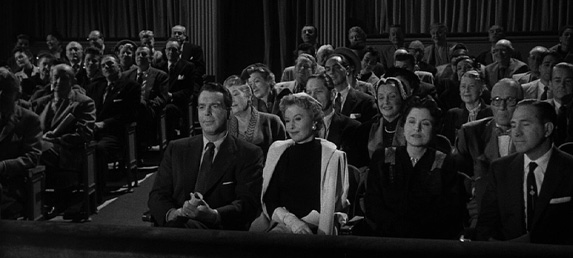
7. Smoking. People do it everywhere in old movies, with unapologetic gusto. The act of smoking can give rhythm to lines, buying the character some time.


It can tell you much about the way the characters relate.


It is, in short, a social activity.


(The Siren here adds the obligatory note that smoking is a Bad Thing, although why the failure to denounce smoking as soon as it's mentioned causes howls of protest is something the Siren doesn't get. No one freaks if the Siren fails to screech "Heroin kills!" when discussing The Man With the Golden Arm.)

8. Drinks. The way people knock 'em back in old movies fills the Siren with awe. And it's not just the ones you expect...


...it's even the folks hanging around the fortress of the American home. Watch Walter Huston pour out a simple Scotch in Dodsworth--about a half-tumbler. The Siren gets goggle-eyed every time she sees it. And of course, nobody drank like these two.


9. Full-length musical numbers in non-musicals. The Siren just saw one in Safe in Hell, in which the adorable Nina Mae McKinney sings a lovely version of "Sleepy Time Down South" while serving dinner to the sleaziest guests in the Caribbean. But there are lots of other examples. Even Howard Hawks had one, the "Drum Boogie" Barbara Stanwyck performs before kicking back with some academic types.


(Notice how often Hawks is popping up here? This is the stuff that really makes an auteur, I tell you.)

10. Closeups of notes in beautiful handwriting.


So, the Siren doesn't want to turn this into a meme. For one thing, the misuse of the term meme is irritating some of the purists around here. For another, the Siren has trouble picking people to tag. So this is not a meme, it's an invitation. If you want to contribute, please do so, either in commments, or at your own blog. If it's the latter drop me a line and I'll link back. The one rule is that we're looking for details and atmosphere, not big artistic stuff. And link back to Jacqueline, since she started it.

While we are on the subject, here are some delightful entries in the A-Z meme oopsImean list-by-invitation:

Operator_99 hits it out of the park with an all-1930s list
Jacqueline T. Lynch shows herself a kindred softy and lover of Dorothy McGuire
Goatdogblog goes international
Glenn Kenny gives some class to the joint
Dirty Harry, in a burst of liberality, mixes in some movies he didn't even like
Robert Avrech includes some wonderful silents
Filmbrain flashes film erudition it will be hard to top with An A-Z of Nikkatsu Sleaze and Action.

For a complete list of all 125 or so, check Blog Cabins. If this doesn't make him King of Google I don't know what will. Am I missing any good lists? Tell me. Finally, if you have the Siren on your blogroll, but have yet to spy yourself in the thickets of her sidebar, please say so via email or in comments. The Self-Styled Siren has a liberal blogrolling policy, and if you list her she will almost always list you back.