PRINCE POPPYCOCK

The graphics are a significant upgrade from the Prince of Persia that was on the Apple computer, but they are not amazing. Players will experience the game on a two dimensional environment (ala Castlevania). You will encounter a myriad of trapped doors, hazardous spikes, and deadly blades. Jumping from platform to platform makes up a great deal of the gameplay (too much for my taste)

Imitation of a Takedown


When it comes to Internet squabbles, the Siren has been on the wagon for a while, give or take an occasional flare-up.

And then she comes across something like this, where the inimitable Jeffrey Wells does a "respectful takedown" of Douglas Sirk using, of all things, the director's masterpiece, Imitation of Life.

Now the proper thing to do is make like Clark Gable: "I apologize again for my shortcomings," and for being a "film dweeb" who appreciates Douglas Sirk.

Then again, screw propriety, when someone is waving a bloody-fire-engine-red cape like this in my face.


Sirk is generally regarded as a pantheon-level guy because the film dweebs have been telling us for years that the dreadfully banal soap-opera acting, grandiose emotionalism and conservative suburban milieus in his films are all of an operatic pitch-perfect piece and are meant as ironic social criticism. (Or something like that.)...


Now why, I wonder, have people been doing that? Just to irritate Wells? Come on Glenn, fess up. You too, Filmbrain.

Wells illustrates his post with a scene from Imitation of Life. Trouble is, the scene is enthralling, and it isn't even a high point of the movie. It's a relatively simple sequence wherein ultra-blonde Susie (Sandra Dee) finds out that mixed-race Sarah Jane (Susan Kohner) is seeing a white boy in the town. Wells says this is bad acting. The Siren raises the point, once again, that there are different styles of acting that are appropriate to different movies. Sirk films work with artificiality; they show how people play roles. Kohner is just beginning to grasp the power of her beauty. Watch her take off her shirtwaist almost like the stripper she will later become, turning to give Dee a good look and sashaying over to the bed as if to say, "I'm better-looking than you, white girl, and I always have been." See the flick of hatred, rising up and quickly suppressed, as Sarah Jane looks at her privileged friend. And look at Susie's clueless reaction to Sarah Jane's secret, the hasty way she tries to cover up her gaffe about the "colored boy," the platitudes she mouths while knowing on some level that Sarah Jane has a point. There's nothing wrong with the acting; it isn't naturalistic, and nor should it be. It's perfectly in keeping with the style and themes of the movie.

And the visuals--how in the name of Lana Turner's hair dye can anyone who loves movies not love the visuals? The angle through the railings as Dee knocks on Kohner's door. The shot through the window of Kohner hiding from her mother. Kohner taking off her dress. The impeccable framing. The way the conversation is blocked, the camera moving at just the right moments and the two girls positioned in just the right way to convey their relationship.

Mr. Wells flatters himself when he styles this as a takedown. Rather, it is the lament of a schoolboy--a dweeb, if you will--forced to watch icky girl stuff instead of the manly men doing manly things in manly ways who form the proper study of all serious critics. Sirk's subject matter, it seems, is a large part of the rap against him:


Sirk was mostly dismissed by critics of the '50s and early '60s for making films that were no more and no less than what they seemed to be -- i.e., emotionally dreary, visually lush melodramas about repressed women suffering greatly through crises of the heart as they struggled to maintain tidy, ultra-proper appearances.


Four assumptions lurk here. One, that contemporary critics are a good yardstick by which to measure a film's worth. Because if you want to know how time is gonna judge a director, the first place to look is Bosley Crowther. Second, that the sufferings of tidy, proper women are somehow a lousy subject for a filmmaker. Surely this argument was put out of its misery by Virginia Woolf all the way back in 1929. Three, that "visually lush" is a negligible quality. The Siren has nothing to say to that; it's on the level of the Emperor complaining to Mozart about "too many notes." Four, that there is nothing below the visually lush surface of a Sirk film. That is the shakiest assertion by far.

You see, when we film snobs have the secret clubhouse meetings wherein we plot ways to force people to watch movies about boring girls and their poky old mothers, we come armed with the words of Douglas Sirk, who gave some long interviews late in life after he went blind, a fate he bore patiently. And in those interviews he shows, repeatedly, that he knew precisely what he was doing:


The stories that I got were, without exception, very trite, without any element of life to them. But still the content of the trite novel could be vivified--you could wake it up--you could put something into it.


It isn't particularly difficult to grasp what is going on in a Sirk movie. Just because there is depth to the movie doesn't mean you need the secret decoder ring they hand out in film studies to find it. In fact, the Siren could introduce Mr. Wells to a whole flock of people who get teary over this movie; it still plays to the emotions, if you watch it with an open mind. Imitation of Life is a shattering statement on American attitudes about race, about working women and their relationships with their children, about how children and mothers are often fated to bring one another agony. It's all right there on screen. You just have to get past the fact that the movie is done in a style that has disappeared--much to our loss, I'd say.

As the Siren has always said, the only rule at her own place is "No dissing Citizen Kane." Some of her commenters dislike Sirk. And (here the Siren adopts her Stuart Smalley voice) that's okay. But please, Mr. Wells, don't try to make your case by pretending a filmmaker was all surface, when even a cursory glance at the films and the words of the filmmaker shows otherwise. Most of all, please don't insult those of us who do like him.

And now I really need that ice pack.

Watching Movies With My Mother


(The scene: The Siren's living room, kids and Mr. C in bed. We just finished watching There's Always Tomorrow (Douglas Sirk, 1956)--we both loved it, of course.)

Me: I've seen Vinnie before. (William Reynolds, who plays Fred MacMurray's square-jawed, glowering son.) He reminds me of a lot of those '50s teen actors, like Troy Donahue and...

Mom: Tab Hunter.

Me: Him too. They all played similar types, good-looking...

Mom: Upright...

Me: It makes me appreciate Rock Hudson, he was different.

Mom: Oh yes, he broke the mold. (Pause) Of course, at the time we didn't know which mold he was breaking.

(Grateful hat-tip to Girish Shambu, who also watches Barbara Stanwyck movies with his mother, and who sent me the DVD. Other thoughts on There's Always Tomorrow may be found at Glenn Kenny's place.)

For the Love of Film: The Lineup Grows (UPDATED)


Update: The number of bloggers pitching in to help raise money just keeps growing and growing; look below for the latest. Roger Ebert, for forty years one of this country's most visible, honored and well-loved critics, has alerted his many Twitter followers to the blogathon. Anyone who has read Ebert's columns or books or watched his television show knows he has spent his career urging people to watch great films from every era, and his support for us means a great deal.

It's time to remind our contributors of the rules of the blogathon. They are few, but important:

1. Post on any topic related to film preservation, at any time during the week of Feb. 14 through Feb. 21.

2. Include the donation link for the National Film Preservation Foundation.

The National Film Preservation Foundation is the independent, nonprofit organization created by the U.S. Congress to help save America’s film heritage. They work directly with archives to rescue endangered films that will not survive without public support. The link is right here:

https://npo.networkforgood.org/Donate/Donate.aspx?npoSubscriptionId=1001883&code=Blogathon

The NFPF will give away 4 DVD sets as thank-you gifts to blogathon donors chosen in a random drawing: Treasures III: Social Issues in American Film, 1900-1934 and Treasures IV: American Avant Garde Film, 1947-1986.

3. Send your link to Marilyn Ferdinand of Ferdy on Films (http://www.ferdyonfilms.com) and to me here(http://selfstyledsiren.blogspot.com/). We will be keeping track of the submissions and linking to them on our respective blogs.

4. Follow the links here and at Marilyn's site to read the contributions of your felllow writers; remember too that nothing gladdens a blogger's heart like a nice comment.

And, most important of all,

5. DONATE GENEROUSLY to the NFPF, and urge your readers to do the same. Film preservation is an expensive process, and our aim is to raise as much money as possible to support the NFPF's work.

In about one week forty-eight hours, on Sunday Feb. 14, the Film Preservation Blogathon, For the Love of Film, will be upon us. The Facebook page is being continually updated so please, keep checking things out. Thanks to the tireless efforts of Marilyn Ferdinand of the most excellent Ferdy on Film and Stylin' Greg Ferrara of Cinema Styles, we have 642 766 fans and more than twenty thirty forty fifty bloggers who have committed to posting something that week.

The fine folks at the National Film Preservation Foundation have really gotten into the spirit, lending us photos and clips from films that their efforts have saved. Do have a look.

Because of course, the important part is to contribute to the NFPF. If everyone who visits these blogs the week of February 14th kicks something, anything, into the kitty, we could be responsible for saving even more films. And wouldn't that be much, much better than the usual run of sad bonbons and wilted bouquets this time of year?

Like I told Marilyn...


This Valentine's Day, Give Her What She Really Wants: Nitrate.

The lineup so far, in addition to Marilyn, Greg and me, includes:

Peter Nelhaus of Coffee Coffee Coffee and More Coffee will review The Penalty, starring Lon Chaney.

Dwight Swanson of Home and Amateur will blog about the restoration of Think of Me First as a Person.

Louie Despres at El Brendel will be writing about El's Mr. Lemon of Orange.

Bucky Grimm will be coming out of blogging semi-retirement at "Mindless Meanderings"

Tony Dayoub at Cinema Viewfinder will be blogging about the 1922 Sherlock Holmes.

Justin Muschong of Brilliant in Context

David Cairns of Shadowplay

Operator 99 of Allure will look at the films listed in a 1931 edition of Photoplay and tally the survivors and the lost.

MaryAnn Johansen of Flick Filosopher will review Peter Jackson's Forgotten Silver.

Lou Lumenick of the New York Post will be writing about To the Last Man and how it fell into public-domain hell.

Glenn Kenny of Some Came Running

Kendra of Viv and Larry

Vince of Carole & Co.

Ryan Kelly of Medfly Quarantine

Ivan G. Shreve of Thrilling Days of Yesteryear will be pulling out the stops with at least two pieces, one on Fred Allen's IT'S IN THE BAG! (1945) and UCLA's restoration of its "alternate" version and the other I've titled "The Singular Case of the Magazine Magnate," which will discuss Hugh Hefner's role in funding the restoration of some of the Universal Sherlock Holmes films.

Jacqueline T. Lynch of Another Old Movie Blog plans to write on Vertigo.

Flickhead knows how to make the Siren happy; he's writing about nitrate.

JC Loophole (still one of my favorite noms de blog--a W.C. Fields ref?) of The Shelf plans a post called "Restoring Film, Preserving Art and Curating Culture."

Rob Gonsalves of Rob's Movie Vault will be blogging about the documentary The Race to Save 100 Years.

Director Jeffrey Campbell of The Last Lullaby (and) Peril

The one and only David Ehrenstein of FaBlog will post about Max Reinhardt's great filming of A Midsummer Night's Dream.

Meredith of Or Maybe Eisenstein Should Just Relax will write on The Red Shoes.

Brian of Stinky Lulu will be writing about Who Killed Teddy Bear?

Filmmaker Max Sacker will be contributing from Berlin.

Tom K. of Motion Picture Gems will be writing about the message in Peter Bogdanovich's Nickelodeon.

Donna at Strictly Vintage Hollywood will be posting on Valentino's lost film Uncharted Seas and a second post to be announced.

Michael Guillen of The Evening Class has tentative plans to write on the Lola Montes restoration (and as far as the Siren is concerned, every blogathon needs some Ophuls) and indices to San Francisco's Noir City and Silent Film Festivals.

Catherine Grant of Film Studies for Free plans to post a set of links to online material about film restoration, preservation and archiving.

Arthur S. of This Pig's Alley plans to post on two neglected Raoul Walsh films, including Me and My Gal.

Plum of Don't Be a Plum plans to post.

Anne Richardson of Oregon Movies A to Z will be interviewing Dennis Nyback about his nitrate stories, as a projectionist.

Gareth of Gareth's Movie Diary plans to write about a vital component of preservation: access to what's preserved.

Brent Walker of the fine Mack Sennett Blog is on board.

Bill Ryan of The Kind of Face You Hate plans to post.

Sarah Baker, author of "Lucky Stars: Janet Gaynor and Charles Farrell," will blog about Charlie and Janet's rediscovered films such as The River (1928) and Lucky Star (1929), as well as about helping to release Olive Thomas' 1920 film, The Flapper to DVD; she will post at Flapper Jane.

Paula of Paula's Movie Page, a collection of great movie pics at Shutterfly, is already showing us some link love.

M.K. Rath of Ehmkay is planning a post on preservation's relevance for young people.

The King of Noir, Steve-O, will post about noir and preservation at Noir of the Week.

Gordon Dymoski of Blog This Pal has "a slightly more pop-culture oriented post in mind."

Tinky Weisblat will be writing about Iris Barry of MoMA and "including a recipe of some sort" at Our Grandma's Kitchen.

Betty Jo Tucker of ReelTalk Movie Reviews has publicized the blogathon and plans to participate with a post about the great Martin Scorsese's preservation efforts.

Elizabeth Hansen of the Texas Archive of the Moving Image has pledged to promote the blogathon.

Joe Thompson of The Pneumatic Rolling-Sphere Carrier Delusion is posting on "Why Do We Need to Preserve Films? A Brief History of Nitrate."

Buttermilk Sky gladdens the Siren's heart by pledging to write about the Marx Brothers in Monkey Business.

Eddie Muller of The Film Noir Foundation, another excellent nonprofit film-preservation outfit, will be contributing an article.

Melissa Dollman, audiovisual cataloguer at the Schlesinger Library, Radcliffe Institute, Harvard University, will be contributing at her Highlights from the Archive Blog.

Adam Zanzie of Icebox Movies will be posting.

Maggie of Silver Screen Dream will post about some favorite movies that need attention, like Love Affair (the Siren loves that one, too) as well as future solutions to classic film distribution.

Dennis Cozzalio of the must-read Sergio Leone and the Infield Fly Rule will be joing us.

Hind Mezaina will be posting from Dubai on her blog The Culturist.

Trisha Lendo and her fellow students in the moving-image archive program at UCLA will be posting from their group blog.

Jenny the Nipper will be posting on CinemaOCD--about "DIY Preservation." (!! Do we have to wear gloves?)

Erik Loomis of Alterdestiny is getting into the spirit in a big, ambitious way, by reviewing one of the NFPF-preserved films each night for seven nights.

Librarian Leo Lo plans to post about the role of libraries in preservation.

Kenji Fujishima of My Life, at 24 Frames Per Second, will post about the greatest of all silent movies (sez me), The Crowd.

Want a reminder of what's at stake? Here's Marilyn's piece on a film badly in need of restoration, from one of the Siren's most revered directors, Douglas Sirk. Michael Guillen of The Evening Class posted a while ago about the restoration of Bardelys the Magnificent from another Siren favorite, King Vidor.

And our banner this week is from another film with a checkered release history that left it in badly in need of restoration, which the magnificent Lola Montes has finally received.

If you need ideas on what to write about, check here on the Facebook Discussions page.

There is no obnoxious door policy at the For the Love of Film Blogathon; all are welcome and you may come as you are. There is no limit to the number of bloggers who can participate and you may post any time next week. Drop me or Marilyn a line at email or comments, or on the Facebook page, and you're in, and most welcome. If you alerted me to your participation, and I somehow haven't added you, prod me again, please. You don't have to know what you are writing about yet, the promise to post that week about restoration is more than enough.


If sticking it out for two-and-a-half episodes of Season 1 and one episode this season can be called trying, the Siren has tried with "Mad Men". She sees the attraction, even if the hype blows her mind--everything from Banana Republic to Barron's, for heaven's sake. The Siren admires the cinematic qualities of the series, the fluid camerawork, the carefully angled shots, the flawless integration of sets and costumes. It's pretty. The actors are pretty. The period detail is enough to warm an old-movie hound's heart. But on the whole, the Siren just doesn't dig it.

Despite the stratospheric sex appeal of Jon Hamm, January Jones and Christina Hendricks, the show is just so goddamned dour. The Siren suspects series creator Matthew Weiner wanted to avoid the nostalgia trap, but this is too far in the other direction. A little soupçon of affection for the past will not turn Mr. Weiner's dead-serious critique into "The Wonder Years Meets Ad Age." The Siren has seen movies from the era, and in those movies, people have a good time--every now and then, you understand, between bouts of weltschmerz. As James Wolcott wrote in Vanity Fair, "Mad Men" "has a seductive look, a compelling mood, a cast that could have been carved from a giant bar of Ivory soap, but zero grasp of the elastic optimism and vigor of the Kennedy years, the let-go spring of release after the constriction of the Eisenhower 50s."

Everyone on "Mad Men" goes around smoking and drinking and eating whatever they hell they want and having office affairs without once looking over their lovers' shoulders for process servers bearing class-action subpoenas, but does anyone enjoy it? Not from what the Siren has seen. It's like Saint Augustine wrote the scripts. Such laughs as "Mad Men" affords are tethered to hindsight--"We never indulge in such sexism/racism/anti-Semitism/homophobia now, and even if we do, we sure don't smoke."

Still, the Siren will probably watch more this season--between Wolcott's liveblogging and Lance's occasional commentaries, she doesn't want to be the clueless playground oddball. But in her heart, she'd rather watch a melodrama from the actual late Eisenhower-early Kennedy era. Good or bad, there's plenty to choose from.

So that's my justification for posting these brief takes on ten films actually made during the "Mad Men" period--dramas, because "Mad Men" is not, god knows, a comedy or a musical. These movies vary widely in terms of quality and critical repute, from bona fide masterpieces to simple soapers. But the Siren likes them all, as she likes a lot of the melodramas from this period. Many directors were exploring widescreen technique to admirable effect, and it was a great era for clothes and interiors. And when you watch the movies, you realize that people were far more aware of what was under society's facade than many suppose. (Two of the movies date to 1959--if Don Draper can fade out to Bob Dylan in 1960 then the Siren can cheat back a single year, she figures.)


Imitation of Life (Douglas Sirk, 1959)
Social Issue: Racism.
Sets and Costumes: Perfection.
Sex appeal (Low/Medium/High): Beside the point. But John Gavin was in the full flower of his lockjaw handsomeness and Susan Kohner and Sandra Dee were lovely.
Why the Siren Likes It: It's a masterpiece, that's why, one that belongs on any list of the great films of the 1950s. A master class in how to make a movie about misguided, surface-focused people trapped by a hypocritical society, without condescending to or withholding compassion from them. The proof is that 50 years after its release, the thwarted mother-daughter love still reduces many to tears. The Siren bristles when she hears this described as camp. There isn't a single unintentional effect in it. The falseness and glitter are there to throw race, this country's original sin, into high relief. But Sirk doesn't invite the audience to feel superior. He wants recognition, AND he wants identification. In the superb opening scene on the beach, when Lana Turner reacts with gooey middle-class "understanding" to Juanita Moore's having a white-skinned daughter, Sirk didn't want the white liberals in the audience to say, "What a hypocrite." He wanted them to say, "Shit, that's me." (The beautiful screen cap is from Ways of Seeing, the Siren's new blog discovery; several others, equally enthralling, right here.)

The Best of Everything (Jean Negulesco, 1959)
Social Issues: Working women and adultery (go together like a horse and carriage in Hollywood movies of all eras), unwed pregnancy, abortion, casting couch, alcoholism.
Sets and Costumes: Great New York exteriors and the ultimate in smart little suits. Best of all, the Mondrian-esque office interiors, which Negulesco, a painter, probably influenced.
Sex appeal: High; Suzy Parker, Stephen Boyd, Louis Jourdan, even Robert Evans looks great.
Why the Siren Likes It: Underrated, influential film whose critical reputation is slowly improving. One of a number of "three [or four] girls" movies from the era, direct ancestors of "Sex and the City." Enjoyable on a number of different levels--as highly informative social artifact, as a proto-feminist tract, as an aesthetic treat, as a showcase for newcomers and old pros. The Siren particularly likes good old Brian Aherne as an ass-pinching executive and Joan Crawford, refusing to play her role as straight office harridan, giving her character both dignity and sensitivity. The beauteous Parker (up top) gets the best line: "Here's to men. Bless their clean-cut faces and their dirty little minds." The best appreciation of this film that the Siren has read is over at Noel Vera's place; he pays great attention to Negulesco's use of Cinemascope.

From the Terrace (Mark Robson, 1960)
Social Issues: Alcoholism, adultery, class snobbery, cutthroat business practices.
Sets and Costumes: High-end all the way. Joanne Woodward doesn't look completely at ease in Travilla, though.
Sex appeal: High. Paul Newman rates an automatic "high" in this category, as does Myrna Loy at any age.
Why the Siren Likes It: A parable about life versus work that everybody calls dated, except "Mad Men" apes the same themes. The Siren wrote a bit about this movie when Newman died; his performance is very good but the direction is noteworthy too, as is the Elmer Bernstein score.


All the Fine Young Cannibals (Michael Anderson, 1960)
Social Issues: Racism, alcoholism, class snobbery, adultery.
Sets and Costumes: Ersatz Southern, then faux bohemian, but extremely well-shot by William H. Daniels.
Sex appeal: Medium, largely because the Siren doesn't get Robert Wagner.
Why the Siren Likes It: Supposedly based on the life of Chet Baker. Jaggedly uneven and no one seems to have a clue about real white Southerners. But deserves to be remembered, if only for Pearl Bailey's haunting performance. For the Siren and those like her, there's also the nifty bit of role reversal for Susan Kohner, the "tragic mulatto" of Sirk's Imitation of Life, in the same movie as the penultimate role for Louise Beavers, of John Stahl's excellent 1934 Imitation of Life. (Poster is from the great Cinema Retro site.)


Return to Peyton Place (Jose Ferrer, 1961)
Social Issues: Working women (don't kid yourself, that's still an issue), rape, incest, adultery, (disguised) abortion, xenophobia.
Sets and Costumes: Meh. The exteriors look great, though.
Sex appeal: High; Eleanor Parker, Tuesday Weld, Carol Lynley, Jeff Chandler if you happen to like Jeff Chandler.
Why the Siren Likes It: Um...hard to say, since by no stretch of the imagination is it a good movie. This one the Siren won't kill you for calling camp. There really isn't anything else you could call it. The first Peyton Place is camp too, but had real value in Franz Waxman's score (heaven), Diane Varsi and the New England ambiance. Return, well, Ferrer was no director, they added lyrics and Rosemary Clooney when Waxman needed neither, and most of the cast looks about as comfortable as a soaking wet cat. But I appreciate Carol Lynley's pursuit of a career over and above a love affair (similar to the reason I liked Valley of the Dolls' fadeout). Mary Astor is great, playing a full-out embodiment of small-minded paranoia and ugliness. And Tuesday Weld manages to have emotional sincerity in some scenes despite playing opposite the stiffest excuse for a Swedish ski instructor you ever saw in your life.


Susan Slade (Delmer Daves, 1961)
Social Issues: Premarital sex, unwed motherhood, the hazards of cigarette smoking.
Sets and Costumes: Beautiful exteriors by master cinematographer Lucien Ballard, and the vaguely Japanese-style house on the Northern California coast, given to Connie Stevens's father by Brian Aherne (there he is again!) is quite an eyeful.
Sex appeal: Medium, though Connie Stevens (above) does her best.
Why the Siren Likes It: Interesting, Sirk-esque late-career movie by the talented Delmer Daves, with several scenes that have lost none of their ability to shock. Dave Kehr: "To an America that needed to believe that 'nice girls don’t,' Daves’s melodramas responded, 'Nice girls do' — or did at least sometimes, when the appropriate distinctions had been made between lust and love, predatory older males and sincere young men, casual encounters and lifetime commitments." Kehr prefers Parrish and Rome Adventure to Susan Slade and the Siren pretty much agrees with him, but Slade is worthwhile and closest to the "Mad Men" school of social history. Peter Nelhaus has a fine review of the movie, in which he compares it to Daves' westerns.


Advise and Consent (Otto Preminger, 1962)
Social Issues: Homophobia, subversion, government corruption.
Sets and Costumes: Stiff, cold and forbidding, perfectly in keeping with the machinations of the plot.
Sex appeal: Low. Gene Tierney is in this but she wasn't looking her best. Perhaps because he was making a movie about politicians, Preminger shot everyone with a GargoyleCam.
Why the Siren Likes It: Another masterpiece, a fisheyed look at the Washington influence game, usually taken as a riff on Alger Hiss but full of other echos as well. The scenes of back-door-dealing and blackmail ring as true as they ever did. Those tempted to tag the young, upright conservative senator's operatic torment over his gay attractions as quaint should think back to Jim McGreevey, Larry Craig and their many brethren--not to mention their wives. Despite the Red Scare trappings (and those are somewhat back in fashion, if you've noticed), Advise and Consent is one hell of a prescient movie. (To see just how prescient, the Siren recommends you check out this article by Meredith Hindley, senior writer at Humanities, on "The Transformation of Advise and Consent.") The above is from Ways of Seeing, whose proprietor clearly has excellent taste; for more screen grabs to show just how good this movie is, please click over and check out the rest.


The Light in the Piazza (Guy Green, 1962)
Social Issues: Mental retardation, class snobbery.
Sets and Costumes: Stunningly beautiful Italian setting (Guy Green was a highly accomplished cinematographer), Christian Dior dresses for Olivia de Havilland.
Sex appeal: High; Yvette Mimieux, George Hamilton and Rossano Brazzi, and de Havilland is much lovelier than the frightening lip color above suggests.
Why the Siren Likes It: Tender romance with a great performance by de Havilland, who carries the movie. Recently turned into an acclaimed musical that the Siren, alas, did not see. She does think the movie's insistence on the primacy of love, both parental and romantic, makes it a good choice for a musical treatment. At a time when the common practice was to shut the mentally retarded away in institutions, the notion that a developmentally delayed girl (albeit a beautiful one) deserved to marry a prince of an Italian and have babies was nothing short of revolutionary.


The V.I.P.s (Anthony Asquith, 1963)
Social Issues: Cutthroat business practices, tax evasion, adultery, domestic violence, depression.
Sets and Costumes: Enough to make you fly to Heathrow and wait to get fogged in--if flying were still like this.
Sex appeal: High. (Elizabeth Taylor at this point in her career does the same for a movie as Paul Newman. Elsa Martinelli was nothing to sneeze at, and neither was Richard Burton or Louis Jourdan.)
Why the Siren Likes It: See Return to Peyton Place. Plenty of lush period visuals, and there are pleasures to be had from Orson Welles even in unworthy roles (this one tinged with painful self-parody). But it's a pretty bad movie, though hardly the offense to all civilization that Walter Chaw paints it, and Elizabeth Taylor is an unconvincing version of Vivien Leigh. (Note to Mr. Chaw: Rod Taylor was a native Australian.) The Siren likes this primarily for Maggie Smith as the devoted secretary. I do love Dame Maggie. Christina Hendricks is good, but she still could learn something from what Smith accomplishes with a cliched role. Smith's scene with Richard Burton is the highlight, the so-so writing propped up with perfectly timed and calibrated reactions and beats.


Love With the Proper Stranger (Robert Mulligan, 1963)
Social Issues: Premarital sex, abortion, unwed motherhood.
Sets and Costumes: Supposedly low-end, but a mite too clean for all that. Steve McQueen made everything he wore look like a well-broken-in motorcycle jacket.
Sex appeal: High. Look at that publicity shot and tell me different.
Why the Siren Likes It: Has comic moments, but at heart a rather melancholy movie about a still-relevant topic, with legendary leads giving warm, authentic performances despite a wan third act. McQueen seldom let his vaunted cool slip to as much effect as here. When "Mad Men" gives a nudge about how far we've come, we should remember Wood planning an abortion, without hysteria. How many recent Hollywood movies or TV shows have let a beautiful, sympathetic lead do the same?

All right, so it's been a while, have at it. Tell me why I'm wrong about "Mad Men." Point out the movies I missed. (The Apartment isn't there and doesn't belong there; it's a comedy, and a satire, and very funny, and "Mad Men" isn't any of those those things.)

But, as always, play nice. The new banner, which MrsHenryWindleVale recognized without a telescope, is courtesy of the great Glenn Kenny. It is of course Dorothy Malone, from another Sirk masterpiece, The Tarnished Angels. Dorothy is meant to illustrate the Siren's general mood for the past month and probably the next.

Postscript: I've added a link to Peter Nelhaus's fine writeup (with lovely screen caps) of Susan Slade. Despite the deliberately provocative title, my main idea in writing this piece was "Hey, these early-1960s films that I love deserve a second look." So if anyone else has a post on some of these, or a similar movie from 1959-1963, post a link in comments by all means and I'll add it here. I'll start by also linking to Peter's post about Strangers When We Meet (b/w Town Without Pity, which also roughly fits our parameters despite the German setting). The Siren forgot about Richard Quine because--well, see banner above. Because of that.

Awesome screen caps from The Best of Everything right here. Apparently my mistake was not Googling "Suzy Parker."

Nathaniel of The Film Experience has been doing a series on movie references in Mad Men; one post involves a Draper household pillow-talk discussion of The Best of Everything that the Siren is sorry she missed. Great for "Mad Men" fans but rewarding for non-watchers too.

MORE UPDATES:

Vertigo's Psyche gives some love to Siren darling Sandra Dee and her exquisite performance in A Summer Place.

Arthur S., one of the most astute commenters in the film blogosphere, links us all up to a Douglas Sirk interview that is not to be missed.

The first thing that strikes you about George Sanders' filmography, after you get over its length, is that he worked with a lot of great directors. Renoir, Hitchcock, Mankiewicz, Duvivier, De Mille, Ulmer, Siodmak. Three good movies for Douglas Sirk, two more good movies for John Brahm. George Cukor, albeit on the misbegotten Her Cardboard Lover. Otto Preminger, for Forever Amber and The Fan--and wouldn't you have loved to sneak on set and see Preminger trying his Prussian dictator act with the unflappable Sanders? For that matter, the Siren yearns to learn whether Sanders bothered to hit any of Fritz Lang's chalkmarks on Man Hunt, or if he just raised an eyebrow and stood where he jolly well pleased. The Siren does know, thanks to Brian Kellow, that Sanders infuriated Joan Bennett by sitting in the director's chair and letting the ladies stand. If you knew nothing else about Sanders, this alone would confirm his sang-froid. I mean, would you sit in Fritz Lang's chair?


Sanders did great work for many of those directors, and even in the lesser movies he was never boring. But he gave three of his most interesting performances for a director judged guilty of vulgarizing literature and "cultural evangelism" by Andrew Sarris and called "that idiosyncrat" (great phrase) by David Thomson. That would be Albert Lewin, the man at right in the still above, a vividly original artist whom the Siren thinks merits more consideration than he usually gets. Of the three Lewin/Sanders films, the Siren ranks The Moon and Sixpence third, although it's interesting and deserves a better fate than the cut-rate DVD currently circulating. The best is The Picture of Dorian Gray, a supremely atmospheric evocation of Oscar Wilde that spooks the bejesus out of the Siren whenever she catches it. Sanders is perfect as the mephistophelian Lord Henry Wotton, who lures Dorian into degradation only to recoil at the results. It is as hard to imagine another actor as Lord Henry as it is to picture Gary Cooper playing Addison DeWitt.

So the Siren has now seen Sanders in The Private Affairs of Bel-Ami, which languishes in only-on-crappy-VHS hell. Some say this is his best performance. It isn't--the best are still Addison and Viaggio in Italia--but it is excellent all the same.

The Siren has mentioned her love for Guy de Maupassant, one of those writers Hollywood was always adapting with merry disregard for the fact that the Production Code kept his best bits off-screen. Lewin, who started as a producer, must have known that Joe Breen was never going to countenance the ending of the original novel, wherein homme fatal Georges Duroy marries the daughter of his boss and looks at all he has wrought without a trace of self-reproach. Lewin must also have realized he would have to add some version of True Love for his amoral hero because the studios always wanted some lovers around, whether the star was George Sanders or Groucho Marx. Still, it is easy to see why Lewin would choose this novel.

For one thing, the setting must have been irresistible. Interesting to reflect that the movie time period, Paris 1880, was more than 60 years in the past at the time of filming. Our own era has many movies set in the 1940s, maybe even too many. But contemporary filmmakers approach the World War II period via two avenues, the movies they have seen from the 1940s and a fairly predictable realist aesthetic. (Although Quentin Tarantino may yet surprise us.)

Lewin takes on the Belle Epoque with the eye of an art collector, and as in all of his movies, he creates a dreamy parallel world where you are supposed to believe in the aesthetics, not the history. The sets on Bel-Ami look like sets, the backdrops look like backdrops, the proportions of the rooms are slightly off and not one street or cafe evokes anything the Siren has seen in Paris. Probably the underlying reason was a low budget, but the Siren firmly believes that Lewin knew exactly what he was creating with production designer Gordon Wiles, art director Frank Paul Sylos and cinematographer Russell Metty. The effect is still beautiful, like watching characters in dollhouses. You aren't supposed to look and say, "Ah yes, that's exactly what Paris looked like in 1880." Rather, Lewin signals the lack of reality at every turn--this is a fable, decorated with a moral that you can either accept or snip off like the ribbon on a corset.

And Sanders creates a character in keeping with the movie's never-was Paris. Georges Duroy is nicknamed Bel-Ami by the women he climbs over to get to the top of Parisian society. The Siren's favorite line comes early on. "I have need of a stout stick," says Duroy at the beginning, as he looks at a Punch doll, "to beat my way." He even repeats that bit of subtlety not three minutes later. Duroy starts his ascent by accepting a job from his friend Forestier, played by John Carradine, whose characters always look as though they are dying of consumption even when they aren't. In Bel-Ami, Carradine coughs and signals another tubercular turn, although he is quite good in the part. Duroy realizes Forestier is dying. Duroy also sees quickly that his friend's writing owes a great deal, maybe everything, to his clever wife Madeleine (Ann Dvorak, a perfect Art Nouveau beauty and delicious in the role). Duroy sets his sights on marrying Madeleine, to the point that he proposes to her by Forestier's deathbed almost before that unfortunate gentleman has completed the formality of dying. Madeleine accepts, and they become quite the Parisian power couple, until Georges is ready to move on via an affair with his boss's wife (an affecting Katherine Emery).

Madeleine tries to ease her loneliness with an affair, and Georges arranges to have a photographer catch the lovers' assignation. (Did Sanders file this idea away for future reference?) In the book Madeleine sleeps with a minister; in the movie it's Duroy's sworn enemy Laroche-Mathieu, and Bel-Ami has thrown her together with him. As soon as you see that Laroche-Mathieu is played by Warren William (looking rather ill in this, his last role) you realize Duroy is a gone goose. But before the tale ends, with a well-executed duel sequence, Duroy will dump his boss's wife and attempt to marry the boss's daughter.


Are you confused? Because I forgot the subplot about Bel-Ami buying a title. Not to mention the love of faithful Clothilde, who meets Bel-Ami early on, falls in love with him and thaws his heart a bit, but not enough for him to stop his cheatin' ways. Can she save his soul?

Clothilde is played by Angela Lansbury, here in the full flower of her peculiar, doll's-head beauty, and almost as moving as she was in Dorian Gray. She has great chemistry with Sanders, particularly in a scene where she persuades him to take her to a down-and-dirty boîte--very Toulouse-Lautrec, just as a later scene will evoke Manet. Lewin gets in a great fake-out shot, panning over a seemingly passed-out woman. The music starts, one woman picks her head up off the table and it turns out she's the floor show, as she sings the Bel-Ami theme song that recurs through the movie.

Before that, Sanders and Lansbury dance the can-can in one of the Siren's favorite Sanders moments of all time. He is dancing with Clothilde, she's kicking away very nicely, and for a minute he looks almost grim, even as he's kicking (and he had a pretty good leg extension, did George). Then his face softens as--for the only time in the movie--you see Duroy thinking hmm, this is...what is the word I'm looking for...tip of my tongue...hop-kick, hop-kick...why, it's FUN. The Bel-Ami/Clothilde romance, grafted onto the novel, takes on life after that. Duroy's behavior toward Clothilde will get worse, and her devotion to him less explainable, until you think back to this moment.

Bel-Ami is the spiritual cousin not of Lord Henry, but of Dorian, a man whose sexual allure makes him both art object and instrument of destruction. In Dorian Gray, Hurd Hatfield's affectless beauty and near-uniform line readings help keep things abstract; in the Private Affairs of Bel-Ami, that's the job of the sets. Sanders was good-looking and he had that prowling baritone voice, but he didn't have Hatfield's perfect face. So he has to convince us of Duroy's sex appeal by some other means, which Sanders does in the very first scene. Duroy has just returned from being a soldier in Algeria. He enters a sidewalk cafe and brushes past a seated woman. She looks up, likes what she sees and saunters over. Sanders barely bothers to size her up--aside from sex, she can give him nothing, so she is nothing, and at first he brushes her off like Cardinal Richilieu dismissing a scullery maid. And, despite the fact that the character is a Frenchman, moreover a Frenchman who has been in the army for several years, you believe it--that Sanders is instantly appealing to a pretty woman, the brush-off, everything. The force of Sanders' charisma is that strong, and it's there because he doesn't care that it's there. And when he goes back to her, and gets her a drink after all, and she beams at him, it makes sense as well. "I've noticed that women take to men who have the look of wickedness," he muses.

More than the air of bored cynicism that Sarris cites, what made Sanders the ideal actor for Lewin was his presentational style. Sanders was so much wittier, so much more clued-in than anyone else on screen that he usually skewed reality just by showing up (that is, until he met his match in Roberto Rossellini). There are only a handful of actors who could give as much zip to a witticism ("I disapprove of hypocrisy in other people") no matter how labored or wordy.

In addition to a deliberately overwrought mise en scène Lewin always worked from ornate scripts. And when Sarris and Thomson disparage Bel-Ami as too literary, they miss the irony. Duroy speaks almost in a series of epigrams, and yet Duroy can't write. An early, well-shot scene shows Duroy in his meager flat, trying to write an article commissioned as an act of kindness by Forestier, and Duroy can't do it. He has to enlist Madeleine, who in turn has been helping Forestier write all this time as well. Duroy is an artist without artistic talent, instead working to create a life of perfect selfishness. In this he will no more succeed than he does in writing a news story, and for that reason the Code-mandated ending works for Lewin's Bel-Ami, even if it turns Maupassant's novel upside-down.

Thwarted love and thwarted art is something that pops up, in Technicolor, in all of Lewin's movies, from the burning masterpiece in Moon and Sixpence, to poor lovelorn Basil's Picture of Dorian Gray, to the Flying Dutchman painting the same face down the centuries. In Bel-Ami, the Technicolor picture is an anachronistic Max Ernst.


This cheery daub, according to a very amusing blog post, was chosen in a publicity contest sponsored by Lewin's production company. Pitting Surrealists against one another was Lewin's idea of how to lure the American public. No wonder he eventually went broke. The Ernst picture is an obvious summary of the temptations gnawing at all the characters, but it's also a typical Lewin flourish, another way of jolting the audience out of any comfy notions about a period piece. How many other Hollywood filmmakers, in 1947, were deliberately reminding the audience of the artificiality of the very thing they are watching?*

The Siren really, really liked this movie, for Sanders, the dialogue, the strong female performances, and for the intoxicated and (yes, Mr. Sarris) evangelical way Lewin throws his artiness at you. Unfortunately, the VHS copy provided to the Siren by an extremely kind reader doesn't do it justice. It's like watching a movie through clear Jell-o. The Technicolor shot of the Ernst looks like early Tex Avery. The even more delirious, equally original Pandora and the Flying Dutchman got a restoration and revival last year, courtesy of Martin Scorsese and the George Eastman House. Is it too much to ask that someone complete the reassessment of Lewin, and release a restored Bel-Ami?

*Perhaps we will get the answer from the excellent 1947 Project at Category D.

Note: Clear, marvelous images from The Private Affairs of Bel-Ami, as well as some publicity stills, are available at this comprehensive Ann Dvorak site. In particular, dig the fantastic set here, the Siren's favorite in the movie, and the composition here and here. The catch: hideous watermarks. However, the site's proprietor says that she will send un-marked scans to people for personal use.

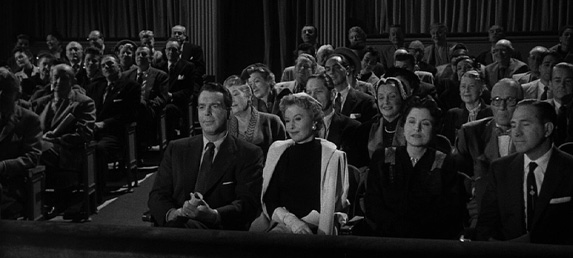
On the Un-Sirkness of Revolutionary Road


After years of complaining that American directors all wanted to be the next De Palma or Scorsese, but nobody wanted to be Lubitsch, the Siren is finally seeing a favorite director get his moment: Douglas Sirk. Of course, Almodovar loves Sirk, and Fassbinder loved Sirk, and Sirk's visual fingerprints are all over something like 8 Women. But in American movies Sirk has been something of a rarefied taste, championed by John Waters but not many others, until recently. He started creeping back around the time of American Beauty (1999), where Sam Mendes and Conrad Hall created a suburb so lush it might have included some fawns wandering past had the filmmakers not chosen a plastic bag. American Beauty was interesting, because many people seemed to walk away liking it a lot, and then at some point, realized they had been had. The Siren will 'fess up to that reaction, since Glenn Kenny was already man enough to do the same. Then there was Far From Heaven, a better movie. Todd Haynes showed some Sirk love earlier than that, in the brilliant Safe, but Far from Heaven was an attempt to make a Sirk movie without the Production Code getting in the way, and it turned out worthwhile, if short of a masterpiece. Now on television there's Mad Men, which tries for The Apartment's bite in the office scenes and Sirk in the houses and bedrooms, though it is about twenty times more dour than either director ever thought about being.

So when the Siren's email turned up an invitation from an extremely nice publicist to go see Revolutionary Road, the Sam Mendes film adapted from Richard Yates' novel, she immediately thought, "Great idea. 1950s suburbia--why, I'll compare it to Sirk. That's what I'll do."

We've somehow been conditioned to look at a lushly photographed 1950s bedroom community and think Sirk, but Sirk's classic late melodramas didn't deal much with the middle class. Frequently his main characters are wealthy or about to become so, as in Imitation of Life, Written on the Wind and Magnificent Obsession. Even All That Heaven Allows, the most suburban of Sirk's movies, shows Jane Wyman as upper-middle enough to be part of the country-club set. Other characters, as with Rock Hudson in Heaven, Juanita Moore and Susan Kohner in Imitation and the flyers in Tarnished Angels, labor physically with varying degrees of enthusiasm. Characters like Frank Wheeler in Revolutionary Road, toiling at medium-paying office jobs that are dependable, but suck the soul, are not as common. Rather, Sirk uses the glittering trappings that his producer Ross Hunter craved, and repeatedly demonstrates that a life of easy material comfort is still a life that American society can smother with appalling ease.

Sirk never met a flourish he was afraid to use, provided it had grace and beauty. The Siren loves nothing better than to sit and watch as the master throws it all at her--angel choirs, mirror shots, splashes of primary color, elegant widescreen shots giving way to close-ups as the music swells, Rock Hudson carrying around a sign marked "Danger," the camera down low to catch every twitch of Dorothy Malone's negligee or Susan Kohner drop-kicking a stuffed animal. The surface is so dazzling the films become subtle, as you are forced to look for the critiques behind the silk curtains.


But here is something that can go ignored in discussions of Sirk: He often does allow individuals their victories. They're trying, good lord they are trying so hard, and Sirk respects that. There's nothing like the exceptional nastiness in American Beauty's depiction of the Marine next door or, for that matter, poor Annette Bening. There are selfish and cruel characters, certainly, like Jane Wyman's children in All That Heaven Allows, but Sirk's camera shows them as stunted and conformist, not as gargoyles. And in the end, as in most classic melodramas, love is allowed its moment of triumph. Jane Wyman and Rock Hudson manage to stay together at the end of All That Heaven Allows. Rock Hudson drives off with Lauren Bacall in Written on the Wind, as they both escape the tentacles of the Hadley money. Rock Hudson breaks through his callow narcissism and finds a vocation, as well as Jane Wyman, in Magnificent Obsession.

You can argue that these endings are intended ironically, but the Siren thinks not. They are shaded, certainly, by what we know about the forces arrayed against the characters, but they are still, as Lawrence Quirk argued for All That Heaven Allows, "paeans to individualism and spiritual freedom." When Sirk needed a tragic ending, he gave us one, as in Imitation of Life, where the characters had to be crushed by the American psychosis about race. To suggest otherwise would be laughably phony, and phony is something Sirk never was. Flamboyant, yes, flashy even--false, never. To find falseness in Sirk means you aren't looking hard enough.

If you try to grasp happiness itself, your fingers only meet a surface of glass, because happiness has no existence of its own, and probably exists only inside yourself.
--Douglas Sirk, quoted in The Bad and the Beautiful


So the trouble with the Siren's game plan was that Revolutionary Road is only partially Sirkian. And that long introduction was a tangent, but as the Siren explained to Glenn Kenny, the urge to discuss Sirk sometimes just takes over. Here we come to that rara avis on the Siren's blog, a new movie.

Revolutionary Road is beautiful to look at, but its visual style (via DP Roger Deakins) is unobtrusive. There are no Mad Men-style "how cool, that is SO period" flourishes. And that's good; you shouldn't be sitting there wondering where can you get a dress just like Kate's. This is a chamber piece, dependent on the filmmaker's ability to draw you into a couple's claustrophobic marriage. Sirk managed that even as he used an extremely strong style, but it is hardly fair to a filmmaker to say he isn't Sirk. The Siren misses the presence of an extraordinary directorial vision, as did Dan Callahan in his perceptive review, but Revolutionary Road is still a good, though not great, movie. Mendes' decision to get out of the way, as Dan puts it, lets the movie swoop in on Kate Winslet and Leonardo di Caprio, both of them as good as they've ever been. The movie is also aided immeasurably by a supporting cast (notably Kathy Bates and a superb Michael Shannon) who must carry a lot of the thematic load, but can do so only in small, telling scenes.


Let it be known that the Siren has not read the book, although now she wants to. Several reviewers have said the movie is a different experience for someone who loved the book, but alas, that is always so. Plot summary doesn't take long. It's 1955. Frank and April Wheeler once dreamed of a life of ideas and importance, leading to some sort of vaguely bohemian, and special, destiny. Now they have two children and live in a house in a Connecticut suburb. April feels life closing in on them; Frank less so, but he certainly feels April's unhappiness. April hatches a plan to ditch it all and move to Paris where she believes, with passionate delusion, she will easily obtain a high-paying secretarial job and Frank will find something to do other than sell stuff he doesn't believe in to people and companies he doesn't give a damn about. As do the characters around the Wheelers, we suspect the plan is DOA. And indeed it is, strangled as Frank's cursory performance at work leads him to a promotion, and April's temporary joy in her marriage leads her to pregnancy. Like the sharks in Moby Dick, the spouses encircle and consume one another, the wife's desperation growing as the husband embraces his fate.

The Wheelers' harrowing arguments are full of the precision cruelty you can experience only with someone you love. Few longtime couples will be able to sit through the scenes without at least one small déjà vu, even if the Siren did frequently wonder why the children never showed up in the middle of things as they do in most small houses. Mendes just ignores the kids as his movie bears down on the marriage. In this world, children are a sideline. They cannot fulfill your life and indeed, their mere existence can ruin it. That is why the Siren found one small part of the denouement out of key, even before she found out that it wasn't from Yates.

Revolutionary Road is a much better movie than American Beauty, simply because you have room to breathe when it comes to how you see the characters. The Siren, for example, didn't find Frank as much of an asshole as many others did. Di Caprio, who's never been able to show menace, sure can show other things. There's the scene where Frank has lunch with his smug, coarse boss (Jay O. Sanders) and asks if the man remembers his father, who worked for the same company for more than 20 years. The boss gives an indulgent smile and repeats the name, as though searching his memory for a lost umbrella, and Di Caprio's look shows us both what Frank fears, and what he will nonetheless become.

Winslet is even better; she breaks your heart. She's grown into her lovely face, which used to suggest a Victorian painting even when she was in a modern movie. Now Winslet can play April and be transparent as rainwater for most of the movie, as in an early scene where she stands in the foyer after Frank has left for work, holding her washrag and staring at the pointless drudgery of the day as though it walked in before he closed the door. We read April so easily for so long, that we do become angry with Frank for turning away from the obvious. Then, toward the end, when April despairs, it's like someone switched off the lights, and in Winslet's face and gestures we can no longer find anything to read. Like Frank and the neighbors, we have to piece together April's thoughts from her final actions.

Sirk's pointed critiques of conformity apply to more than his own time, more than just the U.S. And while at least one crucial plot point in Revolutionary Road is tied to the era, it isn't just a slam at the 1950s. Charles Peguy said the only tragedy was not to be a saint; in Revolutionary Road the tragedy is to discover that you are not an artist. Like Sirk, in David Thomson's phrase, "social decorum smothers love and lovers;" unlike Sirk, in this movie an individual doesn't stand a chance. There's another, and possibly more apt, comparison to be made, with King Vidor's towering The Crowd and its hero who must learn to accept his place among "the seven million that believe New York depends on them." But that movie tells us there is meaning and love to be found in the simple stages of a life--childhood, courtship, marriage, children--and courage in the finding. Revolutionary Road sees each stage as another key turning in another iron door.


(Revolutionary Road opens Dec. 26 in limited release.)

The "12 I Haven't Seen, So Use Them Up" Challenge


So, Dennis Cozzalio of the splendid Sergio Leone and the Infield Fly Rule tagged me with this "12 Movies I Need to See" meme. Now, as I understand it, the original meme was supposed to be about movies that you wanted to see, but could not locate, perhaps in the generous supposition that you've seen all the important stuff that's available. Well, there's a lot the Siren hasn't seen. It is, to be blunt, fucking embarrassing, some of the movies I haven't seen. The biggest gap: no Robert Bresson. Nary a film. You can all log off right now.

But rather than indulge in my own form of Cinematic Humiliation, à la David Lodge, I decided to combine this with another occasional meme from my beauty-blogger pals. This is called the Use It Up Challenge. If you're a beauty-product junkie, you always wind up with a bunch of half-used stuff abandoned in the back of your medicine chest or vanity case, waiting patiently to be taken out and played with again like so many cosmetic Velveteen Rabbits. The Use It Up Challenge asks you to take out the stuff, use it up, recycle the containers and move on with your life. It's a very good thing to do. (Although it has risks. In trying to use up one Serge Lutens perfume, an extraordinarily pungent jasmine scent called A La Nuit, the Siren succeeded in putting herself off jasmine for almost two years.)

So when this homework assignment came up, the Siren's head immediately swiveled from her computer screen to her DVD shelf, and the group of discs she still hasn't watched. It's a diverse and poignantly large group. Poor little guys. They don't ask much, just their chance to strut and fret upon the screen, and instead the Siren keeps tuning into her TCM addiction or her Netflix discs or Netflixing old Columbo episodes (Columbo is what I do for stress, instead of hard liquor) or popping into other people's blogs.

There are the DVDs that the Siren bought, unwrapped and hasn't watched yet, and those are bad enough. But the ones that really reproach her are the unseen movies sent by friendly bloggers. These wonderful guys went to all that trouble, and still I haven't watched. What's wrong with me? I guess I procrastinate a lot. I'd tell you for sure, but I won't be able to ponder it until a bit later in the week.

So here's a list for the Siren's "12 I Haven't Seen, So Use Them Up" Challenge. I am starting this with a handicap, in that I still haven't purchased a DVD player. I'm having a bit of Consumer Anxiety, trying to decide what to get. As soon as this is rectified, however, I am going to watch 'em all, and post at least something brief as I periodically check them off the list.

The first three were received via the kind offices of Mike P., the movie brain known as Goatdog.
1. Heroes for Sale (William Wellman, 1933) Sent to me after I was wowed by Wild Boys of the Road.
2. The Constant Nymph (Edmund Goulding, 1943) Sent to help complete my Joan Fontaine viewing. I read the book as a girl and perhaps that's why I have put it off--it's a tearjerker, if it follows the original story.


3. Christmas Holiday (Robert Siodmak, 1944) Sent because of my kind words for Deanna Durbin. I wanted to schedule this for Christmas but I seem no more capable of watching a Christmas movie at Christmas than I am of finishing all my shopping by Thanksgiving weekend.

The next four came a long while ago via Peter Nelhaus:
4. Blue Swallow (Jong-Chan Yun, 2005) Sent to shore up my shaky Korean film knowledge, without my having to watch someone get tortured.


5. The Curse of the Golden Flower (Zhang Yimou, 2006) Sent because he knows I love both director and star (Gong Li).
6. Exiled (Johnny To, 2006) See #6 (although maybe someone does get tortured in this one, I'm not sure).
7. Letter from an Unknown Woman (Jinglei Xu, 2004) With this one I think I'm just afraid of the comparison to the Ophuls.

This next was received via David Cairns's Duvivier Giveaway.
8. La Fin du Jour (Julien Duvivier, 1939) I will have to get another multiregion to watch it, I'm afraid, but I really want to.

This one was given me ages ago by Girish and somehow I never watched it.
9. The Marriage Circle (Ernst Lubitsch, 1924) God I suck. Why haven't I sat down for this one? It's Lubitsch, for crying out loud.

This one was sent by Flickhead:
10. A Talking Picture (Manuel Oliveira, 2003) Sent because he's a mensch (don't tell him I said so) and because I expressed admiration for Je Rentre à la Maison.

These two were purchased on Glenn Kenny's say-so:
11. L'Argent (Marcel Herbier, 1928) Glenn swore you can read the intertitles with limited French. Let's hope he's right.
12. Make Way for Tomorrow (Leo McCarey, 1937) Actually, this was purchased on the entire blogosphere's say-so.

As a bonus, to keep with the spirit of the original challenge, here are twelve I dearly want to see, but am having the devil of a time finding:

1. No Greater Glory (Frank Borzage, 1934) Of course there's a Borzage. There's always a Borzage. This one is an antiwar allegory based on a novel by Ference Molnar. It's lovingly described in Lawrence Quirk's The Great Romantic Films. (Quirk's volume was one of my first movie books ever and to this day I use it as a reference. If Wikipedia is right, he's about 75 now, and one day I'd like to meet Mr. Quirk and tell him how much his serious exploration of this type of movie influenced my instinct to take them seriously as well.) No Greater Glory is one of the few Borzage movies that doesn't depict a couple's romance. Instead the focus is on the war games played by feuding groups of boys in a lumber yard, and one misfit boy's (George Breakstone) yearning for love and acceptance from his group's leader (Jimmy Butler, who in a painful irony was killed in action in France in 1945).


2. So Red the Rose (King Vidor, 1935) My father preferred this Civil War movie to Gone with the Wind. Dan Callahan's Senses of Cinema article on King Vidor (do click, Dan is worth reading on any topic) says the movie portrays slavery in a far more complex way than Selznick's opus, which might explain why it failed at the box office. It was such a complete disaster, in fact, that no one would touch a Civil War movie for a number of years afterward. Not available in any format.

3. Only Yesterday (John M. Stahl, 1933) Margaret Sullavan in a loose adaptation of Letter from an Unknown Woman. People who have seen it are unanimous in praising it. Apparently stuck back in whatever hidey-hole Fox has put a bunch of other Paramount movies.

4. The Crash (William Dieterle, 1932) Ruth Chatterton was a remarkable actress, stage-trained but perfectly in tune with the camera. She bowled me over in Lilly Turner, Female and the great Dodsworth. I want to see more.

5. Un Carnet du Bal (Julien Duvivier, 1937) Along with Pepe le Moko, one of the movies that put Duvivier on the map. Not available. Why?

6. Safe in Hell (William Wellman, 1931) My respect for Wellman just keeps growing. This one has popped up in repertory houses and at least once on TCM but I haven't seen it yet.

7. Les Visiteurs du Soir (Marcel Carne, 1942) Because Children of Paradise is one of my favorite movies of all time. As far as I know, not available on DVD in any region. I will probably resort to getting it on VHS at some point.

8. La Traversée de Paris (Claude Autant-Lara, 1956) Available in France but not with subtitles.

9. Floating Clouds (Mikio Naruse, 1955) Available in a French DVD and a BFI edition, in both instances packaged with two others I have already seen, which means that on my budget I don't want to stomach the exchange rate. If I hear one more time that Criterion is working on this one I will scream. Promises, promises!

10. The Private Affairs of Bel-Ami (Alfred Lewin, 1947) Lewin was a true talent and this is said to be one of George Sanders' best performances. Will probably resort to VHS for this too.

11. Summer Storm (Douglas Sirk, 1944) Not available in any format.

12. The Blue Veil (Curtis Bernhardt, 1951) Incredibly rare. One IMDB user claims to have spent more than $1,000 trying to locate a watchable copy. Never released on VHS either. Stars Jane Wyman, who isn't a favorite of mine, but also Charles Laughton and Joan Blondell, who certainly are. Curtis Bernhardt directed A Stolen Life and Sirocco, both of which I liked.

I was going to list What Price Hollywood? (George Cukor, 1932), but to my utter delight, this one is showing Oct. 1 at 11:45 pm on TCM. So that's my deadline for fixing the DVD recorder situation.

I'm not sure there is anyone left to tag, but if you want to keep me company and fess up to the DVDs you own, but need to Use Up, by all means do so. And if you haven't contributed to this meme, or its variations, by all means do so.

(Pictures, from top to bottom: Peter Lorre, as fellow bloggers demand to know why he has been neglecting Bresson. Kidding. It's him in Crime and Punishment. I haven't seen that one either. Next, Christmas Holiday: Gene Kelly and pal want me to watch this one before Halloween, Deanna just wants me to watch it. The Curse of the Golden Flower, also know as Gong Li Displays Entirely New Assets. So Red the Rose--probably not a good one to watch if I'm in a firebreathing political snit. Finally, The Private Affairs of Bel-Ami, which was clearly a feminist polemic.)

(Updated & corrected 9/23. Thanks J.C.)

Credit Where Credits Are Due

There's an amusing clip travelling the Internet, of Star Wars credits as rendered by Saul Bass. It's well done, even if Bass would have cleaned up the spelling, but it reminded the Siren of something she misses in current Hollywood movies, along with great character actors, intertitles that tell her things like "meanwhile, as the lava approached the little fishing village" and editing that lets her actually focus on a beautiful shot for a moment: credits.


A good credit sequence puts your head in the right place, whether it's the great "wooooooo" of wind at the beginning of The Wizard of Oz or the man on crutches, steadily advancing toward us at the beginning of Double Indemnity. For a while there our contemporary directors were jettisoning the whole notion of credits. You'd maybe get a title card and then THUMP, in media res. The Siren likes this approach to movies about as much as she does to romance. Lately we are edging back toward real credit sequences but there's still a desultory quality to a lot of them. Put some pizazz in it, fellas.

So, the Siren finally figured out this embedding wheeze. To celebrate, she's sharing two of her all-time favorite credit sequences. The first, by Wayne Fitzgerald, sets the mood perfectly for one of the great movies of the 1950s, a movie the Siren worships, along with a (perhaps) surprisingly large number of women her age and younger.


And, just as a bonus, the Siren's favorite Saul Bass credit sequence. She even prefers these credits to Vertigo. If you go on Youtube you can watch the scene where the great Brook Benton sings the lyrics to the title song. Take that, Mr. Reed.


Postscript: Only fair to add precisely what it is the Siren likes about these sequences.

When you walk in off the street and sit down in a movie theater, and the lights go down (at least, we hope they go down, as the Siren also detests the modern tendency to leave the lights on during the previews so you can go get those Milk Duds) you need a mental adjustment. Then or now, you've been sitting through a bunch of other stuff on screen. At the start of the golden age it would have been a cartoon, a newsreel, a lower-bill feature; later, maybe a cartoon and trailers; still later, commercials (ugh) and trailers. Afterward you need to get your brain in gear for the Big Picture.

A good credit sequence functions as an aperitif. It gets your viewing palate ready. It should be long enough to ease you into the right mindset, but not so long you're thinking "enough already," which mars the occasional Bond credits, good as they usually are. The credits shouldn't tip the movie's entire hand, as with Austin Powers or Down With Love, two movies that employed retro credits but like kids at an ice cream parlor, piled on scoop after scoop until the rest of the movie just became a slightly more elaborate version of the start.

The first sequence above is nearly perfect, in the Siren's view. It prefaces a movie that has the surface of a glossy melodrama, the plotlines of a tragedy and the theme of the most divisive, perpetually unresolved American conflict of all, race. None of this is explicit, but the credits prepare you for it. There's the slightly smoky voice of Earl Grant singing a smooth but melancholy song, and a waterfall of white, imitation jewels flashing colored light against a jet-black background. Grant's singing sounds so much like Nat King Cole that you get an added layer of "imitation," whether intentional or not.

The second credit sequence is so good that reportedly viewers would go into the theater, sit through the credits, then leave because the rest of the movie was all downhill. In a sense they were right, as this Edward Dmytryk movie isn't one of his best, although the Siren finds it better than its reputation. The film is marred chiefly by one of the worst performances Laurence Harvey ever gave. But what's good in the movie is there in the opening--the sexy strut of supporting player Jane Fonda, the quietly prowling visuals, and Barbara Stanwyck being fiercely territorial. And what's phony is there too, as the cat is strolling through some of the cleanest alleys you ever saw.

Do follow Goatdog's example in the comments and link us up to any favorite credit sequences of your own. If you post them on your blog and give the Siren a heads-up, she'll link 'em right here.