
Historical movies fall into one of three categories. Some strive for meticulous accuracy, some leaven accuracy with a few liberties. Then there are those that frankly don't give a damn beyond costumes and sets--and so it was with Affairs of Cellini, the 1934 Gregory La Cava film. This odd comedic swashbuckler sits right near the start of the director's great run of films up to 1941's Unfinished Business. Despite the 16th-century trappings it does fit with the later films, if you figure that instead of monkey imitations, you're getting little bursts of swordplay. It's based on a play by Edwin Justus Mayer, "The Firebrand," about which the Siren knows nothing. Presumably it drew from the Autobiography of Benvenuto Cellini, which the Siren read in abridged form years ago. And the movie is somewhat less weird than the book, which as the Siren recalls had Cellini swearing he saw halos and had clairvoyant visions and conjured up a bunch of devils in the Colosseum in order to get back a mistress who had gone home to mother.
The movie was still pretty weird, though. Supporting player Fay Wray recalled years later, "It had a certain amount of charm, even though it was a little wacky." The Siren couldn't have said it better herself. The rather murky plot doesn't reward much summary, involving as it does Cellini's need to maim and murder various Florentines whom he finds annoying, the Duke de Medici's need to punish Cellini for doing so, and everybody's need to find someone wholly inappropriate to sleep with.
So what was so wacky? Well, the supporting players obliterate the lead, for one thing. Fredric March was a longtime scene-stealer himself, but he doesn't seem comfortable with this character. Instead he glowers from underneath masses of dark curls and moves like he's trying to convince himself the doublet is an English-drape suit. Which is a shame, because March's legs looked great in tights, something that can be said of very few actors. Maybe (here the Siren indulges in idle speculation) maybe March, one of Hollywood's staunchest liberals, had a bit of trouble finding a way into playing an artist, even a great artist, who wrote with perfect sang-froid about beating the hell out of his mistresses and was also a viperous court intriguer, (possible) political assassin and plain old murderer. But the problem is less with March, a fine actor, and more that the script marginalizes its own title character. Cellini's art is confined to one scene in his workshop where he's making his assistant do all the labor. He's reacting to the plots of others as much as he's doing his own scheming, and Cellini's lines aren't as funny, either. And that's also a shame, because March could time a joke to the millisecond, as he showed in Design for Living and Nothing Sacred.
One of the few lines March really gets to tear off is "For your own sake, don't be any dumber than is absolutely necessary"--spoken to Fay Wray, who's playing Angela, an artist's model of wondrous stupidity. Wray, to whom the Siren had never given much thought one way or another, is unexpectedly funny in this simple part. She doesn't have snappy lines; instead she gets laughs just by sticking to the unflappable demeanor of a person who seldom gets upset about anything because she never understands what the hell is going on. Angela sucks the crumbs off a finger or picks at her sleeve, stares off into the middle distance, finally tunes into the conversation, listens patiently and then, having visibly decided that the man isn't saying one thing worth hearing, goes back to whatever constitutes her inner life. The longer Angela stuck around, the more the Siren enjoyed her, and she was often more interesting than Cellini.
The movie's primary flaw, though, was the Duke de Medici. Frank Morgan's Best Actor nomination for Affairs is often cited as a reason why the Academy needed a supporting category, proving that this unavailable-on-home-anything movie hasn't been seen much. Morgan's got almost as much screen time as March, and his performance dominates the movie. Which is not a good thing, or at least the Siren didn't think so. Understand, the Siren finds the actor delightful in many things, including The Shop Around the Corner (easily his best work), Bombshell and The Wizard of Oz. But if you saw Oz (and hasn't everyone?) you will immediately recognize Morgan as de Medici. It's the same performance. The stammering, the stop-and-start motion, the furtive looks, even the humbug. There are some places where the tricks are still funny, particularly in his dinner scene with Angela. The Duke tries to slide one raddled hand up Angela's arm and Wray looks at him like he's picking his teeth with his fork: "What are you doing that for?" Great line delivery by Wray. Angela really does want to know why his hand is on her arm. She really is that stupid. Responds Morgan, as baffled as his seduction target: "Doesn't that make you, ah, burn and tingle?" And then, later, from Morgan: "Would you like some more peacock tongue?" (Technically this was post-Code. Not sure how that line made it in there.) "Yes, milord." Responds Morgan, like a lecherous Santa Claus: "Don't call me milord. I'd prefer that you call me Bumpy."
Mostly, however, Morgan is just tiresome, fluttering everywhere and being such a ninny that you never have a moment's suspense thinking he's any threat to anyone. Louis Calhern (miles from The Asphalt Jungle, but you'd know that nose anywhere) has some Rathbone-esque bite as the Duke's cousin, Ottaviano, but he isn't around enough to build up a sense of menace.
Thank god for Constance Bennett. The other characters may be dumber than one of Cellini's plates, but Constance is smart enough for the entire movie. The usual routine for swashbucklers, even semi-sorta-swashbucklers like this one, is a fiery heroine with a nice line in flashing eyes and snappy comebacks, who spends the first part of the movie telling the hero he's a common pirate, thief, musketeer, ruffian, whatever. Here, however, we have coolly adulterous Miss Bennett as the Duchess de Medici, more Snow Queen than spitfire. As usual, Constance is the most wised-up person in the picture, going after Cellini and manipulating everyone in sight. Also as usual, Constance was the Siren's favorite, giving just the right cynical touch to the picture's best lines: "The tragedy of all great ladies is to discover that the men with the most exaggerated reputations make the poorest lovers. That is the reason we probably marry half-wits." Bennett always seemed ineffably early 1930s, no matter what decade the movie was filmed or set in, and here her silky walk and line deliveries would fit nicely in a later La Cava picture. She's delightful, sweeping into the apartment that the Duke has set up for his adulterous tryst with Angela, pretending to think it's all for her and maliciously complimenting him on every detail.
Constance, along with March's tights, also provides the dose of sex the movie needs. Watch her sink onto a couch as the slinky dress fabric outlines her legs all the way to her ass. The movie looks good, if not great, with sumptuous sets and a few fight scenes that show La Cava's ability to film chaos and make it coherent. Overall, however, if the Siren watched it again, it would be for Constance, sashaying off at the end, ready to keep out-conniving one of the Renaissance's greatest heels.

Imitation of Life and The Oscar lead, in the Siren's convoluted mental Hollywood, to Merle Oberon, the lady who gives out the Oscar in the latter's finale. In her early roles, like The Private Life of Henry VIII and These Three, Oberon had one of the most exquisitely, symmetrically beautiful faces in the history of movies. A perfect oval shape, a nose and mouth balanced just so and breathtaking eyes.
But here is the Imitation of Life twist, no great secret anymore: Oberon's mother was a dark-skinned Ceylonese woman named Charlotte Selby. Some say Charlotte was actually her grandmother, complicating matters; but she raised Merle, and Merle appears to have thought Charlotte was her mother. In any event, Oberon, née Estelle Merle Thompson, spent her life hiding her heritage from Hollywood and the world.
A modern person gazes at the features that columnists called "exotic" and can't figure out how Oberon managed a 40-year career without anyone wising up to the fact that she was half-Asian. And, in fact, she didn't keep it from everyone. The rumor about Oberon's parentage was around for years before it was confirmed in the 1980s by writers Charles Higham and Roy Moseley and by Michael Korda, her nephew by marriage, among others.
Unlike Sarah Jane, Oberon didn't abandon the woman she thought was her mother. She provided for her, stashing her in a flat in London, visiting her and paying all her bills. Oberon lived in glamourous digs that contained no nostalgic pictures of little Queenie, as she was nicknamed in childhood, in her mother's arms. When in London, Merle never said to a friend, "I'd like you to meet my mother." It is said that when visitors asked, Merle pretended Charlotte was the maid.
The Siren likes actors, and even when she doesn't, she admires them. Most of them. When I trouble to write at length about an actor, occasionally I start out rather cool, but I almost always end by feeling affection.
I feel no such affection for Oberon. But she intrigues me no end. How do you reach that point in your ambitions--the point where you'd deny your own mother?
Wikipedia has a odd little phrase in its lengthy and tortuous Merle Oberon entry: "She believed the truth would have destroyed her career prospects." Believed, rubbish. Without question the truth would have kept her from playing leads, thanks to the Production Code's miscegenation clause. No Anglo-Indian woman would ever have played Catherine Earnshaw in 1939. In fact, that casting would cause grumbling in some quarters in 2010, albeit carefully phrased in terms of history and plausibility.
Lena Horne tells of how in her early days, showmen said she was light-skinned enough to play Latina or white. Horne snapped back that she was also dark enough to be what she was. Horne had the courage. But Oberon had the stardom.
If Oberon would not acknowledge her mother in public, neither did she leave her to fate. Her mother was cared for, but concealed. And the Siren will always wonder, how did Charlotte feel, day by day? Was it enough to be provided for by her dazzling daughter, or did that make it worse?
She had a hardscrabble childhood, did Merle, one that she pulled herself out of by becoming a companion to older, wealthy, well-connected men. Whether that extended to outright prostitution is another Oberon mystery. But she worked her way to London and hitched her wagon to Alexander Korda, marrying him some years later.
Oberon became a star, but not a great actress. Oh, she was just right on occasion. Under William Wyler's steel hand she was perfect for These Three, impossibly lovely and poised, the very essence of the things that will always elude Miriam Hopkins. Her character is the sort of woman to whom fate will always lend a hand, because she is beautiful, because men adore her.
She played the same kind of part in The Scarlet Pimpernel, yet made Marguerite more sympathetic than she was in the book. She had a brief affair with Leslie Howard and a more serious one with David Niven. The Siren can't tell you whether Niven, a canny mortal and a world-class gossip, knew. If so, it did nothing to diminish her appeal for him at the time; but he didn't marry her.
During the 1937 filming of I, Claudius Oberon, who'd been cast as Messalina, was in a car accident that sounded the production's death knell and gave us one of the great "what ifs" of movie history. Her face was badly cut and required surgery. In later movies she is still a great beauty, but the pure perfection is gone.
The decade wound down with The Divorce of Lady X and closed with the biggest role of Oberon's career, Cathy in Wuthering Heights. She is appealing in that romantic movie, enough to make Laurence Olivier's love believable, but she lacks the wild, deeply unnerving passion that is the essence of Bronte.
Later good parts for Oberon came in That Uncertain Feeling and Lydia. Some sources claim an allergic reaction to sulfa drugs, compounded by dermabrasion afterward, further marred her looks. She made movies throughout the 1940s, including a preposterous piece of biopic casting as George Sand in A Song to Remember. She also made the very good Jack the Ripper thriller, The Lodger, where she met the great cinematographer Lucien Ballard and eventually married him. He invented a light to help keep the illusion of Oberon's beauty. Still, toward decade's end she began to experience the fading appeal that is the lot of most actresses.
Charlotte Selby, whether mother or grandmother, died in 1937.
As her roles dwindled Merle had compensations. She collected jewelry, she had parties, she painted pictures of flowers. She eased into a jet-set lifestyle, adopted children, and finally moved on to retirement with the Dutch actor who eventually moved on to Audrey Hepburn.
Her filmography consists of roles as love objects of varying degrees of fragility and refinement. You have to look hard in an Oberon performance to find any glint of the iron will that could take a woman from squalid beginnings, to Calcutta nightclubs, then to London, then to Hollywood, and finally to international society, all the while living Sarah Jane's lie. The Siren has never managed to spot it. Each time I see an Oberon movie, I get a thrill from her beauty, but no hint of the riddle's solution. Was she a Scarlett O'Hara who was never going to go hungry again, one to be pitied for the choices racism foisted on her? Or just a Fane-type conniver plying her primary gift, her face, for whatever advantage it would bring?
June Duprez had an opinion, and she expressed it at length in John Kobal's People Will Talk. Duprez had memorable roles in two of the Siren's favorite movies, The Four Feathers and The Thief of Baghdad, but her stay in Hollywood was a miserable one partly, she said, because Oberon backstabbed her. Oberon went out of her way to snub Duprez, and may also have done her best to see that the rest of Hollywood society snubbed the young actress as well. Maybe, said Duprez, it went back to the time that they both showed up at a party in London wearing a white lace dress and a diamond necklace.
Well, Duprez resembled Oberon, but Duprez was seven years younger. That alone could earn an actress's grudge.
Or maybe Duprez needed to cast a single villain in a role that belonged to sheer bad luck. By the time Duprez talked to Kobal, Oberon had been dead for six years, felled by a stroke in 1979.
Now we all hear a lot about the pain and pathos of stardom. Some stories are tragedies by any definition: Wallace Reid, Clara Bow, Rita Hayworth, Gene Tierney, John Garfield, Canada Lee. Other actors' laments leave you thinking that ordinary people make sacrifices, too, only with less fuss and far fewer rewards.
Oberon's life was no tragedy; her mother's, perhaps, was.
 We've had several lively discussions of the Production Code Administration, so the Siren was eager to read Hollywood's Censor, Thomas Doherty's biography of PCA honcho Joseph I. Breen. Doherty is a good writer and the book is intelligent and amusing. He obviously developed a real affection for his subject, and if the Siren in no way came to share that affection it's no reflection on Doherty. This is, however, a frustrating book. Like a pre-Code film shredded for later release, it's the things left out that are the most tantalizing.
The author is probably the first to write of Hollywood's head censor without condescension or smirking, pointing out that Breen genuinely loved movies and saw his role as more of a script advisor than anything else. Contrary to the picture many people have of classic-era Hollywood censors, the PCA's chief role was to vet scripts, not scissor prints. Most of Breen's work consisted of horse-trading with the producers and screenwriters, haggling over word choice and suggesting ways to comply with the Code's various strictures. Those rules enforced a rigidly Catholic sensibility, one with strict views about sin, repentance and redemption. If other faiths countenanced such things as birth control and divorce, the Catholic Church did not, and so for the duration of Breen's tenure they were virtually unknown in Hollywood movies as well. Doherty, while giving full measure to Breen as a particularly rigid example of what he calls "Victorian Irish," also wants to correct the image of the censor as a dimwitted bluenose. As a movie lover, Breen had taste; his letters to Charlie Chaplin when vetting The Great Dictator practically grovel, as Breen apologizes repeatedly for presuming to scissor genius. (But presume he did, as Breen reminded Chaplin that the word "lousy" was forbidden.) One of the few moments when the Siren felt real warmth toward Breen came when she read the glowing praise he sent to Orson Welles after viewing rushes for The Magnificent Ambersons. And while Breen left himself open to mockery, then and later, with his finger-wagging over things like Nick and Nora's king-sized bed, his chief desire was what a later generation would call "deniability." If Ernst Lubitsch's Angel presented a well-appointed "salon" where ladies offered "an amusing time," that was fine. The audience could see a brothel if they liked--Breen's chief concern was whether the up-front appearance was clean. The most talented filmmakers learned to smuggle the smut.
It's become so common over the last few decades to discover the clay feet of moral arbiters, from Jim Baker to Eliot Spitzer, that it's pleasant to hear Breen had no such personal failings. He was a faithful husband, good father to six children and restrained in his personal habits, a man who neither overindulged in alcohol nor partied till the wee hours with his fellow Hollywood Irish. Those searching for censorable qualities in the censor will find only a dedicated smoking habit and salty language--that is, aside from the several historians who have alleged something darker.
"These Jews seem to think of nothing but money making and sexual indulgence," wrote Breen in 1932 to a Jesuit priest, continuing with phrases such as "the scum of the scum of the earth" and "dirty lice." Doherty says the priest refrained from responding in kind, as did another priest, Martin J. Quigley, when Breen wrote him that same year to say "these damn Jews are a dirty, filthy lot." Doherty doesn't try to pretty up the correspondence. He does point out, however, that at this time "blunt slurs were lingua franca at most levels of American society." Doherty also says that the really intemperate language disappears from Breen's correspondence after about 1934, about the time that the Hollywood studio heads consented to enforcement of the Code. (There is an excerpt from the book online that discusses this controversy.)
"Rabid antisemitism is a full-time job," Doherty asserts. "If Breen were a frothing bigot, if his hatred of Jews were passionate and pathological, the fever would infect his entire life and writings, not only a handful of letters written in the early 1930s." Well, no. Bigotry is nothing like a full-time job. Perhaps the key there is the adjective "rabid," but the Siren doesn't think anyone was suggesting Breen's antisemitism was in line with Nazi eliminationism. Everyday prejudice can be quite passionate, and it is situational, something to be brought forward when you need it and denied when you don't. If--just as a hypothetical, of course--you are promoting a movie about the last hours of Christ's life and you want as many tickets sold as possible, why then you have nothing but respect for the Jewish people. Even in solitary moments away from the camera you may convince yourself of your own broadmindedness. When, on the other hand, you are knocking back a few at a bar, get pulled over on the highway and fumble through your alcohol-sodden brain for the reason you are not being treated with the deference you expect, time to trot out the Great Global Jewish Conspiracy, natch.
The Siren has some other questions about whether Breen deserves the antisemite tag that has followed him for some time. Most of her queries come from re-reading another book in tandem with Doherty's. Hollywood Goes to War, by history professors Clayton R. Koppes and Gregory D. Black, was published in 1987, and because the Siren hasn't access to the original correspondence from Breen she doesn't know whether their scholarship has been superseded. But here is an interesting passage:
The conservative head of the Production Code Administration [Breen] was deeply suspicious that Jews in Hollywood, chiefly writers, were trying to use the Nazis' treatment of Jews to make propaganda pictures. He felt the center of this conspiracy was the Hollywood Anti-Nazi League, which was, he said, 'conducted and financed almost entirely by Jews.' Their response to the Spanish Civil War was to vilify [sic] 'the communistic loyalists.' Indeed, Breen feared an attempt to 'capture the screen of the United States for Communistic propaganda purposes.' The censor said he had been able to eliminate all attempts at propaganda thus far, but it was increasing at an alarming rate.
Koppes and Black are quoting a private letter from Breen to Jesuit priest Daniel Lord, who wrote the original Code with fellow priest Martin J. Quigley. This letter was written in 1937, five years after Breen's first burst of slurs and a year after Breen attended a banquet for the anti-Nazi exile and prominent Catholic Prince Hubertus zu Lowenstein. Doherty contends that Breen supported the Hollywood Anti-Nazi League, which was left as left could be although Breen most assuredly was not. Doherty's evidence for this is that Breen attended the League's first-year anniversary celebration, as well as the Lowenstein banquet. Koppes and Black, on the other hand, depict Breen going to Rome, script for Idiot's Delight in hand, and having the Mussolini government vet it. This trip took place in 1938, after the invasion of Ethiopia and after Rome had passed antisemitic laws based on those of the Nazis.
 Doherty tells of Breen writing thoughtful letters of support to Lord and another priest, Joseph N. Moody, after they wrote pamphlets urging Catholics to turn away from antisemitism. At the same time, Koppes and Black have Breen writing in 1938 to Walter Wanger about a screenplay then called "Personal History," later to become Alfred Hitchcock's Foreign Correspondent. Breen told Wanger that "in the opinion of the PCA, the script contained 'pro-Loyalist propaganda...pro-Jewish propaganda, and anti-Nazi propaganda...[which] would inevitably cause enormous difficulty, when you come to release the picture.'"
Doherty doesn't recount the long journey of Foreign Correspondent to the screen, but he does quote a letter from Breen to Warner Brothers when that studio was about to greenlight Confessions of a Nazi Spy, one of Hollywood's first openly anti-Nazi films. Breen's note, which warns that the film will run into trouble in Germany, sounds "pro forma" to Doherty, telling the Warners things they already well knew.
So there is a question of interpretation. Late in the 1930s, was Breen going through the motions as an adviser to the industry, as Doherty says, or actively striving to keep the politics off the screen, as Hollywood Goes to War sees it? It is quite true that the PCA, which saw its job as working in tandem with the studios and not against them, was merely pointing out some economic facts of life to Wanger. It's also true that Wanger needed no reminding, and that in 1938, well after the Nuremberg laws and mere months before Kristallnacht, it rings an odd note for a supposed Anti-Nazi League supporter to be writing to a producer about "pro-Jewish propaganda."
We seem to have a mess of contradictions here, but then again, maybe not. The Siren understands Doherty's desire to balance the picture of Breen--to our eyes, almost seven decades after Auschwitz, antisemitism is the purest kind of evil. As Doherty points out, it is difficult to see how common certain prejudices were and to recognize that not all antisemitism was the direct equivalent of Nazism. But, even if we accept Doherty's interpretation of Breen's late-1930s activities, the Siren still doesn't find Breen's alleged mellowing at all inconsistent with his earlier proclamations. His later dealings with the Hollywood moguls were more pleasant, so Breen was too. Doherty does acknowledge this: "A cynical reading would conclude that the Irish bigot was smart enough to keep his true feelings to himself and suck up to the men who were buttering his bread. Or one might conclude that, on balance, the venom was a transient spasm, the product of a hot temper and simmering frustration."
All righty then. Call the Siren a cynic.
Since Doherty's book is bringing forward an important piece of Hollywood history, the Siren wishes the book spent less time with tales we've all heard many times, such as the fusses over Ingrid Bergman's affair with Rossellini and Jane Russell's breasts in The Outlaw. Hughes' battle over the Billy the Kid movie had important implications, it is true, and there's no way to leave it out, but the movie itself is lousy. The Siren would have trimmed some of the ink devoted to those episodes in favor of discussing, for example, Breen's permanent scissoring of various pre-Code films and locking up others altogether.
 One episode new to the Siren was Breen's role in how Gone with the Wind expunged Margaret Mitchell's frequent use of the "n" slur. Doherty contends that the depiction of African Americans actually improved with the institution of the Code. The Siren would love to see this discussed at more length by Doherty, because it's interesting and new to her. Doherty grants that after the institution of the Code, mainstream Hollywood's roles for blacks narrowed almost completely to comic relief, until small improvements began in the early 1940s. But he argues that Breen's office enshrined one uniform stereotype of black Americans, thus ridding the screen of the "slack-jawed simians" that were common to silent film and pre-Code movies. The professor wrote a history of pre-Code Hollywood, next up on the Siren's nighttable, so he must feel that sympathetic pre-Code movies such as The Emperor Jones and Hallelujah! were vastly outweighed by the loathsome depictions in other films. Certainly Breen seems to have relished playing the broadminded good-cop to some of the South's more racist censors, including Memphis's Lloyd T. Binford, who banned the innocent Hal Roach comedy Curley because it showed a class with black and white students.
The notorious "miscegenation clause" was inserted in the third draft of the Code in 1930 by persons in the Hays office whom Doherty does not name. The two priests who wrote the code, Quigley and Lord, were infuriated by its inclusion and said so to Breen. Doherty doesn't record Breen's response, but notes that any picture with an interracial angle of any kind would never have played in segregated states. After the war, some loosening of racial attitudes began. Doherty says the federal Office of War Information's harping on the theme of a united America "opened the eyes of the Breen Office to its racial blind spots."
To which the Siren responded, "You don't say." The "national feelings" clause of the Code said "The history, institutions, prominent people and citizenry of other nations shall be represented fairly." This worked fine if you were German; the files are full of Breen and OWI admonishing producers not to depict all Germans as Nazis. It worked even better if you were from what Doherty calls "the most-favored nations of Ireland and Italy." Even the Chinese did all right, if they could tolerate being played by Katharine Hepburn and Walter Huston.

If, however, you were Japanese, you were out of luck, whether or not you were a fascist. And that's something Doherty discusses not at all.
This isn't merely the Siren applying latter-day liberalism to another era. As Hollywood Goes to War points out, there were movie fans at the time who found Breen's standards puzzling, like the woman who wrote him after hearing that the censor planned to delete "hell" from the lines permitted General "Vinegar Joe" Stillwell in Objective Burma. Why, she asked reasonably, was the general's language being scrubbed when "she heard the Japanese referred to again and again as 'dirty yellow rats,' 'blasted monkeys,' and the like"? Breen eventually passed on "hell" as an exact quote from Stillwell but drew the line at "by God."
 Another speech, however, passed without a murmur. After Errol Flynn's character discovers the bodies of his friends, mutilated after hideous tortures by the Japanese, a newspaper correspondent spits out, "They're degenerate, immoral idiots. Stinking little savages. Wipe them out, I say. Wipe them off the face of the earth." Flynn says nothing in response.*
This was passed by the Breen Office, without any cavils at needing "good Japanese" or any other balance. All you have to do is spend an afternoon with a few WW II movies set in the Pacific theater to realize that under Breen, the PCA strictures to respect other nations simply did not apply to Japan. It was the studios who churned out the racist films. But Breen, who objected when the first draft for Fritz Lang's Man Hunt showed all Nazis as "brutal and inhuman people," self-evidently enforced no such even-handedness for the eastern half of the Axis. If Doherty is going to say, as he does, that Breen "silenced the sounds of racial invective," then the sounds of scripts calling the Japanese "monkeys who live in trees" (in Guadalcanal Diary) need to be talked about, too.
Overall, while the Siren enjoyed reading the book for Doherty's deft writing and extensive research, she disagrees with the general premise, summed up in the last chapter, "Final Cut: Joseph I. Breen and the Auteur Theory." Films of the classic age are cherished, Doherty says, because of a "longing for the certainty of standards and the security of tradition, and an affinity for a mannered time where curse words, nudity and bloodshed are banished, where bedrooms are for sleeping and bathrooms are unmentioned." This sounds suspiciously like Dume3's acid comment on a prior Siren post about the Code, that some people like old movies "because they're clean." The Siren likes them because they're good--because the studios, aided by a magic combination of lack of competition, vertical integration and an ability to throw money at some of the world's most talented people, produced literate, interesting, visually beautiful movies. The Siren is no more going to thank Breen for the vision behind those movies than she's going to write to the printers at Penguin Classics to thank them for the layout of Great Expectations. He was a technical obstacle, not a creative talent. The moral vision that Breen worked into classic-era movies often feels tacked on, as in John Garfield's ludicrous explanation of why it's all right to execute him for the wrong murder in The Postman Always Rings Twice. And the Siren really doesn't think Lubitsch--or, for that matter, Ben Hecht, Billy Wilder or the Epstein brothers--needed Breen to make them more subtle or delicious.
There's a cute picture of Breen on the cover of this book, showing Hollywood's censor yukking it up with some starlets on the set of a Baghdad-and-boobs epic. It's meant to show that he was no bluenose. In another pronouncement, however, the Siren hears a far more convincing dose of the man's real personality: "If at any time you are a bit foggy as to what constitutes honor, purity and goodness or where sophistication stops and sin starts, I'll tell you."
*Screenwriter Alvah Bessie, of later Hollywood Ten fame, had written a reply for Flynn's character that said the violence was fascist, not inherently Japanese. But producer Jerry Wald cut it.
(From top: Joseph I. Breen; The Great Dictator; Foreign Correspondent; Hattie McDaniel in Gone with the Wind; Objective, Burma!)
 The Siren may not have posted much over the last month, but she did manage to watch a fair number of movies, for a change. December was William Wellman month on TCM, a happy development. You can add William Wellman to the Siren's list of Favorite Directors With Shaky Auteur Status, along with Mitchell Leisen, Jean Negulesco and the award-laden but Cahiers-dissed William Wyler. The Siren saw Night Nurse ("You mother!") and rewatched a bunch of old favorites (no amount of Mr. C's pointing out what the Foreign Legion was really like can dim the Siren's love for Beau Geste). The revelation, however, was Wild Boys of the Road, an uneven but sporadically brilliant movie, sort of what might happen if you sliced out two scenes from an Andy Hardy film and used them to bookend They Shoot Horses, Don't They?.
After watching a Depression-era movie the Siren often turns to one of her favorite works of social history, Since Yesterday by Frederick Lewis Allen. Published in 1940, the book has the advantage of immediacy, and the Siren hasn't read anything that betters Allen's descriptions of daily life in the Terrible Thirties. Still, it must be admitted that Allen is not especially good on the movies, drawn as he is to prestige pictures. Here's his introduction to an aside on Hollywood's output:
As for the movies, so completely did they dodge the discussions and controversies of the day--with a few exceptions, such as the March of Time series, the brief newsreels, and an occaisonal picture like I Am a Fugitive From a Chain Gang and They Won't Forget--that if a dozen or two feature pictures, selected at random, were to be shown to an audience of 1960, that audience would probably derive from them not the faintest idea of the ordeal through which the United States went in the nineteen-thirties.To which the Siren responds, "yes and no." Back we go to the Pre-Code debate below--the crackdown in 1934 had the not-so-coincidental effect of trimming back overt social critiques. From that point on, escapism became the far more dominant mode for big-budget Hollywood productions. But if you watched enough genre movies, you still might get a clear enough picture, and if you watched pre-1934 films you would definitely know how hard the times were. And Joseph I. Breen locked up a lot of Pre-Code movies, so Allen's memory of early 1930s cinema may have faded. Wild Boys of the Road, from 1933, offers a particularly bitter and, the Andy Hardy ending perhaps excepted, accurate indictment of the Depression's cruelties.
The beginning of the movie might fit more comfortably in Only Yesterday, Allen's history of the 1920s. Eddie (Frankie Darro) and Tommy (Edwin Phillips) are teenagers concerned with cars, girls and getting into the local dance. Tommy, whose mother takes in boarders, is barely clinging to the middle class. Eddie has his own car and a father with a steady job. But Eddie soon comes home to find his parents talking quietly and desperately at the dining room table: the father has lost his job. Eddie sells his beloved car for scrap, but despite handing the $22 he makes over to his father, he can't find anything steady to help at home. Unwilling to become a burden on their parents, he and Tommy decide to light out for the territories by hopping freight trains.

Wellman filmed the boy's wanderings on location, and the decision gives the long middle section of the film a depth and darkness the Siren has seldom seen in American movies of the era. The two main actors were quite petite, and Wellman plays this up when filming the dangerous task of getting on and off the trains. The sense of peril, of the speed and size and impossibility of stopping the moving train, makes you realize how something like Sullivan's Travels has glossed over the difficulties. (Wild Boys renders train-hopping several times more terrifying, for example, than watching Tony Curtis and Sidney Poitier in The Defiant Ones.) The cars themselves are dark, cold and offer no protection from predators.
Once on the train the boys meet fellow drifter Sally, who is hopping freight trains disguised as a boy. (Sally is played by young Dorothy Coonan, whose later marriage to Wellman lasted 42 years and produced seven children). There's a humorous bit where Sally, unjustly accused of stealing food, lands a hard blow on Eddie's face that sends him scampering to the other side of the boxcar, even as he realizes he's just been hit by a girl. But Wellman still films this in a way that conveys Sally's vulnerablity--she's horizontal, on one side of the frame, face out of sight, two boys looming over her. You sense the physical dangers for these kids at every second. Later, when the threesome join an expanding army of transient children, Sally's comparative luck is re-emphasized as another girl, left alone in a boxcar, is raped by a guard (Ward Bond, in one of his few turns as a rotten apple). When the crime is discovered the boys, already forming their own rough social code, surround and beat the guard (to death, it's implied).
Attempts to find help get nowhere. Sally, Eddie and Tommy descend upon her aunt. The aunt, it becomes clear, has a brothel to run, but at least she seems willing to help. But police raid the place and the kids must go on the run again.
The number of kids on the train grows until Wellman captures an army swarming off the boxcars in an unforgettable image of social breakdown--his camera never lets you forget that these are children. The fear you feel for them reaches a harrowing climax in a scene frequently excerpted in Wellman tributes. Tommy is jumping off the train with the others, but like a much younger kid he doesn't watch where he's going. The boy's head strikes a metal crossing sign with enough force to send him to the ground, dazed, as a train approaches. Tommy tries to crawl away, but he can't make it in time, and his leg is crushed.


The Siren can't imagine watching this film in 1933, especially as what it depicts is no exaggeration. Allen tells us that by the beginning of that year, estimates put the number of transients at about a million: "Among them were large numbers of boys, and girls disguised as boys. According to the Children's Bureau, there were 200,000 children thus drifting about the United States." Adults having failed them, the kids in Wild Boys form their own city in the sewer pipes, taking care of each other in a set-up that probably gave the socialist-hating Breen the willies. The brief period of safety is broken up by cops, acting on orders to clean out the area. The police are sympathetic--"How do you think I feel?" snaps one, "I have kids at home myself"--but they still turn on the firehoses, and the central trio must move on again.
Toward the end there's a James Cagney moment, which Goatdog nails beautifully in his review (by far the best review available on the Web, by the way):
When the police chase Eddie into a movie theater after he inadvertently gets involved in a holdup, the theater in question is showing another Warner Bros. release, the Lloyd Bacon–directed Busby Berkeley musical Footlight Parade. This goes far beyond cross-promotion and into a covert criticism of escapist entertainment (perhaps specifically answered by Preston Sturges with Sullivan's Travels). Footlight Parade is about Chester Kent (James Cagney), who creates live musical prologues for films; during the chase, Eddie ends up onstage where such a prologue might occur, James Cagney looming over him mid-tapdance. Eddie has become one of Kent's prologues, a bit of escapist entertainment for the audience members, who get an extra vicarious thrill out of Eddie's suffering.
The movie winds up with Eddie, Tommy and Sally before a judge. Society, having manifestly failed the kids for the rest of the movie's running time, is suddenly ready to step up to the plate. All three kids will be taken care of, happy days are here again. As Goatdog notes, no one says the name "Roosevelt" but they might as well have his picture looming over the judge's shoulder instead of the equally subtle NRA poster. This ending was altered by Warner Brothers from a far more downbeat original, but Wellman manages a bittersweet coda. Eddie, overcome with happiness, steps outside the courtroom and does a couple of back flips. He turns around, still giddy--and meets the eyes of Tommy, whose leg is gone forever. Tommy gives a melancholy smile, Eddie returns it--but the point is made. Some marks from bad times are permanent.

Once more, with feeling. The Code was not merely some quaint artifact designed to scrub sex, bad language and strong violence from the screen. It was explicitly political, designed to uphold one view of American life and one view only. Miscegenation was forbidden. So was any mention of birth control. No abortion. No homosexuality. No venereal disease. No drugs. But these subjects were risky for a producer in any case, though certainly some of the topics were broached in Pre-Code movies. No, as noted in Hollywood Goes to War and elsewhere, by far the most onerous provisions for filmmakers were those bearing on political and social themes. Religion and religious figures had to be treated respectfully. Criminal behavior must be a character defect, not an endemic societal problem, much less could social institutions be shown or implied to be criminal or corrupt as a whole. Bad deeds must be punished, and we must never sympathize too much with the bad-deed-doer, no matter the motivation or circumstances. Not that the Code bothered to censor certain aspects of American mores that we find distasteful today. The authors acidly note that Howard Hawks' Air Force depicted the intrinsic disloyalty of all Japanese Americans (or "stinkin' Nips," as the script puts it), and added a tasteful "Fried Jap going down!" when a plane is shot down. Breen passed all that, but carefully excised the forbidden word "lousy."*
The idea that the Code made films "better" is wrongheaded. It's often argued that censorship made movies more subtle, that it forced more creativity from directors and screenwriters who had to labor under its provisions. Force Picasso to get more creative by restricting him to an Etch-a-Sketch and hey, he's still Picasso, and maybe his stuff looks BETTER that way, you know, more SUBTLE.
Well, first of all, the "blossom under censorship" argument presumes that films made during the height of the Code (1934 to about 1954) are better than those made before the Code's strict enforcement, or after it withered away.** The Siren won't make this argument. She readily proclaims that this era--call it Classic Hollywood, High Studio, the Golden Age or whatever you like--is her own favorite. She will happily discuss many films of the period as pinnacles of American art. But Kevin Brownlow could make a passionate argument for the art of the silent era, and in recent years many critics have done the same for the late 60s-early 70s Hollywood renaissance. (That isn't even taking the cinema of other countries into account.) The Siren prefers the studio aesthetic, the look, texture, sound and dialogue of the period, the wider variety of acting styles, the exuberance of directors and cinematographers who were in a great phase of discovery. But better than any other era, anywhere? A shaky proposition, prone to collapse at the first gust of critical hot air.
Even if the Siren yields to her own preferences, and says sure, that was it for filmmaking, as good as it ever got or will get, why on earth do people point to the Code as a major contributing factor? Vertical integration of production and distribution, lack of television competition for talent and audiences, an ironclad contract system, the ability to pay to lure talent, as well as an influx of expatriates as Europe went to hell, surely had more to do with the era's glories. And if you look at the great films of the studio era, it becomes plain that they're great despite, not because of, the Code. The movies we venerate from the period were made by filmmakers testing the limits of censorship, not the guys setting the table with buckets of Breen's wholesome cream of heartland wheat. (Quick, which would you rather watch tonight--Double Indemnity, or Going My Way?)
The best artists in Hollywood worked within the constraints of the Code, as a poet may work within the rigid form of a sonnet. That doesn't mean freedom would have hurt the movies, or made them hopelessly violent or vulgar. The morals of the times alone would have set boundaries; it's silly to suppose that no Code means Lubitsch would have made Last Tango in Paris. Instead the Code forced filmmakers to focus on minutiae such as whether "nuts" was being used in its permissible sense of "crazy" or whether Ona Munson's bosom was too padded in Gone with the Wind.
During the same period the American theater, which had far fewer strictures, also underwent something of a Golden Age. Imagine that Hollywood had been able, say, to film Sinclair Lewis's It Can't Happen Here, which was produced as a play in the 1930s. Or that Robert Sherwood's Idiot's Delight had been filmed as written, instead of bowdlerized at the behest of Breen. (The censor was so anxious not to offend Mussolini that in 1938--19-thirty-bloody-eight, mind you, after the invasion of Ethiopia and the year Nuremberg-style anti-Semitic laws were passed in Italy--that he carried a copy of the script to Rome for inspection by the government there.) Imagine a film version of They Shoot Horses, Don't They? made soon after the novel appeared in 1935. The Code's dim view of social and political subjects meant Hal Wallis spoke for many when he groused that "Hollywood might as well go into the milk business."
It's easy to get all misty-eyed over past glories and forget all the messy bad stuff. People dealing with the Code at the time gave it the contempt it deserved. Let's allow David O. Selznick, maker of films we nowadays regard as fine stuff for the whole family, to have the last word:
We need at least to have something like the freedom that newspapers and magazines and book publishers and the legitimate stage have...Instead, this short sighted industry allows itself to be strangled by this insane, inane and outmoded Code.
*The Siren is also dismayed to see a lot of bloggers pushing the meme that Hollywood movies were in lockstep with the American government's war aims during World War II. The record is, of course, more complex. The Office of War Information spent a great deal of time trying to tone down the slavering racism of many movies set in the Pacific theater. And if there was a simplistic good vs evil dynamic to most WW II movies, that was due in part to Hollywood simply pasting the war into as many stock plots as possible, from the Bowery Boys movies to Tarzan to backstage musicals. The Siren could go on but, unfortunately, her schedule forces her to deal with myths one at a time.
**Please take the time to follow the link to Richard Maltby's Senses of Cinema article, in which he argues that the whole notion of "Pre-Code Cinema" is wrongheaded. Much food for thought, and the Siren would love to hear what her readers think of the article.
 When Alfred Hitchcock called Rebecca "a woman's picture" he was cutting it down, but in fact that's what it is--and a superb one at that. Hitchcock had a dismissive attitude toward the label, and he is seldom discussed as a woman's director in any sense of the term. But women have a love for Hitchcock that they often don't feel for other suspense directors. His movies do an uncanny job of tapping into the darkest, toughest and most common female insecurities--something that has helped keep them alive over all these years.
The films almost always show, whether front-and-center or in the background, the primal fears that woman have regarding the love of men. A man's love is always conditional in Hitchcock, never a sure thing, and more often than not it is a dreadful hard slog for a woman to get any affection from a man at all. A woman looks at a Hitchcock movie and sees the heroine confronting the same questions that may torment her. Does my sexual history make me unlovable? (Notorious, The Birds, North by Northwest). Is he just biding time with me, or will he make a commitment? (Rear Window). Is he crazy? am I crazy for loving him? (Spellbound).
And the two movies that Hitchcock made with Joan Fontaine go very deeply indeed into these questions. In Rebecca, the woman wonders, does he really long for his previous lover? (Which is the same question asked in Vertigo, to be answered in one of the darkest endings Hitchcock ever filmed.) And in Suspicion, the question becomes the worst one a lovelorn woman can ask--did he ever really care for me at all?
Rebecca was the high mark to that point in a series of roles that had Fontaine playing delicate maidens hungry for love. The first such character (and least appealing one, though Joan is believable) was Douglas Fairbanks Jr.'s fiancee in Gunga Din, she who almost spoils the fun by tying the man down. The second was the "sheep," Peggy Day, in The Women. Here you can see Joan, under George Cukor's tutelage, beginning to absorb some real principles of acting. When she asked the director about gestures and tone of voice, he said, "Forget all that. Think and feel and the rest will take care of itself." In her memoirs Fontaine called that "the best and shortest drama lesson" she ever got. In The Women Fontaine's self-consciousness is almost gone and her concept of Peggy is whole. What she hasn't quite mastered is her interaction with the other actresses. Her playing is all outside, she doesn't take what is said to her and weave it into her subsequent lines. She is a straight woman, doing a swell job of setting up other people's jokes, but not yet able to free her reactions as well. Here is one such joke set-up, which the Siren is reasonably certain will not make it into the remake filming now. With big-eyed horror, Peggy exclaims, "He beats you. Lucy, how terrible." And Lucy, played by Marjorie Main, comes back with, "Ain't it. When you think of the lot of women on this ranch who need a beatin' more than I do." Fontaine registers this really outrageous (even in 1939) remark with the same damp-eyed amazement she does most other dialogue.
The Women shows promise, but Rebecca is an astonishing leap forward. Hitchcock worked carefully with Fontaine and she says she liked him, though in retrospect she realized he was manipulating her, telling her that he was the only one who believed she could give a good performance, reinforcing her insecurity at every turn. It wasn't hard. Laurence Olivier made it clear he had wanted his wife, Vivien Leigh, in the part of "I," despite the fact that Leigh's screen test for it was terrible, drawing hoots from George Cukor when it was shown to him by producer David O. Selznick. (Olivier treated Merle Oberon the same way, and for the same reason, on the set of Wuthering Heights.) Fontaine, already nervous and well aware this was a make-or-break role, had to contend with Olivier's idea of banter--informed she had just married Brian Aherne, he sniffed, "Couldn't you do any better than that?" At other times when her costar blew takes he would let fly with words that Fontaine later primly said she had seen only on bathroom walls. Thirty or forty years later she still had little good to say about Olivier and, as this personal reminiscence shows, remembered filming as a nightmare. She said even the other British actors, save Reginald Denny, were cliquish to the point of cruelty, refusing to budge from their afternoon tea in Judith Anderson's dressing room when Hitchcock threw Fontaine an on-set birthday party. And Fontaine doesn't even mention the exterior shots that caused cast and crew to be hospitalized for poison ivy. She couldn't work for three days.
Some actors grow to hate their signature role due to its having typed them, but in Fontaine's case it's easy to see why she retained little personal affection for Rebecca. Still, she shone, and to this day she knows it (check out her answer here to the question of which film of hers is most remembered). The second Mrs. de Winter is often described as weak, docile, terrorized, an example of extreme passivity. But while that is certainly a large part of Fontaine's characterization, it is not all of it, and indeed could not be or the character would probably annoy us all to death. It's the flashes of spirit that Fontaine shows that give you a stake in her heroine.
The first moment you see her, she is stepping up to stop Maxim as he stands on the edge of a cliff and contemplates suicide. She steps back immediately, cowed and uncertain, when he turns around, but then again he is glaring at her as though he might like to throw her over. The Siren would step back too.
Later you get one of the Siren's favorite moments in the movie, when Fontaine defies the dreadful Mrs. Van Hopper (Florence Bates, sheer unbridled delight) and declares she is going to marry Maxim. The Siren loves to watch Fontaine's face in this scene, eyes widening as though she can barely believe her own daring. She's able to muster the nerve, it seems, because Maxim is there with her. Afterward, though, she is unable to stop Mrs. Van Hopper from venomously suggesting that she is a marriage of convenience for her husband and a poor substitute for Rebecca. Later scenes with George Sanders, who was at his very best playing the heel who was Rebecca's former lover, have Fontaine's face registering extreme discomfort in the presence of a cad, as well as knowledge that she can't just bounce this well-bred scoundrel out on his ear, even if he did come in through the window.
Later, there is the celebrated scene where Mrs. Danvers, played to the hilt by Judith Anderson, shows the bride her predecessor's room. Danvers lingers over a transparent negligee in a manner so lewd it makes the audience blush as well as Mrs. de Winter recoil. (This, one of classic Hollywood's most overt suggestions of lesbianism, stayed in, but the du Maurier ending had to be altered.) Here, all by herself, Fontaine finally gathers up her courage and orders Mrs. Danvers to destroy Rebecca's papers and other items. "I am Mrs. de Winter now," says Fontaine. Her attire, her posture, even her tone of voice suggest a schoolgirl at last defying a harsh headmistress. It's the moment you've been waiting for--some spine!--and it also means that later in the movie, when the tables turn and Fontaine becomes the loving support for a shattered Maxim, the shift isn't so abrupt that the audience can't accept it.
David Thomson has called Rebecca "a disguised horror film," and it comes closest to that description in the movie's most famous scene, where a browbeaten and despondent Fontaine comes close to committing suicide, egged on by the diabolical Mrs. Danvers.  Once seen, you remember this moment forever, but the Siren relishes this famous scene more for Judith Anderson than for Fontaine. Fontaine, mind you, plays it perfectly. The conceit is that the second Mrs. de Winter has been driven to the brink of madness. But the young woman, however easily cowed and pathetically eager to please she may be, has seemed up to this point to be eminently sane. Danvers' suicidal coaxing plays as an evil witch casting a spell, not just as a malevolent handmaiden capitalizing on Fontaine's moment of madness. Fontaine's face suggests that she has been hypnotized, more than anything, and it's the sound of noises and flares from the beach that snaps her out of her unwillingly mesmerized state.
Rebecca had the same effect on Fontaine's acting, in that at last she had the impetus to start REacting; indeed, given the part she was playing, if she could not react well the whole movie tumbles around her ears. In Suspicion, her next movie with Hitchcock and the one that won her the Oscar, the task is somewhat different. She must show us everything but the title quality. That emotion she must fight at every turn, because Lina Aysgarth is desperately trying to allay her own suspicions every time her husband, Johnny, piles up another whopper, starting here. Watch Fontaine, at the end, waiting for the entirely-too-pretty maid to exit:
Donald Spoto, in his biography of Hitchcock, says that contrary to popular belief and the director's own later myth-making, the director had always conceived Suspicion as a "film about a woman's fantasy life" and didn't intend to follow the novel, in which Joan Fontaine's character intentionally drinks the glass of milk her murderous husband has poisoned. Spoto says Hitchcock even told RKO executive producer Harry E. Edington that he would resolve any objections to having a romantic lead turn murderer by "making the husband's deeds the fictions in the mind of a neurotically suspicious woman."
But, the Siren insists, Lina is not all that neurotic. Molly Haskell called Fontaine's character "masochism incarnate," and she has a point in that Fontaine shows us, as clearly as the Production Code would allow, the sexual hold that Grant's Johnny has on her. But while critics usually describe Johnny's actions as mere bad gambling habits, the fact is that he's a criminal embezzler, a chronic liar, shirker and cheat, all of which are flaws that the Siren feels justify a little suspicion from a woman without her being called neurotic or masochistic.
It is the buildup of tension that creates Fontaine's mental state, not the other way around. Fontaine must suppress every question that comes to mind, at first for fear of causing strife with her husband, later because she doesn't want to seem a snob--she is upper class British, Johnny is not. In the scene above, Lina's struggle to keep from bursting out with any sort of anger or even reproach seems almost physical, as Fontaine checks herself a couple of times in mid-move toward Johnny. Finally, having choked down every legitimate question that Grant's wildly improper behavior is raising in her, Lina really does begin to succumb to neurosis, taking small actions and turning them into murderous portents.
So the "falseness" of the ending is not so much that Grant isn't a murderer after all, which, whatever Hitchcock may have really wanted, was part of the design from the beginning. It's that suddenly we are supposed to look at Lina as foolish and somehow faithless, not supporting her husband the way she should have, when her husband is a pretty obvious shit, Cary Grant or no Cary Grant.
Fontaine didn't work with Hitchcock again, but her character, as a tightly repressed young gentlewoman, had been firmly fixed by her association with him. She would spend some time trying to break free of that mold, until she took the same character and altered it for all time in Letter from an Unknown Woman.
(Note: The Siren has had to temporarily replace her attempt at embedded video with a link, as it was politely pointed out to her that the video has been cut off. This is what happens when you get all cocky after updating your layout.)
 When you see Ace in the Hole (and the Siren does hope that is "when"), you will immediately understand why, upon its first release, the movie stiffed colder than Harry Cohn's heart. Austrian-born Billy Wilder always claimed affection for his adopted country, but you would never know it from this very great movie and its portrait of what H.L. Mencken called the species Boobus Americanus. There we are--grasping, foolish, gullible, addicted to lousy food and cheap entertainment, as distractible as a toddler. This film is bitter medicine even in 2007. Send not to know for whom the bile flows--it flows for thee.
Ace in the Hole's Charles Tatum (Kirk Douglas at his best) is a big-city reporter, a sharp cookie who's made himself unemployable. When the movie opens he is talking his way into a job in New Mexico, despite his open contempt for the surroundings. "Even for Albuquerque, this is pretty Albuquerque," is his review of the local paper. With a single dissolve, Wilder establishes the passage of a year, and we find Tatum's contempt has turned to desperation. He hasn't found a single story capable of getting him back into large circulation. But while on his way to cover a rattlesnake roundup, Tatum stumbles across a one-stoplight town called Escadero. There, Leo Minosa (Richard Benedict) lies trapped by a cave-in after going too far into an Indian burial site. Here's the human-interest story Tatum's been waiting for--if only Minosa will stay buried long enough for the reporter to milk the pathos.
The local contractor believes he can rescue Leo just by shoring up the walls, which would take about 16 hours. Good for Leo, bad for Tatum. With the connivance of the local sheriff, who is up for re-election, Tatum strong-arms the contractor into drilling through the top of the mountain, a process that could take five days. Thus begins the great ghoulish parade of people seeking something out of Leo's plight. Tatum, of course, wants his career back. His sidekick Herbie (Bob Arthur), a callow young photographer, wants to hitch his wagon to Tatum's. Leo's wife Lorraine, played so dense and so hard by Jan Sterling you could use her to pound a piling, wants out of her Escadero existence and away from the sad-sack Leo.
You can read this movie as an attack on tabloid journalism, which it certainly is, but the press isn't the main target. Tatum is a heel, but he does have a conscience, albeit one that kicks him only faintly and too late. None of these characters have pretty motives, but worst of all are the crowds of people who arrive to camp out, buy souvenirs and eat junk food while waiting for a man to be rescued or to die. Wilder includes a beautiful long shot of a train pulling into Escadero after years of passing the whistle-stop by. What pangs trouble the passengers as they jump out, so eager to mill outside a possible tomb that they leap before the train stops moving? The same that trouble millions of reality-TV viewers, that is to say, none. The throngs believe they are just indulging their God-given American right to be entertained.
Wilder didn't much care for the common American, but he dearly loved the common man's lingo. Here he uses the matchless variety of mid-century Americanese like a dimmer switch, taking the movie from bright to dark. The script starts off funny, as Douglas delivers each staccato burst of sarcasm con brio. "I can handle big news and little news. And if there's no news, I'll go out and bite a dog," he says. To the Albuquerque paper's editor, Jacob Q. Boot (Porter Hall), he remarks, "I've done a lot of lying in my time. I've lied to men who wear belts. I've lied to men who wear suspenders. But I'd never be so stupid as to lie to a man who wears both belt and suspenders." Asked if he drinks, Tatum says, "Not a lot. Just frequently."
The one-liners continue, finally climaxing in the biggest laugh of the picture, Jan Sterling to Douglas: "I've met some hard-boiled eggs in my time. But you? You're twenty minutes." The laughs are quieter from that moment, until all smiles cease together, as Leo's chances get smaller. Nobody laughs when, late in the movie, Douglas tells Boot, "I'm on my way back to the top, and if it takes a deal with a crooked sheriff, that's all right with me! And if I have to fancy it up with an Indian curse and a brokenhearted wife for Leo, then that's all right too!"
As scalding as he is, Wilder doesn't leave audiences utterly without hope. A Wilder picture almost always has at least one character who acts as moral grounding--Edward G. Robinson in Double Indemnity, Arlene Francis in One, Two, Three, Nancy Olson in Sunset Boulevard. You can measure the movie's cynicism by the amount of respect and exposure that character gets. The Apartment, often called bitter, is one of Wilder's most optimistic films, in that the character whose essential decency anchors the movie turns out also to be the protagonist, Jack Lemmon.
In Ace in the Hole, the last good man is the editor Boot. He has about four brief scenes. He may believe in truth, so much so he has his secretary cross-stitch "Tell the Truth" on a sampler, but he is badly outnumbered.
Ace in the Hole is based in part on the real-life story of Floyd Collins. In the movie Tatum talks about the incident, without mentioning Collins' eventual death. No, what's notable to Tatum is the payoff for the reporter on the scene. Listen for Douglas, saying "Pulitzer Prize" the way you hear "Medal of Honor" intoned in a John Wayne movie.
According to Wilder biographer Ed Sikov, the movie also has roots in the even more tragic story of Kathy Fiscus , a three-year-old who fell down a well in 1949. Jockeys showed up, offering to be lowered to rescue her, as did the Philip Morris cigarette midget and some other little people from the circus. This may have sparked Wilder's decision to create the full-scale carnival that springs up next to Leo's mountain prison. See the director's camera come to rest on the trucks delivering the Ferris Wheel and other fairground rides: "The Great S&M Amusement Corp." Sikov notes that head Production Code enforcer Joseph Breen objected to the word "lousy" in the script, but apparently the carnival name flew right over Breen's flat little head.
He didn't work on the script, but we'll let later Wilder collaborator I.A.L. Diamond have the last word, as quoted in Sikov's biography:
Sure, they called it cynical. And then you see thousands and thousands of people turning up at Idlewild airport in New York to watch a plane coming down with bad landing gear. People clog the runway waiting for it to crash--and you ask yourself how cynical Ace in the Hole really was.
Note: This entry is cross-posted at Newcritics, a new outpost for Web criticism that is the brainchild of Tom Watson. The Siren hopes you will visit it frequently.

The Siren moves on to Mandalay (1934), another film she saw while awaiting Ben's debut. This one was directed by Michael Curtiz, Warner Brothers' jack-of-all-trades, and a director whose reputation has been burnished in recent years by admirers such as Spielberg and Soderbergh. The Siren, however, was watching this one for Kay Francis.
The movie came out in 1934, but apparently it was slipped into release just before the Production Code was etched onto stone tablets. The opening shot of Kay on a boat in Rangoon harbor is one of the nicest you will ever see of this actress. Loose-fitting tropical blouse drooping off of one shoulder, Kay waves energetically as lover Ricardo Cortez approaches in a dinghy. The shot has a refreshingly natural, unposed feel to it, and she looks innocent and happy. But this is a Kay Francis vehicle, so that doesn't last long.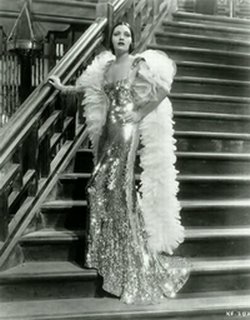 Cortez, you see, is a gun-runner wanted by the authorities. To square his debts and save himself from being turned in, he leaves poor Tanya Borisoff (Francis is supposed to be Russian) as payment with the local bordello owner. After a night spent reflecting on Man's Perfidy, Tanya calls off a brief hunger strike and resolves to make the best of things. Next thing you know, she is sashaying down a staircase in the greatest silver sheath of all time, as a grumpy bordello patron remarks, "They call her Spot White. It should be Spot Cash." (The nickname seems to derive from Francis's all-white wardrobe in the picture, though it's never really explained.)
The Siren thinks of Curtiz's signal virtue as pacing. His films move, often at breakneck speed. Something like Mandalay, with a complicated plot fully teased out over 65 minutes, stands in pleasant contrast to a modern genre movie like X-Men, in which half an hour of exposition is combined with almost zero actual character development. In very short order, after pulling a lucrative bit of blackmail on local official Reginald Owen, Tanya leaves town in a variation on the treatment Claire Trevor got in Stagecoach. But again, this is a Kay Francis movie, and she leaves in a killer white suit, with cushy accomodations on a slow steamer to Mandalay. On the boat she meets and falls in love with an alcoholic doctor With a Past, Lyle Talbot. But Tanya's own past intrudes in the form of Cortez, who turns back up, in the way all rotten exes eventually do. The female audience that loved Kay so much must have enjoyed seeing Cortez get his just deserts more than once, as his character proves as difficult to bump off as Rasputin. I especially liked the bit where he gets stuffed through a porthole.
Mandalay is tosh, but it is enjoyable tosh, and nine-tenths of the pleasure is definitely Kay. You hear a lot about her lisp, but it honestly isn't as prominent as people make it out to be--more Barbara Walters than Elmer Fudd. Still, it is usually irresistible to film writers looking for a laugh, like Jerry Vermilye discussing Mandalay in The Films of the Thirties:
'If you touch my garter, I'll scweam,' she warns a lustful gentleman early on. [The gentleman is actually the consul she is blackmailing, and Tanya is mocking him. -C.] Sympathetic screenwriters usually helped Key avoid these verbal pitfalls, but Mandalay scenarists Austin Parker and Charles Kenyon must have had a grudge against her; near the film's climax, they have her address costar Lyle Talbot with 'Gwegowy, we awwive in Mandalay tomowwow. We ah two wecked people.'
 Cute (although with that second quote Vermilye conflates two separate lines), but the Siren thinks Francis deserves better than jokes about her speech impediment. Though she was hardly a talent for the ages, there was something lovable about this actress. She had huge dark eyes and a slightly receding chin, combined with a low and gentle voice. The effect was of someone easily wounded and in great need of tenderness, though her movie plots usually offered her precious little of that. Her fans flocked to see her suffer, as in The House on 56th Street, a somewhat overwrought but touching movie where the troubles life heaps on her last through 30 years (and some unfortunate blonde wigs). Given a script with genuine wit, as with One Way Passage or the superb Trouble in Paradise, Kay had a gently mocking manner well suited to high comedy.
Her friends remembered her as a kind and generous person, with a warmly self-deprecating manner. She was dismissive about her looks and never had much regard for her own talent. As long as her salary stayed on a steady incline, she took the roles she was offered. As a result, her image was worn down eventually, as Warner Brothers increasingly relied on her name to redeem inferior vehicles. When at last she began to fight for better parts, it was too late. By 1938 her period of greatest stardom was over, and she was labeled "box-office poison" in the celebrated Hollywood Reporter ad. Unlike fellow drugs on the market such as Hepburn and Crawford, Francis didn't get a chance to surmount the stigma.
 From the beginning, she was famed for being a clotheshorse, and though she hated the label, no one wore 'em like Kay. In Hollywood fashion history, Audrey Hepburn had the European tastefulness, Marlene Dietrich was the iconoclast in trousers, Julie Christie had the swingin' attitude, but Kay is tops in the Siren's book. She could wear even a ludicrous gown and make it seem chic. Given a truly elegant ensemble she could take your breath away. She was tall, slender and flat-chested, with a slight give-a-damn slouch that defied you to question why the hell she was wearing white in the middle of the Burmese jungle.
The picture you get in Kay Francis: A Passionate Life and Career, by Lynn Kear and John Rossman, is melancholy. The authors make heavy use of Kay's diary, which was really more of a month-by-month calendar. But instead of just jotting down "buy bread" or "call mom," Kay used shorthand to note liquor consumption and all of her sexual conquests. That frequently filled up the margins, too, with entries like "Swell time but got very drunk. T[allulah] B[ankhead] called me a lesbian" and "We baptized the library floor. Good fucking" and "Slept with him and he may be the best of them all! Christ, I am a slut." (That possible best of them all, if you're interested, was agent Charles Feldman.) Her appetite, encompassing both men and women, was huge. She had four marriages but no children, opting instead for a jaw-dropping number of abortions. As a bit of social history, the ease with which well-connected, well-off Kay got abortions is telling; she had four the year she turned 23.
Several times the sheer volume of Kay's conquests made the Siren reach for a cold cloth to put on her forehead. (Even the authors say plaintively in the preface, "Believe it or not, we truly wanted to find out more about her career ... but the diary focused on her sex life.") Alas, nothing brought the actress much happiness. The book's Kay pursues pleasure but seldom finds it. Eventually the career withered and died, too, killed by public weariness with Kay's kind of pictures and blocked by the rise of a greater Warner star of the four-hanky saga, Bette Davis. Kay made no movies after 1946. In later years she drank too much, but retained a measure of her appeal even in bad times.
Actor-director Harold J. Kennedy ... described how Kay kept her sense of humor during one incident. 'I remember taking her one night to a little restaurant upstairs in the East Fifties when she fell down and it took three of us, the head waiter, the owner and myself, to carry her down the stairs and out into the street. The owner and the maitre d' were holding Kay slumped between them while I was trying to hail a cab when a young sailor went by and stared at her. "Is that Kay Francis?" he said. Kay half-opened her eyes and smiled that million-dollar smile. "I used to be," she said.'
Kay Francis doesn't have the name recognition of a star like Katharine Hepburn or Marlene Dietrich, but her reputation is kept alive by unusually devoted fans. James Wolcott has mentioned his affection for her more than once, and the Web boasts several lovingly detailed Kay sites. The Siren hopes to see more of Kay's movies, as more people succumb to her charm.