PRINCE POPPYCOCK

The graphics are a significant upgrade from the Prince of Persia that was on the Apple computer, but they are not amazing. Players will experience the game on a two dimensional environment (ala Castlevania). You will encounter a myriad of trapped doors, hazardous spikes, and deadly blades. Jumping from platform to platform makes up a great deal of the gameplay (too much for my taste)


It's been a slow couple of viewing weeks chez Siren. She's had a hard time finding quiet periods to watch things, for one. And for another, what she has seen hasn't exactly brought the Muse sashaying over to her computer keyboard. There were a couple of John Garfield movies, Out of the Fog and Saturday's Children. Out of the Fog had Garfield in delicious bad-guy mode, Ida Lupino looking glorious and James Wong Howe making Sheepshead Bay look the way it should look but undoubtedly never did. Still, no inspiration. Saturday's Children had some lovely, delicate moments in the early scenes but slipped later.

There was The Hucksters, deeply disappointing to the Siren, although Sydney Greenstreet hauling off and spitting on a conference table was an unexpected fillip. But Greenstreet, despite the Siren's deep love for the man, was woefully miscast, Gable failed to charm and Ava Gardner's hairstylist must have had it in for her. Deborah Kerr looked ravishing but her part was wan. The movie looked pretty good but was ultimately toothless; maybe if the Siren watches Mad Men again she will now appreciate it more.

Saw Nightfall at the Film Forum, and a good thing too, since its ravishing beauty (via Jacques Tourneur and Burnett Guffey) needed a big screen. But the plot was preposterous in ways both big and small. Saw Cyrus (oh look! a new movie!) and it had some funny moments, but Marisa Tomei's character was frustratingly underdeveloped and the out-of-nowhere constant zooming made the Siren want to gently take the directors' hands off the camera and hand them some worry beads.


Then there was a Frank Borzage night at the home of some dear friends, where we saw Doctors' Wives, an intermittently interesting early work that the Siren has little to say about, and Young as You Feel, a ghastly relic that the Siren cannot recommend even to ardent Borzage completists. There were three shots where she thought she spotted Borzage; otherwise the only sustaining moments came when the Siren's couchmate (He Knows Who He Is) dissolved into inadequately suppressed giggles every time Will Rogers described himself as "an old meat-packer." That sent the Siren into fits as well and she ended the evening with her Serious Classic Movie Viewer cred in tatters.

Hence the radio silence.

Some weeks back we held a belated house-warming and the Siren shut the door to the hall closet where we had piled all the things we didn't know what to do with, like toolboxes and an old bureau and papers to shred and all the pictures we haven't hung because we don't want to face the inevitable debates: "I hate that one." "I hate THAT one more." "Hey, that was a gift." "Oh, a gift, huh. From who? a sworn enemy?" The door to the closet is right next to the bathroom and during the party the Siren kept one eye peeled to make sure no one opened the wrong door and discovered the secret of our Potemkin housekeeping. Since then, the Siren opens the door from time to time, looks in and says to herself, "I ain't touching this shit," and shuts the door, suddenly gripped with the strong desire for a stiff Scotch.

Well, it's only 9:30 am right now and besides, the housewarming guests drank up all the Scotch and it hasn't been replaced. (That isn't a reproach, guys; we had fun doing it.) So the Siren brewed a cup of nicely smoky lapsang souchong and decided to clean out her computer files instead. The Siren wouldn't show you that hall closet's interior if you came over with an armful of gardenias, a sonnet to her left eyebrow and a large bottle of 30-year-old Talisker. But herewith, because her Scots-Irish ancestral blood deplores waste of any kind, and because otherwise the cupboard is bare, a glance at some of the unfinished fragments that have been lurking on the Siren's hard drive.


Here we have the notes for Siren's abortive stab at a comparison between Criss Cross and Touchez Pas au Grisbi, two movies that she saw back-to-back and that still strike her as complementary.

Oddly, it was the French film that ultimately had a less cynical outlook, holding out the possibility of loyalty and even love. Yvonne DeCarlo speaks for the Americans when she snaps at Burt Lancaster: "Love, love! You've got to watch out for yourself."

Criss Cross is even better than The Killers, one of its predecessors, at least in part because of DeCarlo. Her beauty is just lights-out, on a level with the earlier film's Ava Gardner. Unlike Gardner, however, DeCarlo really acts in this movie. She is very good as Anna, Lancaster's ex-wife, showing us a woman who may have some good qualities deep down, but meanwhile is out for herself. Burt Lancaster's magnificent looks help his portrayal of Steve who is, it must be acknowledged, a bit of a drip. Steve takes up a lot of his narration blaming fate, when we can see he's the author of his own misfortunes.

Both of the movies flip sex roles--Steve the drippy romantic, Anna the practical hustler; Gabin the loyal mate, his partner the feckless damsel-in-distress.

Jeanne Moreau really, really, really cannot dance. DeCarlo, on the other hand, tears up the floor.


The opening graf of a planned post on the splendid The Late George Apley. If this one pops up on TCM, by all means watch it.

It has a dry, witty script by Philip Dunne and a wonderfully funny performance from Ronald Colman whom, as her readers know, usually hits the Siren like a big ol' dose of Nyquil. Mr. Siren, who was in the same room trying to beat an external hard drive into submission, at one point looked up and remarked with mild irritation, "You're laughing a LOT at this one." He would have had a much better time just watching it with me.


This is an excellent example of a post the Siren abandoned because she was being entirely too pissy. And no, she won't tell you who it was who aroused her ire, and there are no prizes for a correct guess, either.

Dude ... Stage Door?

There are I-don't-know-how-many actresses and films out there to illustrate your thesis that everything was so much better without feminism, and you choose--Katharine Hepburn in Stage Door?

Okay, don't let me stop you. Maybe next week you'll follow up with how things in Hollywood were a lot better before they invented panchromatic film. I want to be sympathetic here, because I happen to prefer old movies myself. Hence my blogging about old movies. And of course it is a truism that you are entitled to your opinion. But thematic evaluations are supposed to be rooted in something, preferably something connected to the movie. You can't just watch Bringing Up Baby and decide it's all a metaphor for the Boer War.


Yes, we are all better off without that one. It was only going to get worse from there.

Here, to close out this collection of unrelated fragments, are the Siren's notes on My Last Breath, as her British edition titles Luis Buñuel's autobiography.

The book is, surprisingly, in rough chronological order but Buñuel still meanders from topic to topic, detouring for a while and then swerving back onto the road. He was born in the Aragon region of Spain in 1900, at a time when the area was poor and the peasants still lived in much the same way they had for centuries. His father was relatively well-to-do, however, and Buñuel received a good Jesuit education, right up to the day he was expelled, much to the Siren's relief. (Come on, this is Buñuel. You don't want to hear about him being a complete altar boy, do you?) He went to Madrid in the 1920s to be educated at the university, and there Buñuel seems to have met everyone who was anyone in Spain at the time, from the young Garcia Lorca and Salvador Dali to King Alfonse.

He started out studying insects and claims he could recognize and give Latin names for many well into his old age. Eventually he switched to philosophy, but then he moved to Paris. There he made the revolutionary Un chien andalou and L'Âge d'Or, the latter film distinguishing itself by being the first Buñuel to be banned (for about fifty years, as a matter of fact).

In the same way that Buñuel's films can focus on seemingly extraneous details (in The Discreet Charm of the Bourgeoisie, people going on and on about their dreams, as Bunuel does here) and exclude the information you are dying to know (what, exactly, happened to Don Jaime's wife in Viridiana?) the director gives one chapter apiece to his most prolific years as a filmmaker, in Mexico and in France. He is happy to give you a recipe for a Buñueloni (the Siren would love to order one of these at her next blogger outing) but doesn't want to tell you much about, say, Gerard Philippe.


So now we've used up some leftovers. There's about a half-dozen more lurking around, but the Siren promises she won't drag those out until the next time she's just seen a Will Rogers movie and is stumped for material.

If you've seen anything brilliant lately, by all means, tell.

Update: In a nice coincidence prompted by TV5's showing Grisbi last night (Mr. S watched too), James Wolcott posts about the Becker film. The dancing amused him too. Even funnier: Jacqueline Susann's Once Is Not Enough, which may well be playing on a double bill with The Oscar in some midnight-camp-palace of the afterlife.

And the in-depth take on Nightfall that the movie deserves, from Kim Morgan, at Noir of the Week. The Siren was still not keen on the woozy plotting, but Kim points out all the brilliance that made the Siren pretty much love the thing anyway. And Simon Abrams at Slant Magazine liked the movie less than either Kim or me, but makes his case very well (Simon has particular problems with the ending).

The Bitter Taste of Vichy

The Siren has seen only a handful of movies since posting about Jezebel, and two, by pure coincidence, were connected to Vichy France. One was Le Corbeau, Henri-Georges Clouzot's film about the effect of a poison-pen writer. Made during the occupation for the German-controlled Continental Films, it pinpoints mob psychology and collaboration so effectively that it managed to unite right and left in France by offending the hell out of both groups. The other was Un amour à taire (A Love to Hide), a telefilm made for France 2 in 2005, that shows the persecution of homosexuals under the Nazis. Clouzot's movie, itself made under circumstances of collaboration and without a single scene of Nazi atrocity, makes far more telling points about the era, but that isn't surprising. The comparison between the two films is somewhat unfair and the Siren admits this right off the bat. It's like watching CSI: New York and sitting down to compare it with The Naked City. Taken together, though, the Siren does think Le Corbeau and Un amour à taire highlight the problems she has with certain fictionalized Holocaust movies.

Le Corbeau would easily have made the Siren's Top 25 Foreign Films had she seen it in time. Set in "the present," it shows a small French town convulsed by a series of poison-pen letters, many of them directed at the place's popular young gynecologist (Pierre Fresnay). On this simple framework Clouzot and his co-screenwriter Louis Chavance build that rare and precious cinema specimen, a genuinely subversive film. Clouzot gives the audience clue upon clue about the identity of the letter writer, who signs the missives "Le Corbeau" (The Raven), and the movie forces viewers to identify with the suspicious locals and make the same mistakes they make. At one point, a key character theorizes to the town doctor that the Raven has a physical deformity. In walks another character, and for the first time you see her pronounced limp. An obvious visual joke, but at the same time Clouzot has guaranteed that neither the doctor nor the audience will ever view the disabled woman in the same way.

The doctor's practice dries up, as previously fawning townsfolk suddenly discover they aren't so sick after all. Wonderfully typical is the local seamstress, whose apologetic tone turns to petulant anger when the doctor refuses to pretend he understands her decision not to come to him. How dare the doctor make her feel bad about her cowardice? She is just the first of a series of aggressive innocents.

Clouzot underlines his points with several recurring motifs. Several times the letters float down from the sky, like bombs, but they are seized eagerly, not avoided. The doctor accidentally drops a particularly incriminating letter into a courtyard and runs to retrieve it. The wide-eyed child who denies having found the letter devours it line by line as soon as the doctor is safely out of sight. As befits a movie about mob psychology, the crowd scenes are particularly memorable. Children burst from a schoolyard, a funeral cortege turns into an ugly rally against a suspect. Eventually, as the consequences of the letters grow more dire and the town's frenzy grows, the final group of suspects are herded into a schoolroom and forced to take dictation (an extremely French form of writing practice that the Siren herself experienced in high school French classes). Dark echos of other roundups occurring when the film was released in 1943 compete with the nasty but undeniable humor of adult "students" bending head over paper and carefully writing out, "Slut! Whore! What about your abortion?"


No such morbid humor occurs in the painfully well-intentioned Un amour à taire, shown on the US version of TV5 recently with a capricious set of subtitles (now you see them, now you don't). The Siren doesn't question the motives of anyone with the spiritual fortitude to tackle this godawful subject matter. The fate of gay men under the Nazi regime hasn't been much dramatized, aside from the groundbreaking play Bent, which the Siren read some years back (she hasn't seen the movie). Somewhere there may be a film that does justice to this part of history. Un amour isn't it, though.

In occupied Paris two gay men, Jean and Philippe (Jérémie Renier and Bruno Todeschini) are busy concealing their affair and trying to stay clear of the Nazis. The childhood friend of Jean, Sarah (Louise Monot), is arrested with her family; as Jews they are all scheduled for deportation. Sarah manages to break free, and Jean and Philippe help her hide. But the safety of all three is jeopardized by Jacques (Nicolas Gob), Jean's brother, who loves Sarah and hatches an underhanded scheme to get her. Eventually Jean is arrested and sent to a concentration camp, and the movie includes a long sequence showing the horrors endured by the gay prisoners in the camp.

At this point, the imperative to remember the Holocaust, always, seems in no danger of being violated by Hollywood, as the crimes of the Third Reich are regularly filmed in one form or another. It is probably no coincidence that most of the fictional movies the Siren considers artistically accomplished--from Enemies to the precise reenactment of The Wannsee Conference--avoid actual depiction of the camps. The effort to dramatize what took place in Auschwitz and its ghastly siblings is always in danger of devolving into melodrama. Melodrama has a fine cinematic heritage but this subject, of all subjects, does not need it. In fact, the stark facts of the Holocaust scream at you to avoid melodrama at all costs. Melodrama, however, is what Un amour serves up, with Nazis interrogating Jean in a manner that owes more to Hitler's Children than Shoah. When Jean befriends a young gay man in the camp, you cringe for what lies ahead, knowing that the companion will die, and die horribly. But this victim's brief appearance in the movie cannot adequately move the audience. He does not have enough presence or life to be more than a way station to Jean's own depressing fate. And if a filmmaker cannot make this death more than that, then the Siren would rather he not show it at all. The death agonies of this human being--just one, mind you, among millions--should wrench an audience to its soul.

Instead of provoking thoughts about what savagery lurks under any civilized surface, or the huge, echoing "Why?" behind the millions of deaths, movies like Sophie's Choice or (god help us) Life Is Beautiful cater to our desire to tease some sort of meaning out of the carnage. It isn't just millions dying a senseless, horrific death under circumstances you weep even to contemplate--it's also a plot device to bring a writer to maturity, to enshrine a father's love for his dewy-eyed child.

Worse, the camp scenes themselves, as intensely as they make the audience feel, play to its smugness. I'm not a Nazi, you think, as you look at the ghastly violence on the screen. I'm too civilized for this. Never again! Can anyone honestly say we have earned that sense of superiority? Surely the Siren doesn't have to go through the sad catalogue of further crimes against humanity committed since World War II. She often thinks of writer David Rieff's bitter remark, "'Never again' might best be defined as 'Never again will Germans kill Jews in Europe in the 1940s.'"

A movie like Un amour invites you to identify with the courageous gay men and the strong, supportive Sarah, not the sniveling, two-faced brother. Le Corbeau tells you, in no uncertain terms, not to lie to yourself. For every Jean Moulin and Gilbert Renault, there were thousands in France who kept their heads down and tried not to make waves. When it was all over, they took out the pent-up frustration on some who were genuinely monstrous, as well as others who made convenient targets but may have been far less guilty, such as the women who had affairs with Nazi soldiers. While they were marched through towns with heads shaved, others like Maurice Papon managed to continue their lives with tidy, Vichy-free biographies. In this, too, Le Corbeau is eerily prescient, as a young woman is carried away screaming in a van, even as the guilty party prepares his final letter.

Postscript: This piece is now cross-posted at Newcritics. Of the things she read while preparing this post, the Siren is indebted to this piece about Le Corbeau at Raging Bull and this one at Jigsaw Lounge.

Ingmar Bergman, 1918-2007


The Siren pauses to mourn the death of the great Ingmar Bergman. Her knowledge of Bergman's filmography is largely confined to his earlier films--The Seventh Seal, Wild Strawberries, Smiles of a Summer Night, Summer Interlude, The Magician, Persona, The Magic Flute. But the Bergman films she has seen, she loves passionately. Most of all, she loves Fanny and Alexander, that fantastically beautiful ode to family love and the warm, carnal world of art and the theatre.

One of the best film bloggers the Siren has ever read was the late George Fasel of A Girl and a Gun. His family, in what constitutes a very large service to the film-blogging community, has left his archives up at his old blog. In July 2005, a little more than a month before his own death, George posted a piece on Ingmar Bergman, and summed up the director, and what we have lost with his passing, far better than the Siren can:


    Bergman could be funny--uproariously funny--when he chose to be: just have a look at The Magic Flute and especially Smiles of a Summer Night (1955), a timeless comedy of great invention. But for the most part, his work bluntly and unapologetically portrayed intense psychic pain, the emotional violence that people did to one another as a matter of course in the name of love, duty, and God. Bergman hurts, and if you don't feel it, you've unplugged your antennae. But he also presents his pain--which you have no doubt he has felt himself many times--with such honesty, clarity, and aesthetic scrupulosity that one can only respect him. He makes his audience work, not just by enduring the agony, but to find out what is really going on, who is the reliable source and who is not, why people say they are lying when they are actually telling the truth, why they subject themselves to injury needlessly.

    In spite of the subject matter, it all looks and sounds gorgeous. Bergman first hooked up with DP Sven Nykvist in 1960 and they were still together in Fanny and Alexander; I doubt there was a cinematographer in the twentieth century who could render emotional states by light, shade, framing, and camera positioning with his skill and subtlety. And the casts? Well, consider: Harriett Andersen, Max von Sydow, Gunnar Björnstrand, Eva Dahlberg, Liv Ullmann, Ingrid Thulin, Gunnel Lindblom, Erland Josephson--every one of them willing to do what the boss called for, make it even better, and most of all completely submerge themselves in their characters. I can do something with Bergman films I almost never do otherwise, which is to watch them for performances only...

    As [Saraband] finished, I didn't want to believe this was it, that we wouldn't be seeing anything new from this genius. All right, he turned eighty-seven just last week, and a man has a right to throttle back. But I wish he wouldn't. We need his honesty and mastery more than ever.

In Brief: Le Samouraï

The Siren was oversold on Le Samouraï, not by any critic, but by the Jean-Pierre Melville movies she saw previously. Having seen Un Flic, which she thought pretty good, Bob le Flambeur, which she thought excellent, and L'Armée des Ombres, which she thought a masterpiece, the Siren was all in a tizzy to Netflix this classic. Le Samouraï, after a patently phony epigraph, opens with a long shot of Alain Delon, barely visible on the bed in a dirty Parisian flat, smoke from his cigarette gathering above his head. And there was this squeak in the background, and the Siren tried to figure out what it reminded her of, until she thought, "Damn. That sounds like the windmill in Once Upon a Time in the West." It's Delon's pet bird, but the association really, really should have warned her. This movie is a cerebrally paced, meticulously framed, fantastically good-looking stiff. The Siren admired its stark construction but it was an endurance test, 105 minutes that felt twice as long as L'Armée did at 145.

In interviews Melville suggested that Jef, a hired assassin and the "samurai" of the title, is schizophrenic, but crazy people are usually livelier than this, at least in the movies. Somewhere around the time Jef got nicked by a bullet the Siren realized there was never going to be a point where she gave two hoots in hell about him. Instead she found herself looking at Delon's face, dour and unchanging in shot after shot, and remembering the verdict of his ex-lover Brigitte Bardot: "Alain is beautiful, but so is my Louis XVI commode." Nathalie Delon (married to Alain at the time) and Cathy Rosier, both gorgeous, apparently had the same acting coach as the star. The police chief (François Périer) was the Siren's favorite. He cracks jokes and has facial expressions.

The Siren can understand the admiration for the steel-colored perfection of Le Samouraï's look. But watching Delon dart around the Metro, in fear for his life, left her as cold as Harry Lime looking down from the Ferris wheel. The Siren has resigned herself to more lonely iconoclasm, but she did find this. Merci, M. Rosenbaum, for expressing a few reservations. And apologies to Girish.

Above left (click to enlarge): Alain Delon, right three-quarters view; Alain Delon, left three-quarters view; Alain Delon looks at a gun; Alain Delon looks at Cathy Rosier; Cathy Rosier looks at Alain Delon. Special bonus: Compare the second shot with this snap of the Delons' son. Joie de vivre runs in the family.

*****
The Siren likes Delon in other movies, particularly Purple Noon, Rocco and His Brothers and The Leopard. Good takes on the actor to be found at Cinebeats and Sunset Gun. Kimberly of Cinebeats is a Delon expert, having put together a very groovy fan site for him, which is archived here.

It is a lonely thing, disliking Once Upon a Time in the West. Trawling through the vast store of critics' reviews compiled on IMDB yields approximately five thumbs down. The rest fall all over themselves to call this the greatest Western ever made. The Siren's own husband has already penciled in a date to see it with the kids when they're ready (in about ten years). One of my favorite film writers named his blog after Sergio Leone. (Dennis, please try not to hold it against me.) The film's reputation seems impregnable, and in questioning its greatness the Siren plays an exercise somewhat akin to lobbing a spitball at the Washington Monument. She is resigned to the idea that few, if any, will agree with her piece of contrarianism. She does hope, however, that for the time it takes to read this post, you will at least be able to see the movie through her eyes.

Instead of summarizing the plot, which is widely known and too murky anyway, the Siren will state why she dislikes this movie: It is overlong, badly acted, misogynistic and dull. Dear god is it dull. The movie is often compared to an opera, but the more apt comparison is oratorio--plenty of music, no scenery and no acting. The structure cycles through same, same, one minute of dialogue, gunfight, same.

Then again, Leone's camera doesn't seem to care if we ever get interested or not. Again and again we return to the basic pattern of long shot (flat, sun-bleached, not terribly interesting desert) to close-up (flat, sun-creased, not terribly expressive face), close-up to long shot. It has a sort of lulling rhythm to it, like walking through a gallery and turning your head from portrait to landscape and back again. But like the paintings in the gallery, it just hangs there. Leone is supposed to have choreographed OUTITW's performances to Morricone's pre-written, excellent score, but the tempo doesn't change much even when the music does. Certainly there are references to other filmmakers--better filmmakers--Fred Zinnemann with the opening train station sequence, John Ford with the build-up to the massacre, the funeral sequence borrowed from George Stevens. Some take that as a sign of the movie's greatness, but spotting those only irritates the Siren further, as it reminds her of other movies she could be watching. (She could, for example, watch High Noon AND 3:10 to Yuma in only slightly more than OUTITW's running time.)

Said it before, repeat it here--the grand unifying theme of Western movies is, "who's the man here?" OUTITW gives us two. The first is Charles Bronson. Actors do not usually become stars without some sort of star quality, and Bronson has presence, a great deal of it in fact. But Leone's preference for monumental performances, meaning the actors hold poses for beat after beat after beat while we are supposed to wonder what is happening behind those scrunched-up eyes, is catastrophic for Bronson. The Siren is not kidding when she tells you she prefers Bronson in Death Wish, where at least he gets to move. Here he seems preserved in amber, an actor who manages to overplay his lack of affect. That is its own form of odd accomplishment, but that doesn't make it moving.

The second man, more by dint of blowing Bronson off the screen than the script itself, is Henry Fonda. The Siren often wonders how much of OUTITW's impact, then and now, is due to the stunt casting of Fonda. Holy moly, Wyatt Earp just shot a kid! How could Tom Joad be so mean? But is it surprising that a serious, stage-trained actor with a 40-year career behind him at that point could play a villain? Frank is a figure of pure evil, as such his character arc is more like a straight line, and Fonda's chief virtue is in refraining from the sort of hamminess Anthony Hopkins brought to Hannibal Lecter. Fonda, as always, walks softly. The shock from the against-type casting lasts about 20 minutes, and the movie is, of course, 165 minutes long. You have plenty of time to notice that Frank's villainy is no more fleshed-out or believable than hundreds of others, from Lee Marvin as Liberty Valance to Jack Palance in Shane. The difference is that those villains don't overstay their welcome, mostly popping onstage to punch up the action and heighten the stakes. Here you have to spend a long, long time with Frank, and he never gets any less or any more evil, nor does he get more interesting.

If there is anything the Siren can enjoy about the movie, aside from the deservedly praised opening, it is Jason Robards as Cheyenne. He is so deliciously, cornball hammy he seems to have dropped in from another set. When he is on screen the movie does occasionally lurch to life, as when he pops up in a window, hanging upside-down from a railway car, wearing a marvelous expression somewhere between apprehension and glee. Unfortunately, many of his scenes are played with Claudia Cardinale.

Ah, Cardinale as Jill. Misogyny irritates the Siren, but even more than misogyny she is irritated by those who try to gloss or dismiss the problem, for problem it is. OUTITW puts a woman in the middle of the action, gives her character great thematic importance, and then shows her behaving in ways that simply beggar belief. She's the whore with a heart of gold (heaven help us, and in 1968 yet), but more than that she is all appetite and survival instinct, only minimal brain. Jill is an animal shorn of even the small dignity of an animal's initiative. She spends the movie merely reacting to events. Kidnapped? Guess she better sleep with Frank. Railroad workers need water? fine, and because Cheyenne says so she'll let them pat her backside (one of the most bizarre assertions of workers' rights the Siren has ever heard). Bronson rips her dress? She falls in love with him. Duck? Fine, she'll duck. And whether deliberately or inadvertently, Leone cast an actress who was unable at any point in her screen career to suggest much of an interior life for even a well-written character, as in The Leopard. In Visconti's masterpiece, this most beautiful of actresses can mime the charm of a young girl only by waggling her shoulders a great deal and biting her lower lip at strategic intervals. Here Cardinale mostly holds her head still (thank God for that small favor from Leone's techniques) but reverts again and again to the same lips-slightly-parted stare, as the audience wonders whether false eyelashes and Cleopatra liner were around in the 1880s.

Here the Siren returns to the mystery of talent, and why some actors can project things to the camera that others simply cannot. Garbo, whom Orson Welles flatly called "stupid," could stare into the distance and take the audience on a journey through all the ages of Woman, as we pondered what lay behind that beautiful face. Cardinale's beauty is no less stunning, and yet as she looks into the camera you suspect she is trying to recall whether she left the hot plate on in her trailer. Well, perhaps Garbo could have breathed substance into Jill. But the Siren doubts it.

In his better movies (though the Siren has reservations even about those), Leone choreographs the set-up for violence fully as much or more than the violence itself, such as the justly celebrated final shoot-out in The Good, the Bad and the Ugly. The Siren doesn't mind the lack of realism in this; as she has said before, realism is a style like any other, and an overrated one, at that. But here Leone just does not know when to stop. I will accept two men circling one another for a final confrontation, sizing one another up like dogs and spitting. I will accept them doing it for a longer time than any two armed men probably ever did in the history of the Colt 45. But when they do it for a quarter-hour--and stop for a flashback to boot--it becomes ludicrous. You might as well bring in Russ Tamblyn and George Chakiris and let the characters dance it out. Furthermore, the impact of this, the final confrontation, is lost because this is how ALL the confrontations in the movie have played out. We have been watching menacing poses for two and a half damn hours. A few more just aren't that interesting.

The theme of OUTITW is the bloody track of the railroad, and how it brings the tough-hombre era to an end even as it brings more exploitation. Leone correctly grasps that the idea of space--that, like Huck Finn, you can always light out for the territories--is a big part of our fascination with the push westward. The director's other idea, here as in his Dollars trilogy, is to strip away the myth that out there was something good or noble, and show that greed and violence built the West. He was hardly the first to do that, but he was one of the most thorough. Trouble is, Leone takes every traditional aspect of the Western and, rather than building on it, either mocks it or replaces it with relentless, dour pessimism. So when the end credits roll at long-bloody-last, all you have is a funhouse reversal of Roy Rogers. Once Upon a Time in the West is, finally, as predictable in its darkness as Rogers was in his eternal goody-goodyness.


(This post is offered as part of the Contrarianism Blog-a-Thon sponsored by Jim Emerson at Scanners.)

Viridiana (1960)

Viridiana may seem like an odd film to fall in love with, but the Siren did, and hard, back in her college days when she was trying to see every European film denied her back home in Birmingham, Ala. Her first months in New York often found her in the college cafeteria with a copy of the New Yorker, staring at the listings, like a Soviet refugee transfixed by the overstuffed produce aisle at D'Agostino's. Viridiana was an early choice, and a formative experience. Along with Les Enfants du Paradis and a handful of others viewed around age 18, the Buñuel
film was an electrifying gateway drug to European cinema. However, there are many things the Siren loved when she was 18 that she loves no longer--Southern Comfort, four-inch heels, false eyelashes--so who knew how'd she react when Turner Classic Movies recently screened the movie.

Happily, the Siren can report that Viridiana still knocks her sideways. It has been dissected many times, by critical minds more refined than hers, but the Siren wants to tell you about why she loves this rather bleak, but utterly brilliant film.

Anybody here familiar with Alabama? To say it's religious down there is like remarking that Manhattan is urban. Now my late father and my beloved mother both grew up a few blocks from a local church--Baptist for Daddy, Methodist for Mom. They attended every Sunday until the day they left home, with the happy result that neither one wanted anything to do with weekly services as an adult. But they were Christian enough to want their offspring to choose a nice denomination to settle down with. So the Siren went often to several churches, spent a long time studying Catholicism, and in the end picked the box marked "none of the above." She was tired of Jesus. He kept turning up in the Siren's daily life, whether she invited Him or not, usually invoked by people who wanted to tell her she was wrong. The Siren started to regard the Lord the way other people saw Chuck Barris--someone who pops up to tell you the gong has rung and the fun's all over.

So the lights go down on Viridiana, and the Siren's eyelids pop. There, up on screen, was every seething, rebellious thought she ever had during a Sunday sermon, or while resisting recruitment for the Brothers And Sisters in Christ club, or listening to Coach Jeffries at the pep rally asking Jesus to help us whup the Spartans on Friday night.

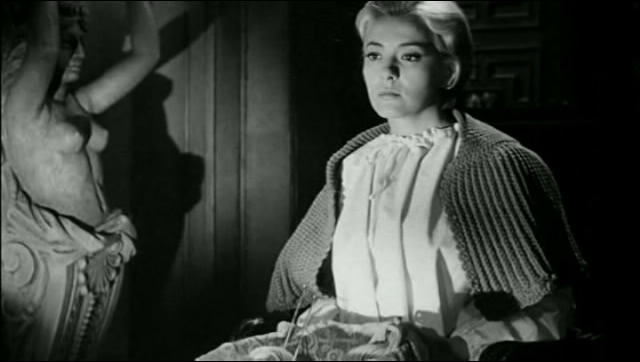
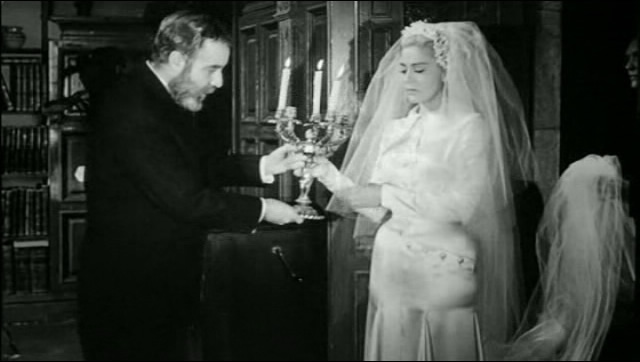
For those who haven't seen it--and if you haven't, what else are you doing that's so important?--a little plot summary. Gorgeous Viridiana (Sylvia Pinal) is a novice at a local convent, and one day she is told she should visit her uncle, local farmer Don Jaime. When Viridiana arrives, her uncle, played by a gloriously lecherous Fernando Rey, is thunderstruck by her resemblance to his dead wife. From there out, he is obsessed with getting his virginal niece into bed. What follows includes a drugging and contemplated rape, a nice little episode of foot fetishism and the uncle's abrupt exit. Don Jaime's illegitimate son Jorge (Francisco Rabal) arrives and he too lusts for Viridiana, but is content to wait for her to see the error of her virginity. She takes over the farm and tries to set up a sort of rural food kitchen for the local beggars, but they prove to be about as salvageable as her uncle. To watch the film is to see Viridiana's Christian ideals taken apart, hanged, burnt, tied up, knifed, buried and seduced into a possible game of strip tute. Maybe others find it depressing. To me, it's pure adrenalin. That night in New York, if I could have found Luis Buñuel, I'd have touched the hem of his garment.

You can find a lot of writing on Viridiana around the Web, some of it claiming that the film is anti-Catholic but not anti-Christianity, and it really isn't all that shocking anymore. To which the Siren says, poppycock. If you could show the BASIC club or Coach Jeffries this movie, I guarantee they would ban it just as fast as Pope John XXIII did. If Viridiana's sensual pleasure in whipping herself while wearing a crown of thorns didn't do it, the beggars' celebrated burlesque of the Last Supper would. You can easily turn a screening into a game of Spot the Blasphemy.

Christian beliefs are hung out to dry (in one instance literally), but the film has no special contempt for Christians personally. Viridiana isn't a bad sort, just rather dopey and possessed of a virgin's tendency to think all the other characters are making sexual innuendos at her expense. (Sometimes they are, as with Rabal; sometimes they aren't, as when Pinal is invited to milk a cow.) Her vows of poverty aren't admirable, but neither are they especially despicable. They are just Viridiana's particular way of entertaining herself, no more or less worthy than jumping rope or drugging someone's tea.

There is a great deal of political satire too, although in Buñuel's memoirs he said that when General Franco saw the movie he didn't see what the fuss was about. To the Siren, this just demonstrates that dictators aren't always very bright. (John Nesbit at Toxic Universe points out the acid implication of the line, "The weeds have taken over the past 20 years... And beyond the second floor, the house is overrun with spiders.")

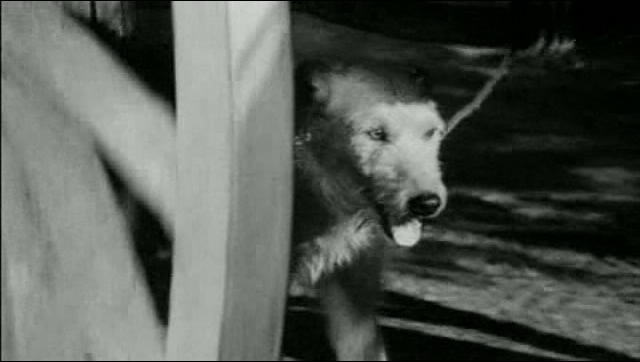
But there is little comfort for the do-gooder liberal, either. Buñuel refuses to romanticize poverty. There is nothing ennobling or beautiful about it, whether it is chosen like Viridiana's, or forced by circumstances like that of the beggars. They aren't purehearted children of the sod, oppressed by the system. They're just poor, and creepy, and eager to grab any momentary gratification. Emerging from poverty is purely a matter of luck, as it is for an abused mutt in the movie's other celebrated sequence. Whether you seek it through Jesus or the kindness of the better-off, your illusion of salvation is just that.

Buñuel made this film after a 22-year exile from Spain. (Here the Siren sees a bit of similarity to Robert Altman, another gleefully godless filmmaker: Invited to return to his homeland and make a movie, Buñuel made a lengthy disquisition on what bums they all were.) If Franco wasn't incensed, plenty of others got the point. When Viridiana was released, it was promptly banned in Spain and denounced by the Vatican. Spain's chief censor was forced to resign. Even Sturges and Lubitsch didn't manage to get the censors fired. If that doesn't tell you Viridiana's worth, the Siren doesn't know what will.