PRINCE POPPYCOCK

The graphics are a significant upgrade from the Prince of Persia that was on the Apple computer, but they are not amazing. Players will experience the game on a two dimensional environment (ala Castlevania). You will encounter a myriad of trapped doors, hazardous spikes, and deadly blades. Jumping from platform to platform makes up a great deal of the gameplay (too much for my taste)


My final defeat, which made me cry real tears, came at the end of [Pandora's Box], when [G.W. Pabst] went through my trunks to select a dress to be 'aged' for Lulu's murder as a streetwalker in the arms of Jack the Ripper. With his instinctive understanding of my tastes, he decided on the blouse and skirt of my very favorite suit. I was anguished. "Why can't you buy some cheap little dress to be ruined? Why does it have to be my dress?" To these questions I got no answer till the next morning, when my once lovely clothes were returned to me in the studio dressing room. They were torn and foul with grease stains. Not some indifferent rags from the wardrobe department but my own suit, which only last Sunday I had worn to lunch at the Adlon Hotel! Josifine hooked up my skirt, I slipped the blouse over my head, and I went on the set feeling as hopelessly defiled as my clothes. Working in that outfit, I didn't care what happened to me...

I did not realize until I saw Pandora's Box in 1956 how marvelously Mr. Pabst's perfect costume sense symbolized Lulu's character and her destruction. There is not a single spot of blood on the pure-white bridal stain in which she kills her husband. Making love to her wearing the clean white peignoir, Alva asks, "Do you love me, Lulu?" "I? Never a soul!" It is in the worn and filthy garments of the streetwalker that she feels passion for the first time--come to life so that she may die.
--Louise Brooks, Lulu in Hollywood

The Siren was recently designated a fashion blogger by a European site called Wikio, an honor that left her equal parts amused, flattered and puzzled. Aside from her annual rant about the costume awards at the Oscars, a tribute to Mary Astor's makeup and a brief series of posts about perfume, the Siren can't recall saying much about fashion here at her Web outpost, although certainly clothing and makeup rank high on her list of semi-private obsessions. Yet there she is, right next to the black-belt shoppers of Fashionista and seven notches below the cool gaze of the Sartorialist, who would probably stop the Siren in the street right around the same time Dorothy Lamour showed up in hell with a platter of Mai Tais.

Still, the unexpected accolade made the Siren start thinking about costumes in film. The period stuff does get most of the attention, but sometimes deservedly so, as with Walter Plunkett's incredible designs for Gone with the Wind. Those dresses are so brilliantly in tune with Scarlett's character and the events of the movie that you would swear they all must be in the book. The drapery dress is, but just about none of the others are. William Pratt points out that if Plunkett had followed Margaret Mitchell's descriptions to the letter, Scarlett would have spent 9/10ths of the movie wearing green, the author's favorite color. The "scarlet woman" dress that Rhett throws at Scarlett before Ashley's birthday party, for example, was entirely Plunkett's doing. And the Siren has always wanted a better look at the cloudlike indigo gown Scarlett wears in a brief scene of her New Orleans honeymoon. Look closely and you'll see it's adorned with nine stuffed birds--a witty commentary on the once-starving Scarlett stuffing herself with the finest in Louisiana cuisine.

Other great moments in period costume would have to include Marie Antoinette; Jezebel (that red dress was actually bronze, the better to photograph in black-and-white); The Adventures of Robin Hood (Olivia de Havilland spends most of the movie with her hair completely covered, so when she shows up in her bedroom with her hair down in braids, it's a potent sign of sexual yearning); and Queen Christina (the moment when Garbo turns so the firelight outlines her form under a man's shirt is one of the most sensual in all of 1930s cinema).

But the Siren is always drawn to contemporary costumes, particularly those for women. Louise Brooks's essay on Pabst contains what is still the best explanation of costume and performance that the Siren has ever read. Robert Avrech recently posted about designer Helen Rose, and in comments we discussed how an actor's clothing influences a performance. Confronted with that, plus her new job description, the Siren's palms began to itch and she got that yen, the one that says, "It's time to make a highly idiosyncratic list of things I like so that everyone can argue with me, politely."

As Yojimboen has pointed out, the ins and outs of costume credits in old movies can be worse than Kremlinology. Some of these were undoubtedly purchased off the rack, but as Annie or Daria could tell you, there's an art to selecting the right clothes, too. The Siren is mostly sticking with the screen credit, but if someone knows the real scoop on who did what, by all means tell us in comments and I'll update.

So, ten great moments in women's costume design. Let's hope this makes whoever clicks over from Wikio more happy and less confused.

1. Bette Davis in Now, Voyager (Orry-Kelly)
I’ll be wearing my white lace gown tonight. I’d like you to wear your black and white foulard.
--Gladys Cooper as Mrs. Henry Windle Vale


Cooper has a lot of bitchy moments in Now, Voyager, such as, just to pick one out of a hat, throwing herself down a staircase to ensure her daughter stays chained up as a nursemaid.

But the Siren thinks even trying to order the newly fashionable Charlotte back into this offense to the human eyesight is as evil as it gets. Have you ever seen anything to equal this horror? The hem that hits just the right spot to get that redwood-forest effect every woman wants for her legs. The neckline that rests at her throat only because the climb to the earlobes got too exhausting. The lace at the collar, probably thrown there by Gladys in one of her temper fits. The way the dress droops away from the body, yet clings enough to say, "There is a whole world of lumpy oatmeal under here and brother, you want no part of it." It's a goddamn triumph of costuming. Kim Morgan recently said every woman should have Claude Rains as her psychiatrist, and ain't that the truth--but Dr. Jaquith's one mistake is waiting to talk to Charlotte. The second she entered wearing that monstrosity, he should have said, "Right, we're outta here."

2. Jean Seberg in Breathless (N/A)
Michel: How old are you?
Patricia: A hundred.
Michel: You don't look it.


Throw a rock down any street in America and you will hit a woman wearing tight pants and a t-shirt. And not one of them, no matter how beautiful, will look one infinitesimal fraction as dangerous as Jean Seberg does in Breathless. Seberg wears this getup because it's her job to wear it, but when Godard's camera catches her calling "New York Herald Tribune," you see a warning sign that Belmondo does not. It's more than her beauty. It's the way she walks, not just casual in her clothes, but careless. Another down-market outfit, another wasteful American in Paris, ready to toss things aside for who knows what reason.

3. Audrey Hepburn's suit in Sabrina (screen credit, Edith Head; actual design, Hubert de Givenchy.)

You needn't pick me up at the airport. I'll just take the Long Island Rail Road and you can meet me at the train...If you should have any difficulty recognizing your daughter, I shall be the most sophisticated woman at the Glen Cove station.


Over at Glenn's place there is a discussion under way about the old saw that Jaws and/or Star Wars "killed the movies." The Siren remarked that the movies were neither dead, nor dying, nor even feeling a bit faint. Here she adds that this kind of chic, however, is deader than vaudeville. Just imagine showing up at the fetid underground bunker that is modern-day Penn Station wearing that suit. You'd get fewer stares wearing a sandwich board. The suit isn't the movie's most famous costume; that's the Sabrina dress, a version of which the Siren has in her own vintage-clothing collection. But this moment, as Wilder's camera gloats over Hepburn from the top of her hat to the little dog at her feet, is one of the most thrilling in the history of film fashion. Sabrina, the lovelorn chaffeur's daughter, has learned poise and confidence, the essential elements of style. Even the least observant visitor to Paris sees that a fashionable Frenchwoman wears chic clothing because she IS self-assured, not because she WANTS to be. This, this is what Paris and a genius designer can do for you!

4. Jean Harlow in China Seas (Adrian)

During my earliest days at Metro, I was put into movies with Joan Crawford and Jean Harlow, and I was always taking their men away from them. Temporarily. It was ludicrous. There would be Jean, all alabaster skin and cleft chin, savory as a ripe peach, and I'd be saying disdainfully (and usually with an English accent, I played a lot of Lady Mary roles) to Gable or Bob Montgomery, "How can you spend time with her? She's rahther vulgar, isn't she?"
--Rosalind Russell, Life Is a Banquet


The Siren would love to tell you this little number is a turning point in China Seas, Tay Garnett's lovable strumpet-on-the-high-seas melodrama from 1935. It isn't, although Harlow wears it in a drinking scene with thoroughgoing louse Wallace Beery, and the jeweled straps do suggest a trap. The neckline is almost modest--right up near the collarbone--as long as you ignore Harlow's obvious lack of underwear and those strips of fabric making an oh-so-scalable ladder down the pure-white arms. Russell was right; it is unlikely Gable would even realize there were other women on the ship.


5. Mary Astor & Ruth Chatterton in Dodsworth (Omar Kiam)
Edith: My dear...don't.


The British gave us the cruel expression "mutton dressed as lamb," but it's Americans who gave us its best illustration, in Dodsworth. Poor Ruth Chatterton. Her character may turn out to be a harpy, but here the Siren aches for her. That hairpiece, ridiculous on anyone who's out of the schoolroom, hellishly combined with the ill-judged white fabric and the simpering black-velvet bow at the too-low neckline. And, to complete the picture of humiliation, there's Mary Astor, a piece of carved ivory in a perfectly draped evening gown, necklace nestled in a neckline that's even lower than Chatterton's--yet somehow not the slightest bit vulgar. The scene is one of the most poignant in the movie, as Dan Callahan writes so well here, but the costumes take the contrast even further.

6. Barbara Stanwyck in The Bitter Tea of General Yen (Robert Kalloch & Edward Stevenson)

General Yen: I'm going to convert a missionary.


From the second she dons a spectacular Chinese robe, every aspect of Stanwyck's movement changes. Her arms float away from her body, she takes longer strides around the room, she suddenly seems conscious of having breasts and hips under the fabric. And you sense, too, that the lack of underpinnings makes her feel just that much more vulnerable to the General, even though she is technically as covered up as she was in her missionary garb.

7. Kay Francis in Mandalay (Orry-Kelly)
They call her Spot White. It should be Spot Cash.


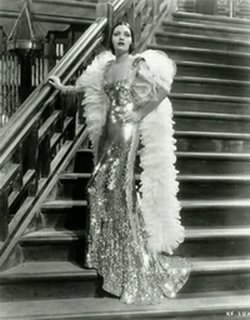
Like Harlow's China Seas dress, this one wins for sheer wow factor. Kay Francis, betrayed by the man she loves, winds up as the top earner in a Burmese whorehouse, and shows she won't let the bastard get her down by strutting down a staircase wearing this. She makes that piece of liquid silver seem worth a crash course in male perfidy.

8. Myrna Loy in The Thin Man (Dolly Tree, wardrobe)
Nick: Have you a nice evening gown?
Nora: What's that got to do with it?
Nick: Have you got a nice evening gown?
Nora: Yes, I've got a lulu. Why?
Nick: I'm going to give a party and invite all the suspects.
Nora: The suspects? They won't come.
Nick: Yes, they will.


The Siren can't remember whether the above-referenced "lulu" is the famous one in the above picture, or the halter-necked black gown Loy wears in the last scenes of the movie. No matter; every good husband who asks a question like that should be rewarded by the sight of his wife wearing something like this, even if nobody ever does show. Maybe especially if no one shows.


9. Elizabeth Taylor in Cat on a Hot Tin Roof (Helen Rose, costume and wardrobe department)

Maggie: You've got a nice smell about you. Is your bath water cool?
Brick: No.
Maggie: I know somethin' that would make you feel cool and fresh. Alcohol rub. Cologne.
Brick: No thanks. We'd smell alike. Like a couple of cats in the heat.


In New York City this past week it has been, as Auntie Mame would say, "hot as a crotch." So of course the Siren had to give a nod to Elizabeth Taylor, who set the standard for riding out a heat wave without air conditioning by donning a slip and trying to seduce Paul Newman. The Siren once had the pleasure of relating Cat on a Hot Tin Roof's censorship history to a confused Argentine male who had just watched it and could not get over, indeed seemed personally offended by, Newman's failure to respond to Taylor's come-on: "It was the strangest thing I have ever seen. There's Elizabeth Taylor! and she's wearing that slip! Thank god you explained this..."

10. Kasey Rogers in Strangers on a Train (Leah Rhodes, wardrobe)
Senator Morton: Poor unfortunate girl.
Barbara Morton: She was a tramp.
Senator Morton: She was a human being. Let me remind you that even the most unworthy of us has a right to life and the pursuit of happiness.
Barbara Morton: From what I hear she pursued it in all directions.


Alfred Hitchcock's attention to what his actresses wore gets a lot of press, usually for Rear Window and Vertigo. Here's one that deserves more discussion. Every time the Siren sees this magnificent movie, she's struck again by the brilliance of Miriam's look, how it represents a summit of Hitchcock's oft-stated preference for buttoned-up women. We've already been told about this mantrap who's cuckolding handsome Farley Granger, and we're expecting maybe Linda Darnell. Instead we get a four-eyed tootsie wearing a simple print dress with cap sleeves and a daintily pointed collar, not nearly as tight, body-conscious or as low-cut as you could go in 1951. Miriam probably wore it because it was vaguely pretty and would be easy to clean if she got popcorn butter on it. And the glasses--the Siren can't be the only one mesmerized by Miriam's eyeglasses. Mind you, the glasses are vital to the plot, but Kasey Rogers wields them the way Dietrich wielded a cigarette. This is an everyday black widow we're dealing with, says that costume, the sort of woman who would show up to a backyard pool party in a full-coverage one-piece and a sarong and, given five minutes' opportunity, would still wind up behind the rhododendrons pulling the swimming trunks off the hostess' husband.

There's an awful of lot of sex in this post, isn't there? There are advantages to this whole fashion-blogger gig...

Unquote, Please

The Siren reads way too much about movies, although the fabulous Sheila O'Malley may have her beat. After a while you start to come across the same quotes again and again. Some are still funny ("I think that 'e' made the whole fuckin' difference," mused Carole Lombard, born plain old Jean Alice Peters.) Some are just true. ("It's the friends you can call up at 4 a.m. that matter," said Marlene Dietrich, a theory she tested quite a bit in later life.)

But the Siren realized this week that there are several very famous remarks made by famous movie people that she never wants to hear again, although she will, she will. In reverse order, here they are, starting with the one that triggered this post:

5. "After 40 you must choose between your face and your ass."

This is usually attributed to Catherine Deneuve, but the Siren thinks Zsa Zsa Gabor is a more likely source. We have it on Brian Aherne's authority that Zsa Zsa is quite funny when she wants to be and she was always making remarks like this. One reason to hate this quote is that the age at which you must make this decision is always changing. In this month's InStyle it's pegged at 30. Thirty!! So Amy Adams, currently igniting newstands everywhere on the cover of Vanity Fair, chose one or the other four years ago? Rubbish. Mere mortal women figure on losing both the face and the ass at some point (a point well past 30, thankyouverymuch) unless we're blessed with superb genes and/or an unlimited plastic surgery budget. But for most actresses it isn't true at 40, or even 50. The Siren's favorite example is Diane Lane...


but there's plenty of others. Please, let's not pull out this tired old saying every time we see a woman who's dieted too much or has a face that's been injected too often with the scary stuff du jour. And one last thing. This quote is always applied to a woman.


If that's fair, then tell me, which did Mickey Rourke choose?

4. "For attractive lips, speak words of kindness.
For lovely eyes, seek out the good in people.
For a slim figure, share your food with the hungry.
For beautiful hair, let a child run his fingers through it once a day..."

Usually attributed to Audrey Hepburn. There's more like that afterward but it always turns the Siren into a version of Daffy Duck, muttering "Easy stomach, don't turn over now," so that's all you're getting. Reason number one to hate this "poem" is that it's insipid nonsense. The Siren feeds hungry children every day and they run their fingers through her hair, as well as anything else that's less than five feet off the ground, but the Siren assures her readers that it has no effect on her looks one way or another. The second reason is that although Hepburn apparently liked this tripe and used to quote the whole thing, in public even (which we will let slide because Hepburn really was a generous lady with otherwise impeccable taste), she didn't write it. It was written by someone named Sam Levenson.


If we are going to talk sensible beauty quotes, let's talk about the wonderful Bette Davis vehicle, Mr. Skeffington. Claude Rains, in the title role, tells his vain, selfish wife that a woman is beautiful when she's loved. Davis retorts, as only Davis can, "A woman is beautiful when she has eight hours' sleep and goes to the beauty parlor every day. And bone structure has a lot to do with it, too."

3. "Ginger Rogers did everything Fred Astaire did, backwards and in high heels."

Often attributed to Ann Richards, but it predates the late, great Texas gov by some years. Rogers included Bob Thaves' Frank and Ernest comic strip, which appears to be the source, in the photos for her autobiography. The Siren cited Ginger for The Performance That Changed My Life, and will defend her abilities against all comers. But as for this quote--it's cute and all, but again, not true. She wore high heels, sure, although take a good look below--compared to today's skyscrapers they're practically flats.


Rogers also rehearsed on slippery Bakelite floors until her feet bled and she probably fantasized about stuffing Fred's top hat up his nose. But she did not do everything Astaire did. Together they were dazzling, but he was self-evidently the greater dancer, which Ginger herself probably would have admitted if you asked her nicely enough. Plus, their duets, carefully designed for maximum beauty on camera, use a lot of forward and side-by-side steps. The Siren is no choreographer, but she's seen these movies over and over, and Ginger doesn't move backwards all that much. Check out "Cheek to Cheek", and see who's moving backwards during most of the first part.

2. "Hollywood is a place where they'll pay you a thousand dollars for a kiss and fifty cents for your soul."

Oh boo hoo hoo, Marilyn. After the past few months of watching our economy do a face-plant, the Siren thinks a thousand dollars for a kiss is a darned good price, even without adjusting for inflation. And meanie-weenie Hollywood sold your soul for cheap, huh. The people standing by the clothing racks and saying "Can I help you?" to grumpy, dead-broke customers, and the ones getting repetitive-motion injuries at their keyboards and jumping every time the boss calls them in the office for fear they're getting the old pre-Christmas pink slip--they all got a much better rate for their souls.

Most irritating is when this quote is used to illustrate how Marilyn Monroe suffered. She was charming and funny, really good in several movies, certainly she was beautiful, and you could say she had a hard time. Though, it seems to the Siren, not as hard as her colleagues did, standing around on the set waiting for Marilyn to get her act together. But you want suffering, real suffering, the kind to make Melpomene weep? Without Googling: Clara Bow. D.W. Griffith. Orson Welles. Gene Tierney. John Garfield. Dorothy Dandridge. Rita Hayworth. Canada Lee. Charles Boyer. Wallace Reid. Montgomery Clift. Lou Costello. Roscoe Arbuckle. Erich von Stroheim.

1. "He gives her class. She gives him sex."

Oh, Katharine. The Siren hasn't been able to track down exactly when and where Hepburn said this (anyone know?) but it was probably a fairly casual observation, not one supposed to substitute for any other analysis of the all-time greatest dancing team. Even when people don't invoke the quote itself, as David Thomson mercifully did not in his well-written but dead-wrong Astaire piece last Sunday, they regurgitate its assumptions. Astaire was plenty sexy. The routines themselves, as often noted, echo the rhythms of seduction and even the sex act itself, and that ain't possible with a sexless male.


As for Ginger needing more class, the Siren wonders if that was somehow a leftover bit of cattiness because Rogers stole Stage Door right out from under Hepburn. Rogers had a wonderful common-girl persona in the 1930s, but her movies relied on her self-confidence and grace. Check out something like Gregory La Cava's charmingly subversive 5th Avenue Girl, in which Rogers poses as a millionaire's mistress without losing a shred of her honor. The point to Ginger Rogers, and what made her such a perfect on-screen American woman, was that she constantly proved class is a state of mind and not birth.

The Siren has a suggestion for anyone itching to use the above-listed quotes. Look up Tallulah Bankhead instead. Now there's someone who could give you an evergreen yarn. The Siren winds this up with Tallulah, from A Southern Album, on the perils of stardom and election season:

"Be careful how you quote me. No swearing, no naughty cracks. This is a campaign year, you know, and I must be discreet. If I'm not, I'll have the whole goddamn Bankhead family on my neck."

Anytime Annie: Role Model

Emma of All About My Movies called this Blogathon for The Performance That Changed My Life. Right there--"changed my life"--seems the Siren should be delving into something deep and meaningful. "Marlon Brando in On the Waterfront showed me the possibilities of a new style of acting!" "Audrey Hepburn in The Nun's Story showed me the agony of spiritual struggle!" "Meryl Streep in Sophie's Choice broke my heart!"

But the Siren can't lie to Emma. The performance that really did change my life wasn't deep and wasn't even a star turn, though certainly it was meaningful to me. It was Ginger Rogers as Anytime Annie in 42nd Street. I saw this movie as a kid, probably chopped up on TBS, source of many of my cinematic touchstone viewings. I must have been well under 10, too young to catch a single double-entendre. Still, Ginger fascinated me. That tart tongue, that supreme self-confidence, the way she took any obstacle from the Depression to a catty costar and rolled right over it. I love almost all of Ginger's early tough-tootsie characters, but 42nd Street was the first one I saw and it holds a special place for me. (I am happy to note that it recently charmed Siren favorite Tonio Kruger as well.) Over the years I saw the movie again and again, and here are the lessons it carried for me:

1. People used to dress a lot better, especially starlets. The Siren defies you to look at any modern-day picture and tell her she is wrong. For a time in the 1930s Ginger had one of the best figures in Hollywood. She loved clothes and she wore each ensemble with dash. Which leads into

2. With the right attitude, even an odd outfit can be carried off. When Anytime Annie enters, she is wearing tweeds and a monocle.


And, in the modern parlance, she rocks them.

3. Bad girls have more fun. Does this even need elaboration? Here's how Annie is introduced:

Andy Lee: Not Anytime Annie? Say, who could forget 'er? She only said "No" once, and then she didn't hear the question!

And here we have Ruby Keeler, as insipid ingenue Peggy Sawyer:

Chorine: You, uh, looking for somebody - or just shopping around?
Peggy: Could you tell me where I'll find the gentleman in charge?
Chorine: First door to your left, dearie!

Which woman would you like to hang out with?

4. Dealing with male lechery? Mock it. The Siren read one reviewer who was so offended by the scene in which the chorus girls have to show off their legs to the producers and director that he compared it--unfavorably--to a scene in Takeshi Miike's Ichi the Killer where a prostitute gets her nipples sliced off. The Siren suggests, politely (because she is a little afraid of this guy) that he is missing an important element of the scene. That would be Ginger and Una Merkel (as Lorraine), rolling their eyes as soon as the director moves down the line, not taking any of it seriously for a minute. You know they are thinking it beats stenography, which at the time also attracted a fair share of wolves (check out Joan Crawford dealing with Wallace Beery in Grand Hotel). In Showgirls, Elizabeth Berkley and the others stand around tremulously, like Irish setters on point, waiting for that magic bit of male approval. Ginger and Una know they're attractive, they know they will make it through, and they also know the men are drips. Which brings us to

5. See an opportunity for a wisecrack? Grab it.

Marsh: Address?
Chorine: Park Avenue.
Annie: And is her homework tough!

Lorraine: ...I always said she was a nice girl. And she's so good to her mother.
Annie: She sure is. Do you know that she makes forty-five dollars a week and sends her mother a hundred of it?

Annie: [to chorus girl] It must have been hard on your mother, not having any children.

Music director: Get some feeling into it, willya?
Annie: Whaddya want me to do, bite my nails?

6. What's going on at the margins is often more interesting than the main event. Ginger and Una in their upper berth, sarcastically commenting on the newlyweds, are the best part of "Shuffle Off to Buffalo":

Matrimony is baloney
She'll be wanting alimony in a year or so
Oh-oh-oh
Still they go and shuffle, shuffle off to Buffalo.
When she knows as much as we know
She'll be on her way to Reno
While he still has dough
Oh-oh-oh
She'll give him the shuffle, when they get back from Buffalo.

7. Sisterhood is beautiful. Watch as Annie and Lorraine adopt Peggy, for no apparent reason, and Lorraine holds up three fingers to indicate they need three parts:

Annie: (to Peggy) Stick with us girl, and you'll come in on the tide.

Later, when cast in the lead due to a fortuitous relationship with porky "angel" Guy Kibbee, Annie gives up the part because Peggy supposedly has a better chance of saving the show. Here we have the movie's most glaring logical flaw, though. The Siren cannot look at Keeler without thinking of lines in a much-later show-business satire: "She can't act, she can't sing, she can't dance. A triple threat." Keeler wasn't a patch on Rogers, and something about the former Ms. McMath's face in this scene shows she knows it.

Finally,

8. Men are wonderful, but they aren't necessities. Annie, sending Kibbee out to walk her Pekingese and rushing back onstage, showed the Siren that there are plenty of different ways to a happy ending.

*******


Wow, Emma's blogathon was an absolute roaring success. The Siren is including all the links in her post, because ALL of the links are so well worth reading. Get a long cool glass of something and settle in front of the screen. The final roundup:

Kendra at Jake Weird on Michael Caine in Sleuth
Catherine from The Mixed Up Files of Catherine on Bette Davis in All About Eve
Adam from All Things Film on James Stewart in It's a Wonderful Life.
Anna at Verging Writer on Sally Field in Norma Rae.
DL at Cellar Door on Samantha Morton in Morvern Callar.
Sen at Les montreurs d'images on Robert Redford in All the President's Men.
Becci at The Sacred Ramblings of Becci on Emmy Rossum in The Day After Tomorrow.
Marius at Blog by Cosmo Marius on Marco Hofschneider in Europa Europa.
Dave over at Victim of the Time on Jodhi May in The Last of the Mohicans .
Kayleigh at Shiny Happy Blog on Audrey Tautou in Amélie.
Vertigo's Psycho from And Your Little Blog, Too on Shani Wallis in Oliver!.
RC at Strange Culture on Stéphane Audran in Babette's Feast.
Beautiful.Adam at DVDPanache on Joseph Cotten in The Third Man.
Rant1229 from The 400 Obscure Passions of the 8½ Personas on Erland Josephson in The Sacrifice.
Nathaniel R from the Film Experience on Marni Nixon in West Side Story.
Mr. Movie Geek at Movies to Movie Geek No Kamikakushi on Kate Winslet in Eternal Sunshine of the Spotless Mind.
Adam Carson Keller from Crumb by Crumb picks Geena Davis in Thelma and Louise.
Jose at The pathetically normal, pop culture obsessed, life of Jose on Vivien Leigh in A Streetcar Named Desire.
StinkyLulu goes for Anne Meara in Fame.
Piper from Lazy Eye Theatre on Daniel Day-Lewis in Gangs of New York.
Luke at The Musings of a Movie Maestro on Nicole Kidman in Moulin Rouge!.
Lylee from Lylee's Blog on Jane Powell in Seven Brides for Seven Brothers.
Cal from Shake Well Before Use on Henry Fonda in 12 Angry Men.
As Cool as a Fruitstand on Scarlett Johansson in Lost in Translation.
Erich Kuersten from acidemic-film on Jon Voight in Runaway Train.
Cinefille from For Cinephiles by a Cinefille goes for Katharine Hepburn in The African Queen.
Bob Turnbull from Eternal Sunshine of the Logical Mind looks at the entire cast of Network.
Damian at Windmills of My Mind on Liam Neeson in Schindler's List.
Arden at Cinephilia picks Mark Ruffalo in You Can Count on Me.
Midento from when i look deep in your eyes selects Ninón Sevilla in Aventurera.
Glenn Dunks from Stale Popcorn on Drew Barrymore in Scream.
Peter Nellhaus from Coffee Coffee and More Coffee on Sean Connery in From Russia With Love.
Kimberly from Cinebeats on Barbara Shelley in Dracula: Prince of Darkness.
Chris from Drunken On Celluloid on Robert de Niro in Raging Bull.

Kay Francis in Mandalay (1934)


The Siren moves on to Mandalay (1934), another film she saw while awaiting Ben's debut. This one was directed by Michael Curtiz, Warner Brothers' jack-of-all-trades, and a director whose reputation has been burnished in recent years by admirers such as Spielberg and Soderbergh. The Siren, however, was watching this one for Kay Francis.

The movie came out in 1934, but apparently it was slipped into release just before the Production Code was etched onto stone tablets. The opening shot of Kay on a boat in Rangoon harbor is one of the nicest you will ever see of this actress. Loose-fitting tropical blouse drooping off of one shoulder, Kay waves energetically as lover Ricardo Cortez approaches in a dinghy. The shot has a refreshingly natural, unposed feel to it, and she looks innocent and happy. But this is a Kay Francis vehicle, so that doesn't last long.

Cortez, you see, is a gun-runner wanted by the authorities. To square his debts and save himself from being turned in, he leaves poor Tanya Borisoff (Francis is supposed to be Russian) as payment with the local bordello owner. After a night spent reflecting on Man's Perfidy, Tanya calls off a brief hunger strike and resolves to make the best of things. Next thing you know, she is sashaying down a staircase in the greatest silver sheath of all time, as a grumpy bordello patron remarks, "They call her Spot White. It should be Spot Cash." (The nickname seems to derive from Francis's all-white wardrobe in the picture, though it's never really explained.)

The Siren thinks of Curtiz's signal virtue as pacing. His films move, often at breakneck speed. Something like Mandalay, with a complicated plot fully teased out over 65 minutes, stands in pleasant contrast to a modern genre movie like X-Men, in which half an hour of exposition is combined with almost zero actual character development. In very short order, after pulling a lucrative bit of blackmail on local official Reginald Owen, Tanya leaves town in a variation on the treatment Claire Trevor got in Stagecoach. But again, this is a Kay Francis movie, and she leaves in a killer white suit, with cushy accomodations on a slow steamer to Mandalay. On the boat she meets and falls in love with an alcoholic doctor With a Past, Lyle Talbot. But Tanya's own past intrudes in the form of Cortez, who turns back up, in the way all rotten exes eventually do. The female audience that loved Kay so much must have enjoyed seeing Cortez get his just deserts more than once, as his character proves as difficult to bump off as Rasputin. I especially liked the bit where he gets stuffed through a porthole.

Mandalay is tosh, but it is enjoyable tosh, and nine-tenths of the pleasure is definitely Kay. You hear a lot about her lisp, but it honestly isn't as prominent as people make it out to be--more Barbara Walters than Elmer Fudd. Still, it is usually irresistible to film writers looking for a laugh, like Jerry Vermilye discussing Mandalay in The Films of the Thirties:

'If you touch my garter, I'll scweam,' she warns a lustful gentleman early on. [The gentleman is actually the consul she is blackmailing, and Tanya is mocking him. -C.] Sympathetic screenwriters usually helped Key avoid these verbal pitfalls, but Mandalay scenarists Austin Parker and Charles Kenyon must have had a grudge against her; near the film's climax, they have her address costar Lyle Talbot with 'Gwegowy, we awwive in Mandalay tomowwow. We ah two wecked people.'


Cute (although with that second quote Vermilye conflates two separate lines), but the Siren thinks Francis deserves better than jokes about her speech impediment. Though she was hardly a talent for the ages, there was something lovable about this actress. She had huge dark eyes and a slightly receding chin, combined with a low and gentle voice. The effect was of someone easily wounded and in great need of tenderness, though her movie plots usually offered her precious little of that. Her fans flocked to see her suffer, as in The House on 56th Street, a somewhat overwrought but touching movie where the troubles life heaps on her last through 30 years (and some unfortunate blonde wigs). Given a script with genuine wit, as with One Way Passage or the superb Trouble in Paradise, Kay had a gently mocking manner well suited to high comedy.

Her friends remembered her as a kind and generous person, with a warmly self-deprecating manner. She was dismissive about her looks and never had much regard for her own talent. As long as her salary stayed on a steady incline, she took the roles she was offered. As a result, her image was worn down eventually, as Warner Brothers increasingly relied on her name to redeem inferior vehicles. When at last she began to fight for better parts, it was too late. By 1938 her period of greatest stardom was over, and she was labeled "box-office poison" in the celebrated Hollywood Reporter ad. Unlike fellow drugs on the market such as Hepburn and Crawford, Francis didn't get a chance to surmount the stigma.

From the beginning, she was famed for being a clotheshorse, and though she hated the label, no one wore 'em like Kay. In Hollywood fashion history, Audrey Hepburn had the European tastefulness, Marlene Dietrich was the iconoclast in trousers, Julie Christie had the swingin' attitude, but Kay is tops in the Siren's book. She could wear even a ludicrous gown and make it seem chic. Given a truly elegant ensemble she could take your breath away. She was tall, slender and flat-chested, with a slight give-a-damn slouch that defied you to question why the hell she was wearing white in the middle of the Burmese jungle.

The picture you get in Kay Francis: A Passionate Life and Career, by Lynn Kear and John Rossman, is melancholy. The authors make heavy use of Kay's diary, which was really more of a month-by-month calendar. But instead of just jotting down "buy bread" or "call mom," Kay used shorthand to note liquor consumption and all of her sexual conquests. That frequently filled up the margins, too, with entries like "Swell time but got very drunk. T[allulah] B[ankhead] called me a lesbian" and "We baptized the library floor. Good fucking" and "Slept with him and he may be the best of them all! Christ, I am a slut." (That possible best of them all, if you're interested, was agent Charles Feldman.) Her appetite, encompassing both men and women, was huge. She had four marriages but no children, opting instead for a jaw-dropping number of abortions. As a bit of social history, the ease with which well-connected, well-off Kay got abortions is telling; she had four the year she turned 23.

Several times the sheer volume of Kay's conquests made the Siren reach for a cold cloth to put on her forehead. (Even the authors say plaintively in the preface, "Believe it or not, we truly wanted to find out more about her career ... but the diary focused on her sex life.") Alas, nothing brought the actress much happiness. The book's Kay pursues pleasure but seldom finds it. Eventually the career withered and died, too, killed by public weariness with Kay's kind of pictures and blocked by the rise of a greater Warner star of the four-hanky saga, Bette Davis. Kay made no movies after 1946. In later years she drank too much, but retained a measure of her appeal even in bad times.

Actor-director Harold J. Kennedy ... described how Kay kept her sense of humor during one incident. 'I remember taking her one night to a little restaurant upstairs in the East Fifties when she fell down and it took three of us, the head waiter, the owner and myself, to carry her down the stairs and out into the street. The owner and the maitre d' were holding Kay slumped between them while I was trying to hail a cab when a young sailor went by and stared at her. "Is that Kay Francis?" he said. Kay half-opened her eyes and smiled that million-dollar smile. "I used to be," she said.'

Kay Francis doesn't have the name recognition of a star like Katharine Hepburn or Marlene Dietrich, but her reputation is kept alive by unusually devoted fans. James Wolcott has mentioned his affection for her more than once, and the Web boasts several lovingly detailed Kay sites. The Siren hopes to see more of Kay's movies, as more people succumb to her charm.